Introduction
In modern institutional operations, efficiency hinges on the ability to manage complex, multi-path workflows. The University Student Registration Process serves as a prime example of how organizations can move beyond linear, sequential processing to embrace parallel execution. By identifying independent tasks—such as visa applications, tuition payments, housing assignments, and academic advising—institutions can significantly reduce bottlenecks and improve the student experience.
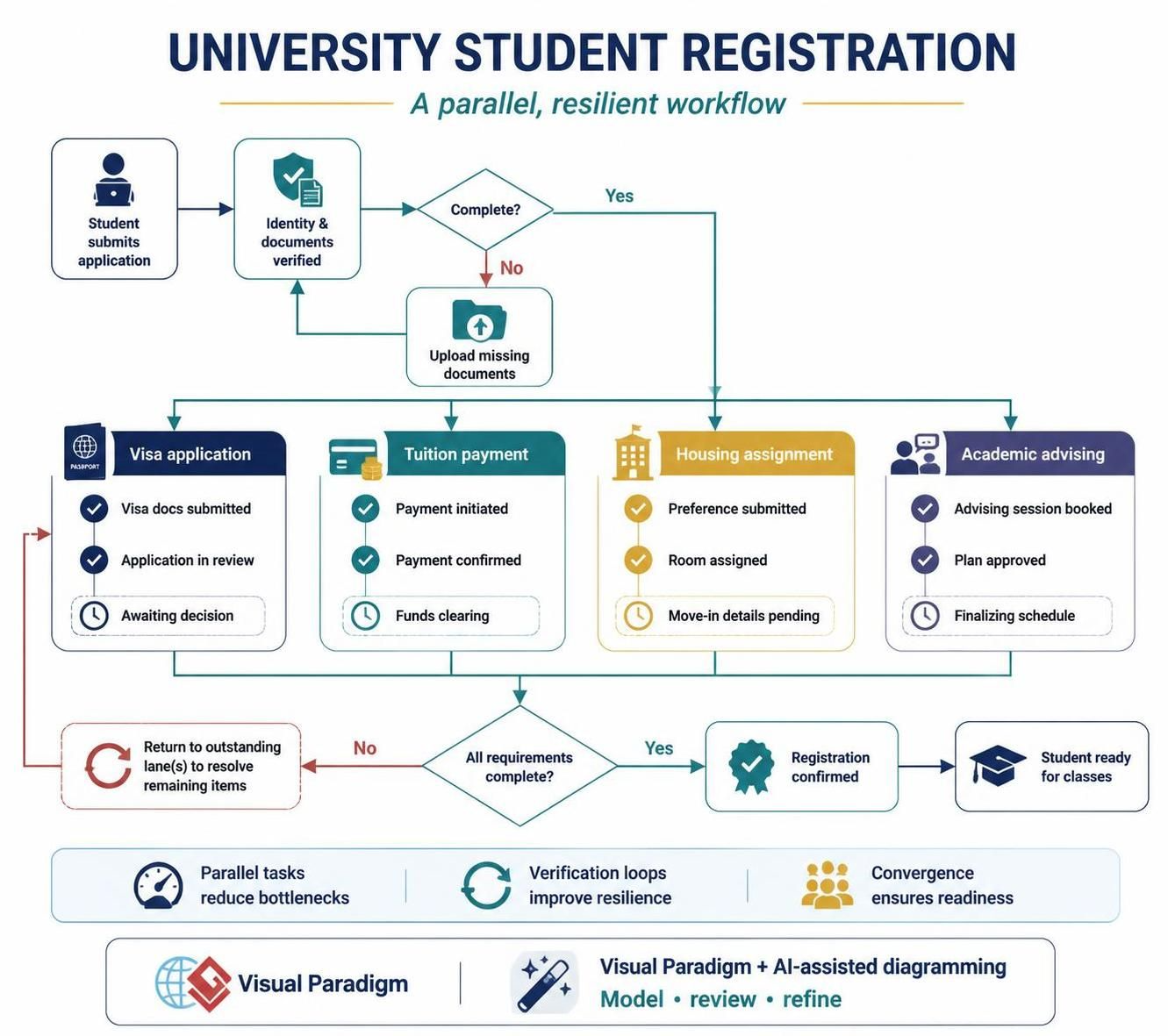
This guide explores the architecture of a robust registration system, highlighting how verification loops, parallel pathways, and convergence points create a resilient and scalable process. We will also examine how modern tooling, including Visual Paradigm and AI-assisted diagramming, can help product managers and systems analysts visualize and refine these workflows.
Key Concepts in Workflow Design
1. Verification Loops
Before any parallel processing begins, data integrity must be ensured. A verification loop ensures that incomplete or incorrect submissions are returned to the source (the student) for correction before entering the main workflow. This prevents “garbage in, garbage out” scenarios in downstream departments.
2. Parallel Pathways
Once verified, the workflow splits into independent tracks. In the registration context:
-
Visa Track: Conditional logic based on international status.
-
Financial Track: Mandatory payment confirmation.
-
Housing Track: Conditional assignment based on accommodation requests.
-
Academic Track: Tutor assignment and course selection.
These paths operate concurrently, meaning delays in one area (e.g., visa processing) do not necessarily halt progress in others (e.g., tutor assignment), provided the system allows for asynchronous updates.
3. Convergence and Completion
The process only concludes when all parallel paths reach their terminal states. This “join” point ensures that no student is marked as “fully registered” until every requirement—financial, legal, residential, and academic—is satisfied.
Diagram Example: PlantUML Code
Below is a PlantUML representation of the University Student Registration Process. This code can be rendered in tools like Visual Paradigm, PlantUML Live, or integrated into documentation platforms.
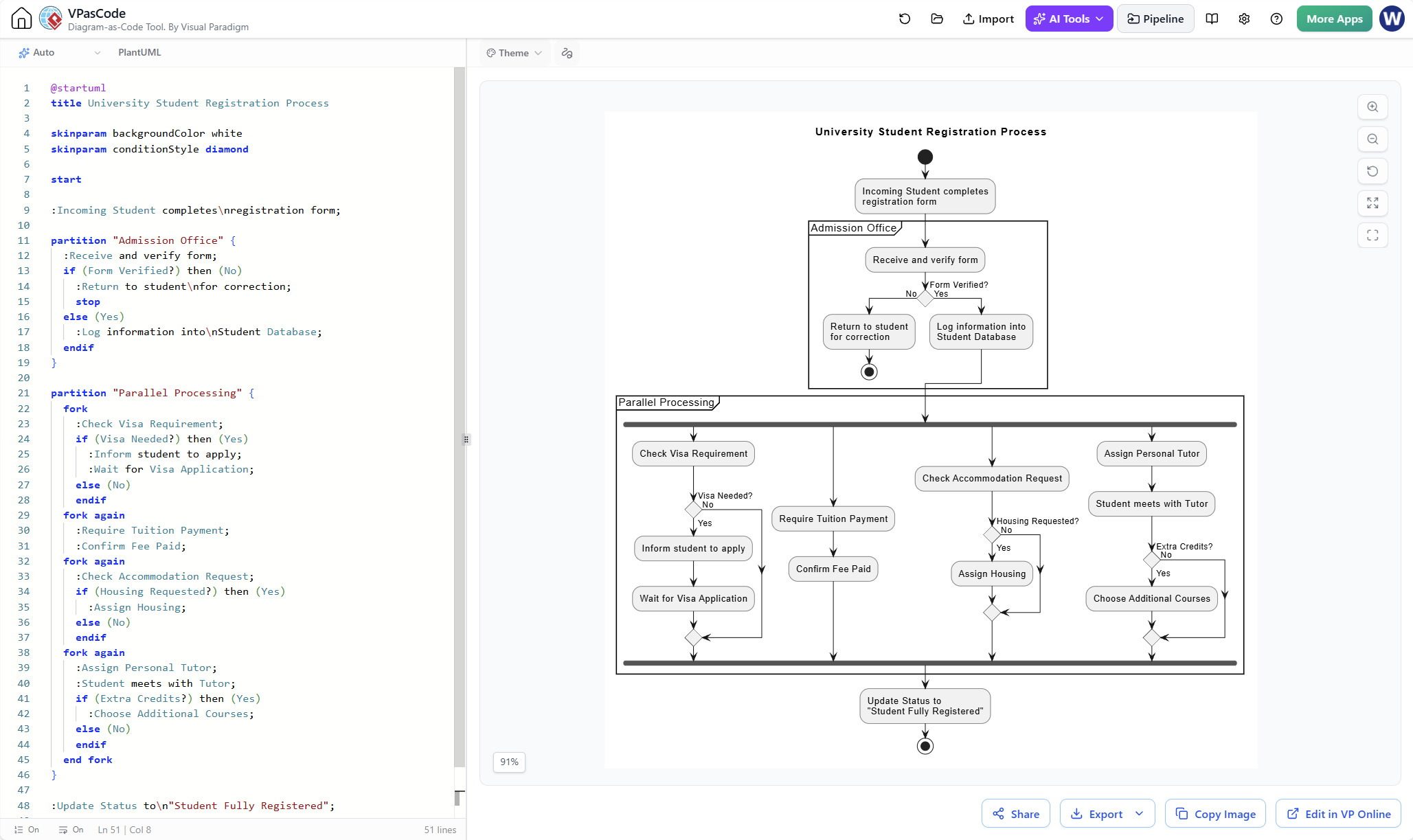
@startuml
title University Student Registration Process

skinparam backgroundColor white
skinparam sequenceLifeLineBackgroundColor #FFE0E0

start

:Incoming Student completes\nregistration form;

partition "Admission Office" {
  :Receive and verify form;
  if (Form Verified?) then (No)
    :Return to student\nfor correction;
    detach
  else (Yes)
    :Log information into\nStudent Database;
  endif
}

partition "Parallel Processing" {
  fork
    :Check Visa Requirement;
    if (Visa Needed?) then (Yes)
      :Inform student to apply;
      :Wait for Visa Application;
    else (No)
      detach
    endif
  fork again
    :Require Tuition Payment;
    :Confirm Fee Paid;
  fork again
    :Check Accommodation Request;
    if (Housing Requested?) then (Yes)
      :Assign Housing;
    else (No)
      detach
    endif
  fork again
    :Assign Personal Tutor;
    :Student meets with Tutor;
    if (Extra Credits?) then (Yes)
      :Choose Additional Courses;
    else (No)
      detach
    endif
  end fork
}

:Update Status to\n"Student Fully Registered";

stop
@enduml
Tooling: Visual Paradigm Flowchart + VPasCode + AI
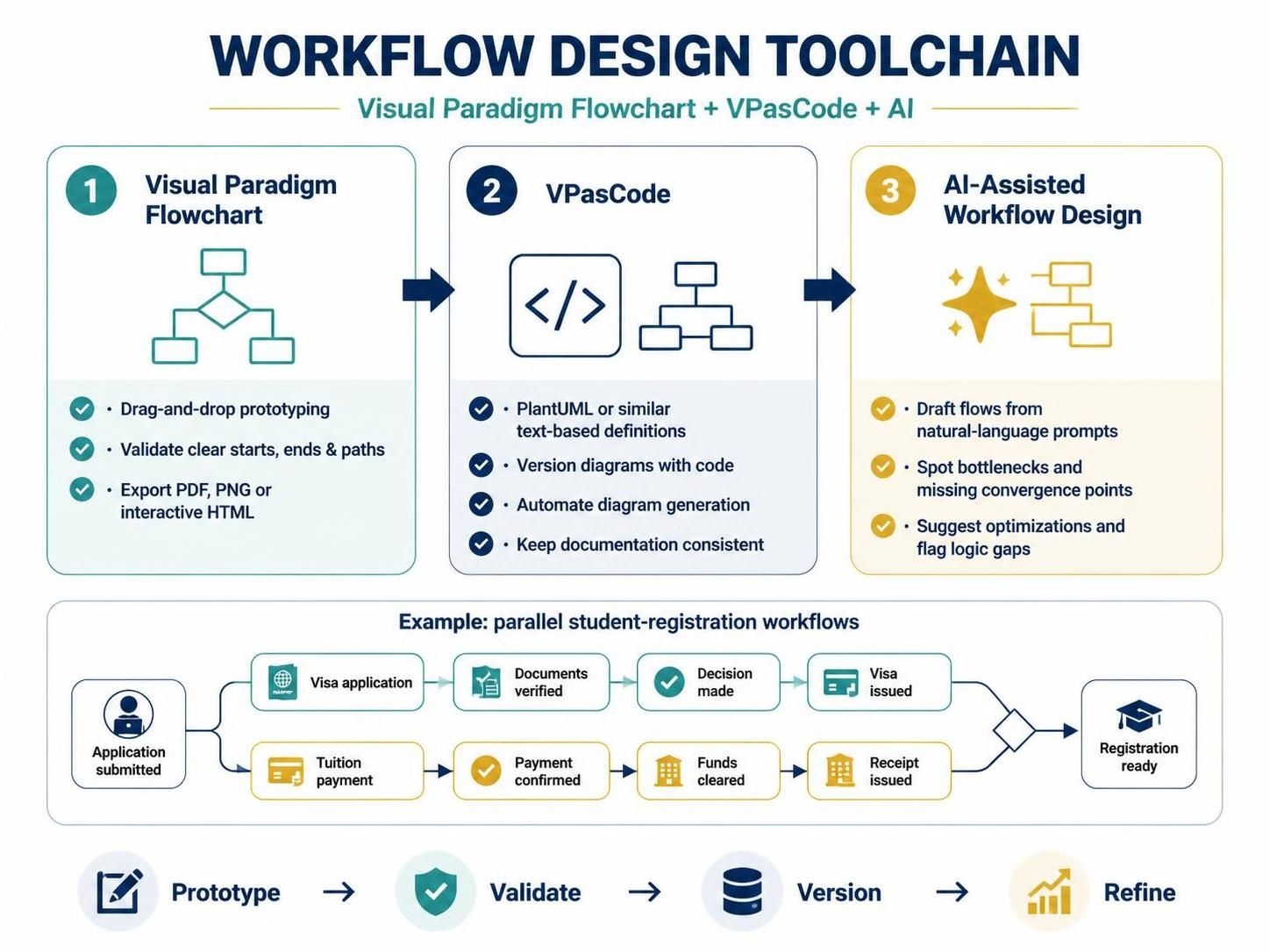
To effectively design and maintain such workflows, leveraging the right toolchain is essential:
Visual Paradigm Flowchart
Visual Paradigm offers robust support for BPMN (Business Process Model and Notation) and standard flowcharts. It allows for:
-
Drag-and-drop interface for quick prototyping.
-
Validation checks to ensure all paths have clear start and end points.
-
Export options for sharing with stakeholders in PDF, PNG, or interactive HTML formats.
VPasCode Tool
VPasCode bridges the gap between visual modeling and code-based definitions. By using PlantUML or similar scripting languages, teams can:
-
Version control their diagrams alongside code repositories.
-
Automate diagram generation from textual descriptions.
-
Ensure consistency across large documentation sets.
AI-Assisted Workflow Design
AI tools can enhance this process by:
-
Generating initial drafts of flowcharts from natural language descriptions (e.g., “Create a registration flow with parallel visa and tuition tracks”).
-
Identifying bottlenecks or missing convergence points in existing diagrams.
-
Suggesting optimizations, such as combining redundant steps or highlighting conditional logic gaps.
Conclusion
The University Student Registration Process illustrates the power of parallel workflow design. By decoupling independent tasks and managing them concurrently, institutions can reduce processing time and improve resource allocation. However, this complexity requires careful management of verification loops and convergence points to ensure no requirements are overlooked.
Using tools like Visual Paradigm, VPasCode, and AI-assisted design, product managers and systems analysts can create clear, maintainable, and efficient workflow diagrams. These visual artifacts not only serve as technical documentation but also as communication tools for aligning stakeholders across admissions, finance, housing, and academic departments.
As organizations continue to digitize their operations, mastering these workflow patterns will be critical for delivering seamless user experiences in education, healthcare, and beyond.