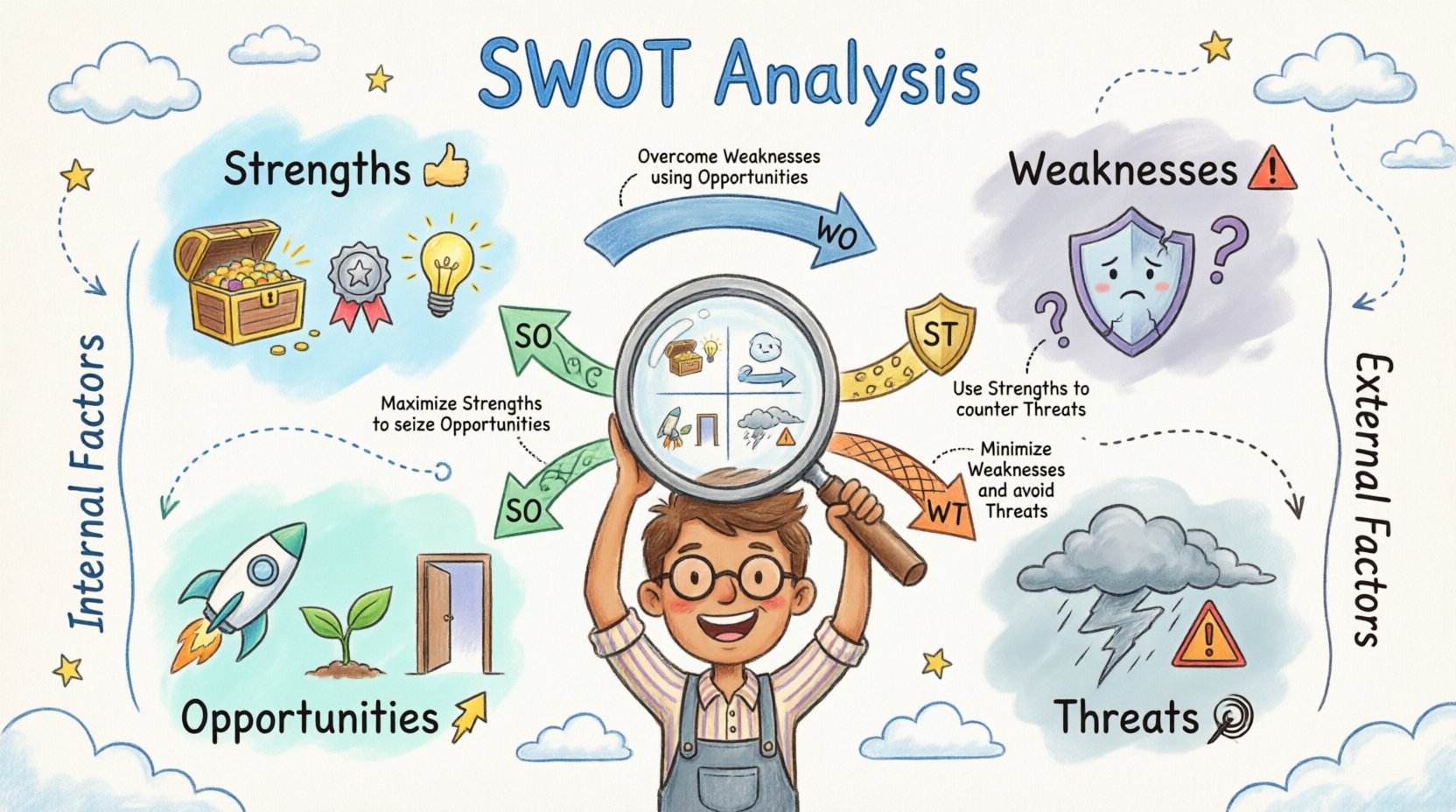
Strategic planning forms the backbone of any sustainable organization. Among the various frameworks available, the SWOT analysis remains a foundational tool used across industries to assess the current standing of a business or project. This framework categorizes critical factors into four distinct quadrants: Strengths, Weaknesses, Opportunities, and Threats. Understanding these elements allows leaders to make informed decisions based on internal capabilities and external market conditions.
This guide provides a detailed examination of each component, offering a structured approach to applying this methodology without relying on specific software or tools. The goal is to foster clarity, strategic foresight, and actionable planning.
🔍 The Four Core Components
To utilize this framework effectively, one must distinguish between internal factors and external factors. Internal factors are elements within the control of the organization, while external factors exist in the broader environment.
1. Strengths (Internal & Positive) 💪
Strengths represent the advantages an organization possesses over competitors. These are attributes that are internal and under your direct control. Identifying these helps in leveraging them to maximize potential.
- Resources: Financial capital, proprietary technology, or physical assets.
- Capabilities: Skilled workforce, efficient processes, or strong brand reputation.
- Intellectual Property: Patents, trademarks, or exclusive licenses.
- Market Position: High market share or loyal customer base.
When analyzing strengths, ask: What do we do better than anyone else? What unique resources do we have access to?
2. Weaknesses (Internal & Negative) ⚠️
Weaknesses are internal attributes that place the organization at a disadvantage relative to others. Acknowledging these is crucial for improvement and risk mitigation. Ignoring weaknesses often leads to strategic failure.
- Gaps in Expertise: Lack of specific skills or knowledge within the team.
- Operational Inefficiencies: Outdated systems or poor workflow management.
- Resource Constraints: Limited budget, smaller team size, or lack of inventory.
- Reputation: Negative customer feedback or poor public perception.
When analyzing weaknesses, ask: What do we need to improve? What do competitors do better than us?
3. Opportunities (External & Positive) 🚀
Opportunities are external chances to improve performance or expand. These factors are not within direct control, but they can be capitalized on if the organization is prepared.
- Market Trends: Shifts in consumer behavior or emerging technologies.
- Regulatory Changes: New laws that open up new markets or reduce barriers.
- Competitor Moves: A rival exiting the market or failing to meet demand.
- Economic Growth: Rising disposable income in target demographics.
When analyzing opportunities, ask: What positive trends could we exploit? What changes in our environment could help us grow?
4. Threats (External & Negative) 🌪️
Threats are external elements that could cause trouble for the business. These are risks that must be monitored and managed to prevent damage.
- Competition: New entrants or aggressive pricing strategies from rivals.
- Economic Downturns: Recession or inflation affecting purchasing power.
- Technological Obsolescence: New technologies making current products irrelevant.
- Supply Chain Disruptions: Global events affecting material availability.
When analyzing threats, ask: What obstacles do we face? What do our competitors or suppliers do that could hurt us?
📊 Internal vs. External Factors
Distinguishing between what you control and what you cannot control is vital for accurate analysis. The following table summarizes the classification of each quadrant.
| Factor | Control Level | Focus | Example |
|---|---|---|---|
| Strengths | Internal (Controllable) | Advantages | Proprietary patent |
| Weaknesses | Internal (Controllable) | Disadvantages | High employee turnover |
| Opportunities | External (Uncontrollable) | Potential Growth | New market regulation |
| Threats | External (Uncontrollable) | Risks | Economic recession |
📝 Conducting a Comprehensive Analysis
Executing a SWOT analysis requires a structured process to ensure data integrity and actionable outcomes. It is not merely a brainstorming session but a rigorous evaluation.
Step 1: Define the Objective
Before gathering data, establish the specific goal of the analysis. Are you evaluating a new product launch, assessing overall company health, or planning a market entry? A clear objective narrows the focus.
Step 2: Gather Data
Collect information from multiple sources. This includes internal reports, financial statements, customer feedback, and market research. Rely on facts rather than assumptions.
Step 3: Brainstorm and Categorize
Engage stakeholders from different departments. Assign each point to one of the four quadrants. Avoid overlap. If a point fits multiple categories, choose the most relevant one based on the primary impact.
Step 4: Prioritize Findings
Not all points are equal. Rank the strengths, weaknesses, opportunities, and threats based on their impact and urgency. This helps in resource allocation.
Step 5: Develop Strategies
Once the data is categorized, move to the next phase of strategic planning. This involves matching internal capabilities with external possibilities.
🚀 Turning Analysis into Actionable Strategy
Identifying the four elements is only the first step. The true value lies in connecting them to form strategies. This is often referred to as TOWS analysis, which focuses on the interactions between the quadrants.
- SO Strategies (Maxi-Maxi): Use Strengths to maximize Opportunities.
- Action: Leverage a strong brand (Strength) to enter a new market (Opportunity).
- WO Strategies (Mini-Maxi): Overcome Weaknesses by taking advantage of Opportunities.
- Action: Invest in training (fixing Weakness) to adopt a new technology trend (Opportunity).
- ST Strategies (Maxi-Mini): Use Strengths to minimize Threats.
- Action: Use strong cash reserves (Strength) to withstand economic downturns (Threat).
- WT Strategies (Mini-Mini): Minimize Weaknesses and avoid Threats.
- Action: Automate manual processes (fixing Weakness) to reduce dependency on volatile suppliers (Threat).
⚠️ Common Pitfalls in Strategic Planning
Even with a solid framework, errors can occur during the process. Awareness of these common mistakes helps maintain the integrity of the analysis.
- Being Too Vague: “Good customer service” is a strength, but “24/7 support with a 1-hour response time” is measurable.
- Confusing Internal and External: A competitor’s failure is an opportunity, not a strength. Strengths must be internal.
- Ignoring Negative Data: Teams often focus on positives and gloss over weaknesses. This leads to blind spots.
- Lack of Stakeholder Buy-in: If the team does not agree on the findings, the resulting strategy will lack support.
- Static Analysis: Treating the analysis as a one-time event rather than a living document that requires updates.
💼 Real-World Application Examples
Understanding the theory is helpful, but seeing it in context clarifies its utility. Below are generic scenarios illustrating how these factors interact.
Example 1: Retail Business Expansion
- Strength: Established local supply chain relationships.
- Weakness: Limited online presence compared to national chains.
- Opportunity: Rising demand for e-commerce in the region.
- Threat: New regulations on shipping costs.
Strategy: Utilize the supply chain strength to offer faster local delivery (SO), while investing in a website to capture the e-commerce trend (WO).
Example 2: Technology Startup
- Strength: Innovative proprietary algorithm.
- Weakness: Small marketing budget.
- Opportunity: Competitor facing a data breach crisis.
- Threat: Rapid changes in data privacy laws.
Strategy: Highlight the algorithm’s security features to attract users leaving the competitor (ST), and ensure compliance to avoid legal penalties (WT).
❓ Frequently Asked Questions
Addressing common queries helps clarify the scope and limitations of this framework.
- How often should a SWOT analysis be performed? It depends on the industry pace. For stable sectors, annually may suffice. For dynamic markets, quarterly reviews are recommended.
- Can individuals use this framework? Yes. It applies to personal career planning, project management, and academic research.
- Is this only for businesses? No. Non-profits, government agencies, and educational institutions use it for strategic planning.
- What if there are no weaknesses? This is rare. If you cannot identify any, your analysis may be too superficial. Re-evaluate your processes and resources.
- Does this guarantee success? No tool guarantees success. It provides a structured way to assess risk and potential, improving the probability of a positive outcome.
🏁 Final Thoughts
The SWOT analysis is more than a checklist; it is a mindset for evaluating the current state before planning the future. By clearly separating internal capabilities from external realities, leaders can navigate complexity with precision. The value lies not in the list itself, but in the strategic connections drawn between the quadrants.
Consistent review and honest assessment are key to maintaining a competitive edge. When used correctly, this framework transforms uncertainty into a roadmap for deliberate action.