
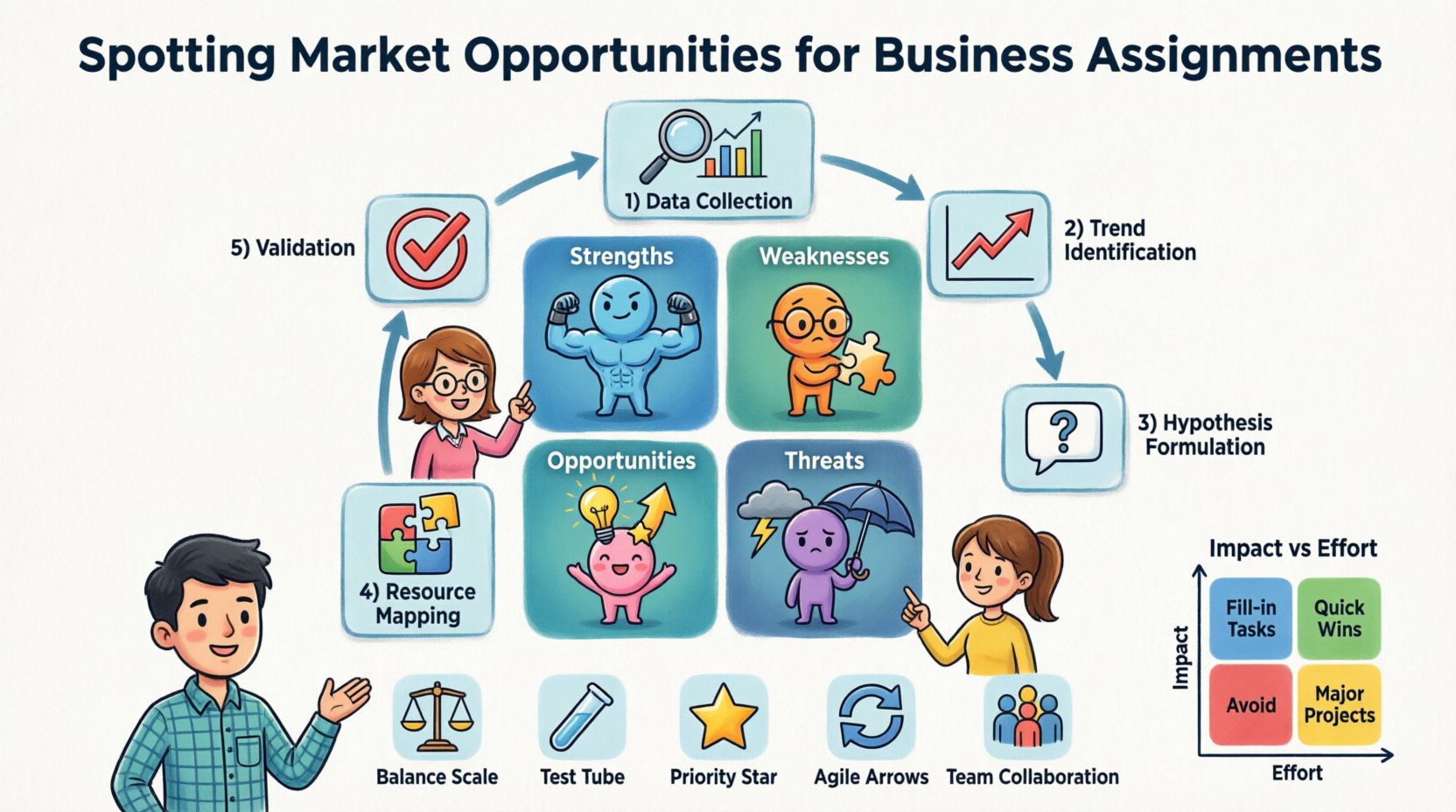
In the complex landscape of modern commerce, success often hinges on the ability to identify and capitalize on specific market gaps. For teams tasked with business assignments, the difference between a successful project and a failed initiative frequently lies in the depth of market analysis conducted during the planning phase. One of the most robust frameworks for this task is the SWOT analysis. While often viewed as a static checklist, when applied dynamically, it becomes a powerful mechanism for spotting market opportunities that drive growth and sustainability.
This guide explores how to leverage this strategic tool to uncover viable opportunities within your business assignments. We will move beyond basic definitions to discuss practical methodologies for data gathering, analysis, and strategic integration. By understanding the internal and external forces at play, organizations can make informed decisions that align resources with high-potential market segments.
📊 Understanding the SWOT Framework
The SWOT acronym stands for Strengths, Weaknesses, Opportunities, and Threats. It is a structured planning method used to evaluate these four elements of a project or business venture. In the context of spotting market opportunities, the focus often shifts heavily toward the ‘O’ quadrant, but this is impossible to do in isolation.
- Strengths: Internal attributes and resources that support a successful outcome.
- Weaknesses: Internal attributes that place the business at a disadvantage relative to others.
- Opportunities: External chances to make greater profits in a business environment.
- Threats: External elements in the environment that could cause trouble for the business.
When analyzing market opportunities, it is crucial to recognize that strengths and weaknesses are internal control factors. Opportunities and threats are external uncontrollable factors. A thorough analysis requires separating these distinct categories to avoid conflating internal capabilities with external market conditions.
🔍 Analyzing Internal Factors: Strengths and Weaknesses
Before looking outward, you must understand what you bring to the table. This internal audit forms the foundation for assessing whether an identified market opportunity is actually viable for your specific team.
Identifying Core Strengths
Strengths are the competitive advantages your organization possesses. These can be tangible or intangible. In the context of business assignments, consider the following:
- Human Capital: Do you have specialized skills or experienced personnel that competitors lack?
- Proprietary Technology: Are there unique processes or tools that improve efficiency?
- Brand Reputation: Is there established trust with your customer base?
- Financial Resources: Does your cash flow allow for aggressive expansion or investment?
Recognizing Internal Weaknesses
Weaknesses are areas where you are at a disadvantage. Honest assessment here prevents the pursuit of opportunities that overextend your resources.
- Limited Budget: Are there constraints on capital expenditure?
- Skill Gaps: Is there a lack of expertise in a specific technology or market sector?
- Operational Inefficiencies: Are there bottlenecks in current workflows?
- Market Penetration: Do you have a weak presence in key geographic regions?
By mapping these internal factors, you create a boundary for your opportunities. A market opportunity is only relevant if your strengths can support it and your weaknesses do not hinder execution.
🌍 Analyzing External Factors: Opportunities and Threats
This is where the search for market opportunities truly begins. External factors are outside your direct control, but they present the possibilities for expansion. This section focuses heavily on identifying and validating these opportunities.
Sources of Market Opportunities
Opportunities arise from changes in the macroeconomic environment, industry trends, and competitor movements. Common sources include:
- Technological Advancements: New tools that reduce costs or improve user experience.
- Regulatory Changes: New laws that open up previously restricted markets.
- Demographic Shifts: Aging populations or migration patterns changing demand.
- Competitor Failure: When a rival exits a market or loses quality focus, gaps appear.
- Consumer Behavior: Shifts in lifestyle or preference that create new needs.
Distinguishing Opportunity from Noise
Not every external change is an opportunity. Some are distractions. To filter noise, apply a validation filter:
- Relevance: Does this align with our core mission?
- Feasibility: Can we execute this with current or accessible resources?
- Profitability: Is there a clear path to revenue generation?
- Timing: Is the market ready now, or is it too early?
📋 Comparative Analysis: Internal vs. External
To visualize the relationship between your internal state and the external environment, use a structured comparison table. This aids in clarity during team discussions.
| Category | Focus Area | Key Question | Impact on Assignment |
|---|---|---|---|
| Strengths | Internal | What do we do better than anyone else? | Enables rapid execution |
| Weaknesses | Internal | Where do we need improvement? | Requires mitigation or avoidance |
| Opportunities | External | What trends can we exploit? | Drives growth and innovation |
| Threats | External | What obstacles stand in our way? | Requires risk management |
🛠️ Methodology for Identifying Market Opportunities
Spotting opportunities is not a passive activity. It requires a deliberate process. Below is a step-by-step approach to conducting this analysis without relying on proprietary software solutions.
Step 1: Data Collection
Gather qualitative and quantitative data. This involves:
- Customer Feedback: Review support tickets, surveys, and interviews to find unmet needs.
- Market Research: Read industry reports, government statistics, and competitor press releases.
- Internal Data: Analyze sales records, conversion rates, and operational logs.
- Competitor Analysis: Monitor competitor pricing, product launches, and marketing campaigns.
Step 2: Trend Identification
Look for patterns in the collected data. Are certain products selling faster? Is there a recurring complaint that no one is solving? Is a specific demographic growing rapidly? Trends are the signals that point toward opportunities.
Step 3: Hypothesis Formulation
Based on the trends, formulate hypotheses. For example: “There is a demand for eco-friendly packaging among our target demographic.” This turns a vague observation into a testable business assignment goal.
Step 4: Resource Mapping
Match the hypothesis against your strengths. If you hypothesize a need for rapid deployment, do you have the staff to support it? If not, is that a weakness to address or an opportunity to partner?
Step 5: Validation
Before full commitment, validate the opportunity. This can be done through small-scale pilots, focus groups, or pre-orders. Validation reduces the risk of investing in a false opportunity.
🎲 Prioritizing Opportunities
Once you have a list of potential opportunities, you cannot pursue all of them simultaneously. Resources are finite. You need a prioritization framework to decide which business assignments to undertake first.
The Impact vs. Effort Matrix
Plot your opportunities on a 2×2 matrix based on potential impact and required effort.
- High Impact, Low Effort: These are quick wins. Prioritize these immediately.
- High Impact, High Effort: These are major projects. Plan these carefully and allocate significant resources.
- Low Impact, Low Effort: Fill-in tasks. Do them when capacity allows.
- Low Impact, High Effort: Avoid these. They drain resources without returning value.
Strategic Alignment
Another critical filter is alignment with long-term goals. An opportunity might be profitable in the short term but distract from the core mission. Ensure every selected assignment contributes to the broader organizational strategy.
🚧 Common Pitfalls in Opportunity Analysis
Even with a solid framework, teams often stumble. Awareness of common mistakes helps avoid them.
Confirmation Bias
This occurs when you seek information that confirms what you already believe and ignore evidence to the contrary. To avoid this, assign a team member the role of “devil’s advocate” specifically to challenge the identified opportunities.
Internal Focus Overload
Organizations sometimes spend too much time discussing their own strengths and forget to look at the market. Ensure the ratio of external analysis is significant. The market does not care about your internal history.
Ignoring Threats
Focusing solely on opportunities blinds you to threats. A new opportunity might come with a significant regulatory risk. Always weigh the opportunity against the associated threat.
Analysis Paralysis
Collecting endless data without making decisions stalls progress. Set a time limit for the analysis phase. Once the data is sufficient, move to the execution phase. Perfect information is rarely available.
🔄 Integrating Findings into Strategy
The analysis is useless if it stays on paper. The findings must be translated into actionable business assignments.
- Define Objectives: Convert opportunities into specific, measurable goals.
- Assign Ownership: Ensure a specific individual is responsible for each opportunity.
- Set Timelines: Establish clear deadlines for milestones.
- Monitor Progress: Regularly review the performance of the assignment against the original SWOT findings.
When integrating findings, communicate the rationale clearly to the entire team. When everyone understands why a specific opportunity was chosen, alignment increases, and execution improves.
🌱 Long-Term Value of Rigorous Analysis
Building a habit of thorough market analysis creates a culture of strategic thinking. Over time, the organization becomes more agile. Teams learn to spot patterns faster. Decisions become less reactive and more proactive.
This disciplined approach to spotting market opportunities ensures that business assignments are not just tasks to be completed, but strategic moves to be won. By balancing internal capabilities with external possibilities, you create a roadmap that leads to sustainable growth.
📝 Summary of Key Takeaways
To recap the essential points for spotting market opportunities effectively:
- Balance Internal and External: Do not ignore weaknesses while chasing opportunities.
- Validate Before Investing: Use small tests to confirm market demand.
- Prioritize Ruthlessly: Use matrices to select the highest value assignments.
- Stay Agile: Be willing to pivot if the data changes.
- Collaborate: Involve diverse perspectives to reduce bias.
By applying these principles, you equip your organization with the insight needed to navigate complex markets. The goal is not just to find opportunities, but to find the right opportunities that fit your unique position in the marketplace.
🔗 Next Steps for Implementation
Begin by scheduling a dedicated workshop. Gather key stakeholders. Prepare the necessary data. Walk through the SWOT framework together. Document the findings. Select the top three opportunities. Assign owners. Begin execution. This simple workflow transforms abstract analysis into concrete business outcomes.