Understanding the language of strategy is a fundamental skill for academic success and future professional growth. Whether you are working on a capstone project, a business case study, or preparing for a strategic management exam, clarity in terminology ensures precision. This guide provides a comprehensive breakdown of the essential terms associated with SWOT analysis, designed to help students navigate complex assessments with confidence.
Strategic planning frameworks rely on specific vocabulary to differentiate between internal capabilities and external conditions. Using these terms correctly demonstrates a deep understanding of the subject matter. Below, we explore the core components, related concepts, and the distinctions that matter in an academic context.
🔍 The Core Four Components
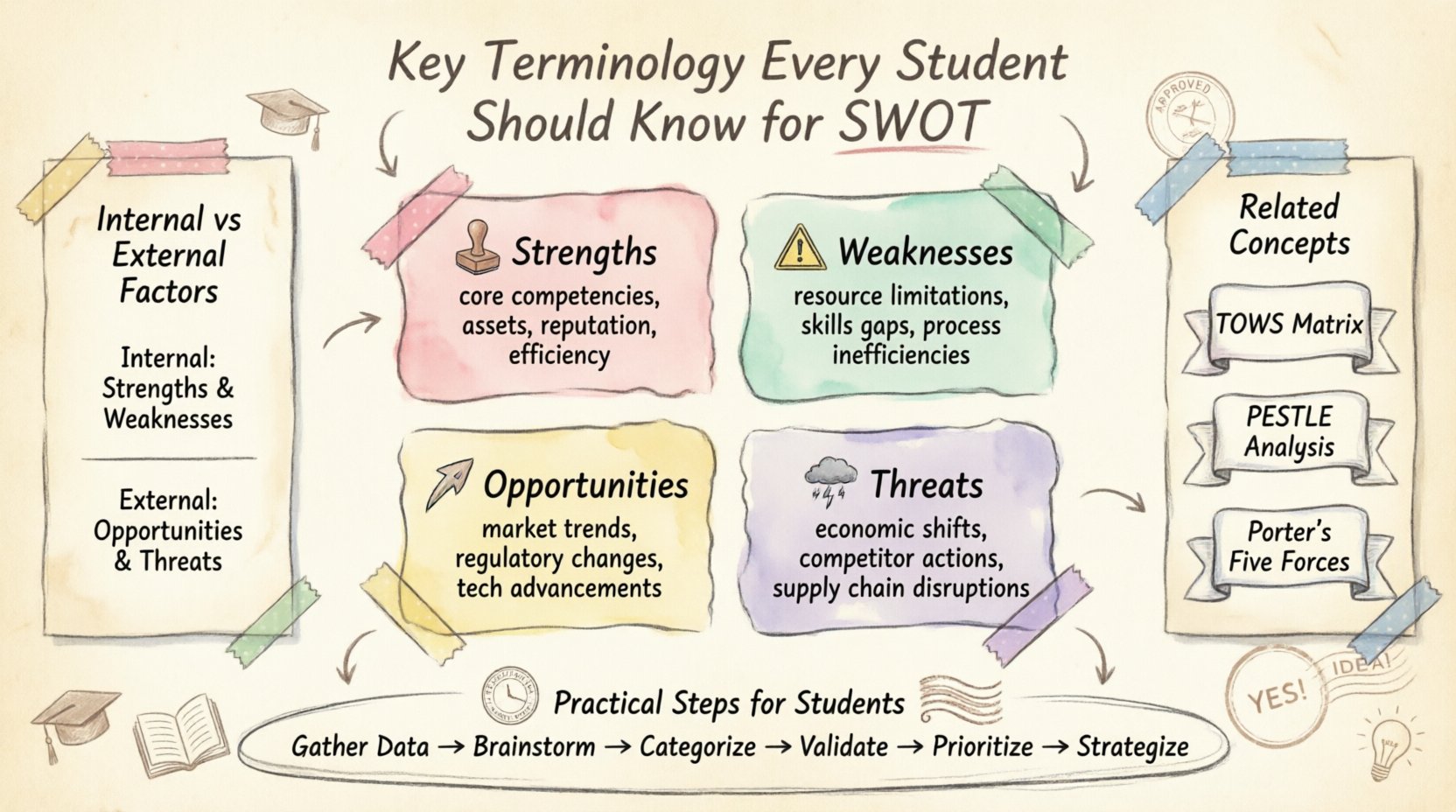
The foundation of this framework consists of four distinct quadrants. Each represents a specific category of information that must be gathered and analyzed. Accuracy in defining these areas prevents confusion during the evaluation process.
1. Strengths 💪
Strengths represent the internal attributes and resources that support a successful outcome. These are factors over which the organization or individual has control. When analyzing strengths, focus on what is done well compared to peers or competitors.
- Core Competencies: Unique skills or technologies that provide an advantage.
- Assets: Physical, financial, or human resources available.
- Reputation: Brand recognition or trust established over time.
- Efficiency: The ability to produce output with minimal waste.
For students, a strength might be a strong network of contacts, proficiency in specific software, or a proven track record in group collaboration. Identifying these correctly sets the stage for leveraging advantages.
2. Weaknesses ⚠️
Weaknesses are internal factors that hinder performance or prevent the achievement of objectives. Unlike threats, these are within the scope of influence and can be improved. Honest assessment is crucial here to avoid overlooking critical gaps.
- Resource Limitations: Lack of funding, time, or personnel.
- Skills Gaps: Areas where training or experience is insufficient.
- Process Inefficiencies: Flaws in workflow or communication.
- Market Position: Low brand awareness or poor location.
In an academic setting, a weakness could be a lack of access to primary data, limited experience with a specific methodology, or tight deadlines. Recognizing these allows for proactive mitigation strategies.
3. Opportunities 🚀
Opportunities are external conditions that could be exploited for advantage. They represent trends or changes in the environment that align with internal strengths. These are not guaranteed results but potential pathways.
- Market Trends: Shifts in consumer behavior or industry demand.
- Regulatory Changes: New laws that create demand for specific services.
- Technological Advancements: Emerging tools that improve productivity.
- Competitor Weaknesses: Gaps left by others in the market.
Students often look for opportunities in project scope, such as applying a new theory to a classic problem or targeting a specific demographic for a case study. These external factors require monitoring.
4. Threats ⛈️
Threats are external factors that could cause trouble for the business or project. These are outside the control of the subject and require defensive planning. Ignoring threats can lead to unexpected failures.
- Economic Shifts: Recession or inflation impacting resources.
- Competitor Actions: New entrants or price wars.
- Supply Chain Disruptions: Delays in obtaining necessary materials.
- Political Instability: Changes in government policy or trade agreements.
For a student project, a threat might be a change in assignment criteria, data unavailability, or a shift in the course focus. Identifying these early allows for contingency planning.
🌐 Internal vs. External Factors
Distinguishing between what is internal and what is external is a critical step in the analysis process. Misclassification can lead to flawed strategies. The table below clarifies the scope of each category.
| Category | Control Level | Examples |
|---|---|---|
| Internal | High | Staff skills, budget allocation, company culture |
| External | Low | Competitor pricing, tax laws, economic growth |
| Internal | High | Product quality, marketing strategy |
| External | Low | Consumer tastes, technological innovation |
When conducting research, ensure data sources reflect this distinction. Internal data often comes from audits or internal reports. External data typically comes from industry reports, news, or government statistics.
🧠 Related Strategic Concepts
SWOT analysis does not exist in isolation. It is often paired with other frameworks to provide a fuller picture. Understanding these related terms adds depth to your analysis.
TOWS Matrix 🔗
The TOWS matrix is an extension of SWOT that focuses on action. While SWOT lists factors, TOWS creates strategies by crossing them.
- SO Strategies: Use strengths to maximize opportunities.
- WO Strategies: Use opportunities to overcome weaknesses.
- ST Strategies: Use strengths to avoid threats.
- WT Strategies: Minimize weaknesses to avoid threats.
This step transforms a static list into a dynamic plan. It forces the student to think about how the factors interact rather than treating them as separate items.
PESTLE Analysis 🌍
PESTLE is often used to populate the Opportunities and Threats sections. It stands for Political, Economic, Social, Technological, Legal, and Environmental factors.
- Political: Government stability and tax policy.
- Economic: Interest rates and exchange rates.
- Social: Cultural trends and demographics.
- Technological: R&D activity and automation.
- Legal: Employment laws and consumer protection.
- Environmental: Climate change and sustainability.
Using PESTLE ensures that the external analysis is comprehensive and does not miss broader macroeconomic forces.
Porter’s Five Forces 🏭
This framework analyzes the competitive intensity of an industry. It helps refine the Threats and Opportunities sections.
- Threat of New Entrants: How easy is it for others to enter?
- Bargaining Power of Suppliers: Can suppliers raise prices?
- Bargaining Power of Buyers: Can customers demand lower prices?
- Threat of Substitutes: Are there alternative solutions?
- Rivalry Among Existing Competitors: How aggressive is the competition?
📝 Common Misconceptions
Students often make specific errors when defining terms. Being aware of these pitfalls improves the quality of the work.
| Misconception | Correction |
|---|---|
| Confusing Weaknesses with Threats | Weaknesses are internal; Threats are external. |
| Listing Problems instead of Weaknesses | Weaknesses are capabilities, not just current issues. |
| Listing Goals as Opportunities | Opportunities are external conditions, not internal goals. |
| Ignoring the Timeframe | Factors change; define the relevant period for the analysis. |
🎓 Application in Academia
In a university setting, these terms appear in various disciplines, from business administration to public policy. Proper application demonstrates critical thinking.
- Case Studies: Analyze a real company using the framework.
- Group Projects: Assign team members to specific quadrants to ensure coverage.
- Thesis Work: Use the terminology to define the scope of research.
- Exams: Use precise definitions to secure marks for terminology.
When writing reports, avoid vague language. Instead of saying “we are good at this,” use “core competency in data analysis.” Precision in terminology signals professionalism.
📊 Validation and Prioritization
Once the terms are identified, they must be validated. Not every factor is equally important. Prioritization ensures focus on what drives the outcome.
- Evidence-Based: Support claims with data or citations.
- Relevance: Does this factor directly impact the objective?
- Urgency: Does this need immediate attention?
- Impact: How significant is the effect on the result?
Validation prevents the analysis from becoming a list of opinions. It grounds the work in reality and factual evidence. This step is often overlooked by students who prefer to brainstorm freely without verification.
🔄 Continuous Improvement
Strategic analysis is not a one-time event. Environments shift, and factors change. Maintaining the terminology helps in updating the analysis over time.
- Review Cycles: Schedule regular updates to the analysis.
- Feedback Loops: Incorporate results from implementation.
- Adaptation: Adjust strategies based on new information.
- Documentation: Keep records of why terms were chosen.
By treating the framework as a living document, students develop a habit of continuous learning and adaptation. This mindset is valuable in both academic and professional environments.
🔗 Connecting the Dots
The value of this terminology lies in the connections it creates. It forces the thinker to link internal capabilities with external realities. This synthesis is where strategy is born.
- Alignment: Ensuring strengths match opportunities.
- Gap Analysis: Identifying the difference between current and desired states.
- Resource Allocation: Directing effort where it matters most.
- Risk Management: Preparing for potential negative events.
Mastering these terms allows for clearer communication with stakeholders. Whether presenting to a professor or a board of directors, shared language facilitates understanding.
🛠️ Practical Steps for Students
To apply this knowledge effectively, follow a structured approach.
- Gather Data: Collect internal reports and external market research.
- Brainstorm: List factors for each quadrant without judgment.
- Categorize: Sort items into Internal/External and Positive/Negative.
- Validate: Check facts and remove irrelevant items.
- Prioritize: Rank the top three items in each category.
- Strategize: Use TOWS to create action items.
This sequence ensures a logical flow from information gathering to strategic output. It reduces the likelihood of bias or oversight.
🌟 Final Thoughts on Terminology
Language shapes thought. Using the correct terms for SWOT analysis structures the way students approach problems. It moves the discussion from general observations to specific, actionable insights. By internalizing this vocabulary, learners build a foundation for complex strategic thinking.
Remember that the goal is not just to fill out a chart. It is to understand the dynamics at play. The terms serve as tools to dissect reality. With practice, the distinction between strengths and weaknesses becomes intuitive. The relationship between opportunities and threats becomes clearer. This clarity leads to better decisions and stronger academic performance.
Keep the focus on accuracy and relevance. Avoid fluff and focus on the substance of the analysis. This approach will serve well beyond the classroom.