Strategic planning relies on a clear understanding of where an organization stands and where it is heading. The SWOT analysis remains one of the most enduring frameworks for this purpose. However, the effectiveness of this tool depends entirely on correctly categorizing the variables that influence business performance. Distinguishing between internal and external factors is the cornerstone of a valid SWOT assessment. Without this distinction, the resulting strategy lacks direction and actionable insight.
Many organizations struggle not because they lack data, but because they confuse what they can control with what they cannot. This guide breaks down the nuances of internal versus external elements, ensuring your strategic planning is grounded in reality rather than speculation.
🔍 Understanding the Core Distinction
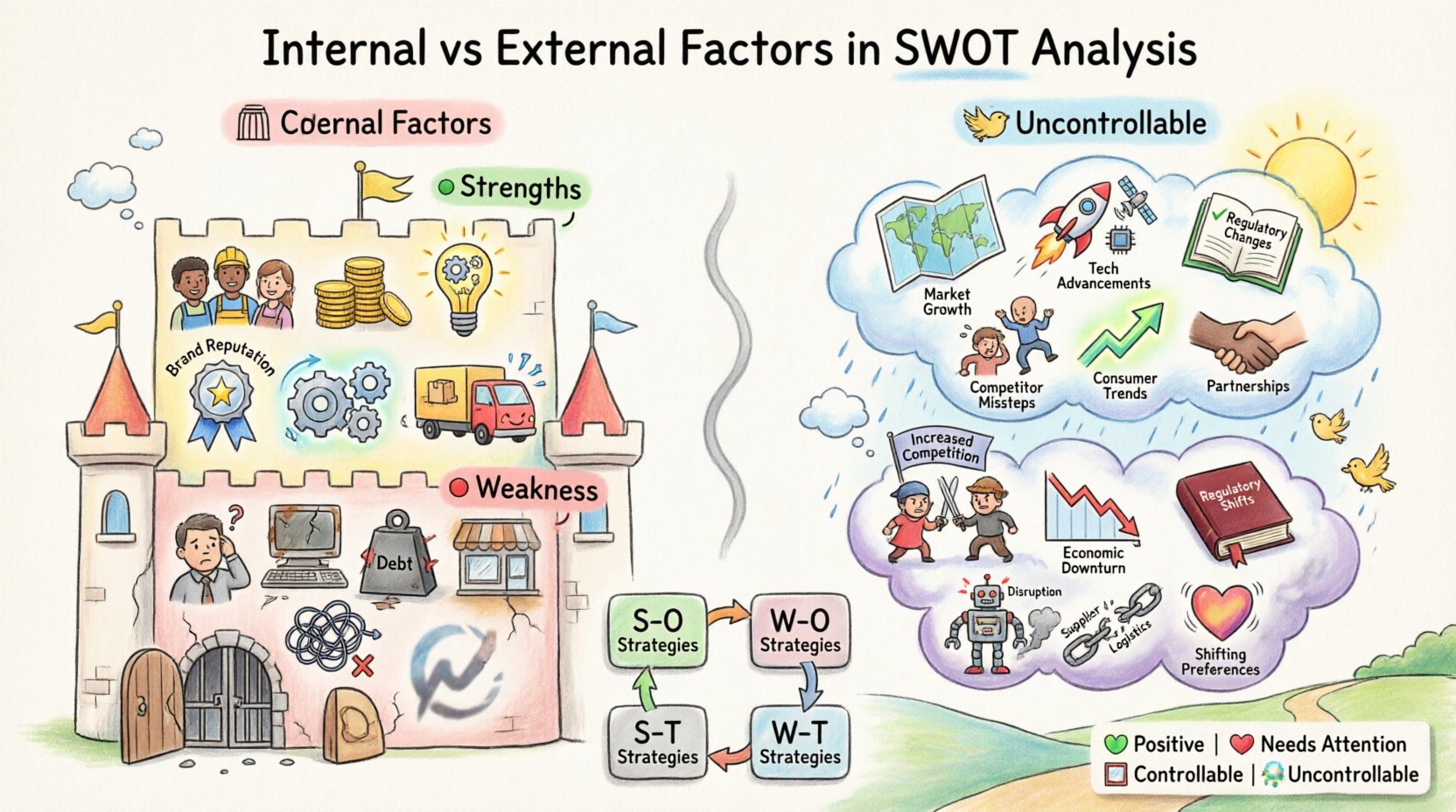
The fundamental difference lies in control. Internal factors are elements within the organization’s boundaries that it can directly influence. These are typically resources, capabilities, and processes. External factors exist outside the organization’s immediate control. These include market trends, regulatory changes, and competitor actions.
When conducting a SWOT analysis, confusion often arises here. A common mistake is listing a competitor’s price cut as a weakness. While it affects you, it is an external threat, not an internal weakness. Your response to that price cut might be a weakness if you lack the financial flexibility to compete, but the price cut itself is external.
- Internal: Originates within the company. Controllable. Relates to Strengths and Weaknesses.
- External: Originates in the market or environment. Uncontrollable. Relates to Opportunities and Threats.
🏭 Deep Dive: Internal Factors (Strengths & Weaknesses)
Internal factors are the assets and liabilities you manage daily. They define your operational capacity and organizational health. Analyzing these requires honesty and a willingness to look at the business objectively.
🟢 Strengths: What You Do Well
Strengths are positive attributes that give the organization a competitive advantage. They are the foundation upon which strategies are built. Identifying these correctly allows you to leverage them for growth.
- Human Resources: The skills, experience, and morale of your workforce. A highly trained team is a tangible asset.
- Financial Health: Cash flow, access to capital, and profitability margins. Strong liquidity provides stability during downturns.
- Intellectual Property: Patents, trademarks, proprietary technology, or unique trade secrets that competitors cannot easily replicate.
- Brand Reputation: Customer loyalty and recognition. A strong brand reduces customer acquisition costs.
- Operational Efficiency: Streamlined processes, low waste, and high productivity levels.
- Distribution Networks: Established relationships with suppliers and retailers that ensure product availability.
🔴 Weaknesses: Where You Need Improvement
Weaknesses are internal limitations that hinder performance. They are not failures, but areas requiring attention or investment. Ignoring weaknesses can turn them into critical failures when external pressure increases.
- Lack of Expertise: Gaps in knowledge or skills within the team that prevent taking on complex projects.
- Obsolete Technology: Legacy systems that slow down operations or increase maintenance costs.
- High Debt Levels: Excessive leverage that limits financial flexibility and increases risk.
- Poor Location: Physical or digital presence that limits access to target markets or customers.
- Inefficient Processes: Bottlenecks in production or service delivery that cause delays.
- Weak Brand Presence: Low market awareness or negative perception among consumers.
🌍 Deep Dive: External Factors (Opportunities & Threats)
External factors shape the landscape in which the business operates. You cannot change these factors, but you can adapt your strategy to navigate them. This requires constant monitoring of the environment.
🟢 Opportunities: Potential for Growth
Opportunities are favorable conditions in the external environment that the organization can exploit for growth. These often arise from changes in the market, technology, or regulations.
- Market Expansion: Emerging markets or new customer segments that are underserved.
- Technological Advancements: New tools that can improve efficiency or create new product lines.
- Regulatory Changes: New laws that remove barriers to entry or create demand for specific services.
- Competitor Missteps: Rivals leaving the market or suffering from scandals, creating a vacuum.
- Consumer Trends: Shifts in lifestyle or preference that align with your offerings.
- Strategic Partnerships: Alliances with other firms that open new channels or technologies.
🔴 Threats: Risks to Avoid
Threats are external challenges that could jeopardize the organization’s stability or growth. These require mitigation strategies rather than direct elimination.
- Increased Competition: New entrants or aggressive pricing from existing rivals.
- Economic Downturns: Recession, inflation, or currency fluctuations affecting purchasing power.
- Regulatory Shifts: Stricter compliance requirements that increase operational costs.
- Technological Disruption: New innovations that render current products obsolete.
- Supply Chain Disruptions: Geopolitical issues or logistical failures affecting raw materials.
- Changing Consumer Preferences: Trends that move away from the core product offering.
⚖️ Comparison: Internal vs External Factors
To ensure clarity, here is a structured comparison of the two categories.
| Feature | Internal Factors | External Factors |
|---|---|---|
| Control | Controllable by management | Uncontrollable by management |
| Location | Within organizational boundaries | Outside organizational boundaries |
| SWOT Quadrant | Strengths & Weaknesses | Opportunities & Threats |
| Focus | Resources, Capabilities, Culture | Market, Economy, Competition |
| Analysis Tool | Internal Audit, Resource Review | PESTLE, Porter’s Five Forces |
🛠️ Methodology for Identification
Identifying these factors requires specific methodologies to ensure accuracy. Relying on intuition often leads to bias. Systematic analysis provides a clearer picture.
📋 Internal Audit Techniques
To identify internal factors, you must look inward. This involves examining the company’s core functions.
- Financial Statement Analysis: Review balance sheets and income statements to assess liquidity and solvency.
- Employee Surveys: Gather feedback on morale, culture, and operational bottlenecks.
- Process Mapping: Visualize workflows to identify inefficiencies or redundancies.
- Competitor Benchmarking: Compare your internal metrics against industry leaders.
- Product Review: Analyze the lifecycle and performance of current offerings.
🔭 External Environmental Scanning
To identify external factors, you must look outward. This involves monitoring the broader ecosystem.
- PESTLE Analysis: Assess Political, Economic, Social, Technological, Legal, and Environmental factors.
- Market Research: Study customer behavior and market size.
- Competitor Analysis: Track the strategies and performance of rivals.
- Industry Reports: Review data from trade associations and research firms.
- Regulatory Monitoring: Keep track of pending legislation that could impact the sector.
⚠️ Common Pitfalls to Avoid
Even with the right tools, errors occur. Being aware of common mistakes helps maintain the integrity of the analysis.
- Confusing Internal with External: As mentioned earlier, listing a competitor’s action as an internal weakness is a fundamental error. It dilutes the strategic focus.
- Being Too Vague: “Good management” is not a strength. “15% faster delivery than industry average” is a strength. Specificity matters.
- Ignoring Weaknesses: Focusing only on strengths creates a false sense of security. Weaknesses must be acknowledged to be managed.
- Static Analysis: The external environment changes rapidly. A SWOT done once a year may be obsolete by month three.
- Overlooking Interconnections: An external threat might exploit an internal weakness. These relationships drive strategy.
🚀 Integrating Factors into Strategy
The value of the SWOT analysis lies in the synthesis of these factors. Once categorized, the next step is matching internal capabilities with external possibilities.
🔄 Strategic Matching
This involves pairing elements to form actionable strategies. It is not enough to simply list them; they must interact.
- S-O Strategies (Maxi-Maxi): Use Strengths to maximize Opportunities. Example: Using strong R&D (Strength) to launch a product in a growing market (Opportunity).
- W-O Strategies (Mini-Maxi): Overcome Weaknesses by taking advantage of Opportunities. Example: Partnering with a tech firm (Opportunity) to fix outdated systems (Weakness).
- S-T Strategies (Maxi-Mini): Use Strengths to minimize Threats. Example: Using strong cash reserves (Strength) to survive a price war (Threat).
- W-T Strategies (Mini-Mini): Minimize Weaknesses to avoid Threats. Example: Cutting unprofitable lines (Weakness) to reduce exposure to market decline (Threat).
📝 Actionable Planning
Once strategies are defined, they must be translated into plans. This ensures the analysis leads to movement.
- Assign Ownership: Every strategic initiative needs a responsible party.
- Set Timelines: Define when results should be achieved.
- Allocate Resources: Ensure budget and personnel are available.
- Monitor KPIs: Establish metrics to track progress against the SWOT goals.
- Review Regularly: Revisit the analysis periodically to account for new data.
📉 Real-World Application Context
Consider a traditional retail business facing the rise of e-commerce. This scenario highlights the necessity of distinguishing factors.
- Internal Strength: Prime physical locations in high-traffic areas.
- Internal Weakness: Outdated inventory management software.
- External Opportunity: Growing consumer demand for same-day delivery.
- External Threat: Aggressive pricing from online-only retailers.
A strong strategy might use the physical locations (Strength) to create local pickup hubs, addressing the delivery demand (Opportunity) while differentiating from the online-only threat (Threat). Simultaneously, upgrading the software (Weakness) is necessary to support this new model.
🔮 Looking Forward
Strategic planning is not a one-time event. It is a continuous cycle of assessment and adaptation. The distinction between internal and external factors remains constant, even as the specific factors change.
By rigorously categorizing these elements, organizations can build resilience. They understand what they can control and what they must anticipate. This clarity allows for decision-making that is both confident and realistic.
Remember, the goal is not perfection. The goal is awareness. With a clear view of the internal landscape and the external horizon, an organization can navigate uncertainty with greater precision and purpose.
Invest time in this analysis. The insights gained will inform every major decision moving forward, ensuring resources are directed where they yield the highest return.