Strategic planning often begins with a SWOT analysis. It is a familiar tool, offering a snapshot of Strengths, Weaknesses, Opportunities, and Threats. However, relying on SWOT in isolation can lead to incomplete insights. To build a robust strategy, leaders must combine this foundational model with complementary frameworks. This approach ensures that internal capabilities align with external market realities.
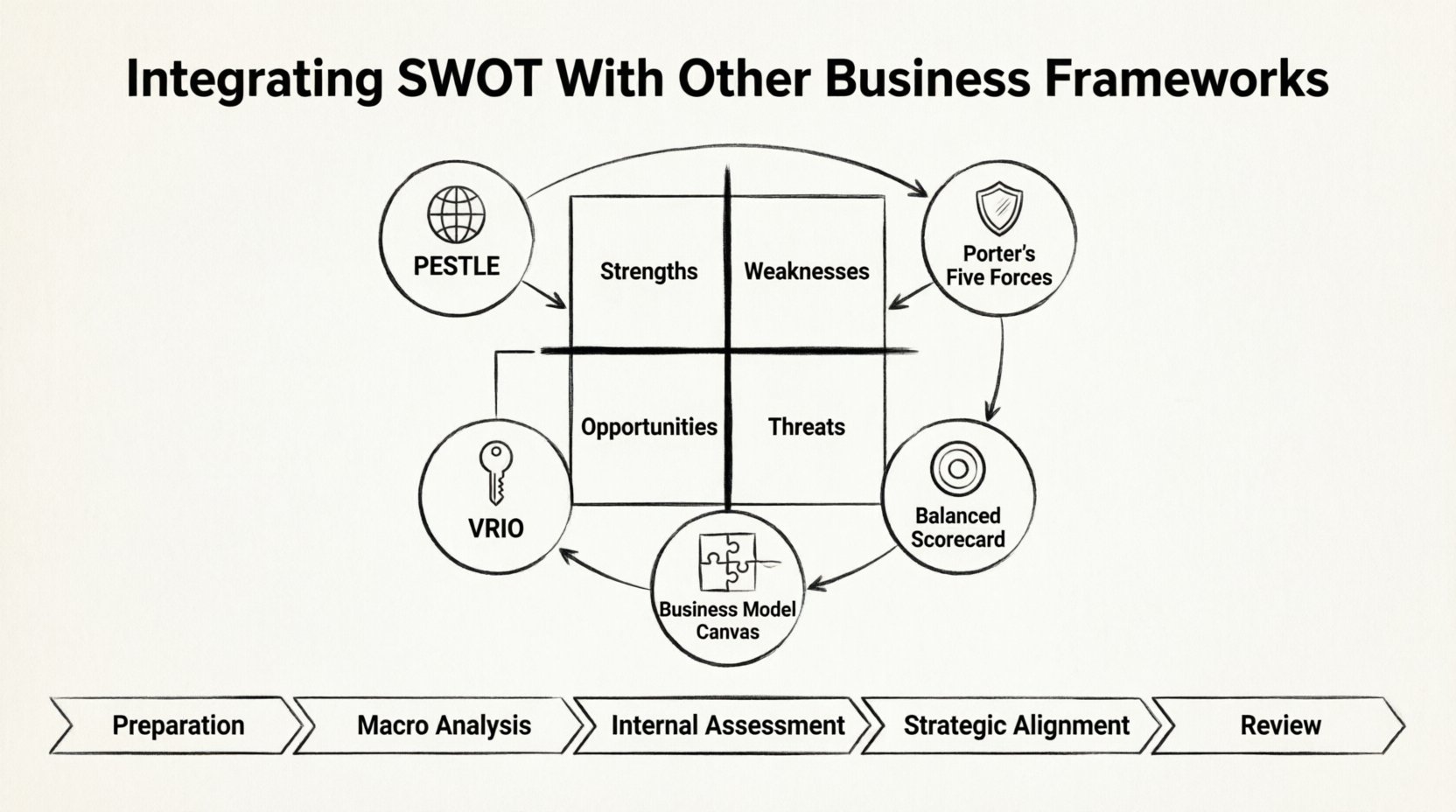
This article explores how to integrate SWOT with PESTLE, Porter’s Five Forces, the Balanced Scorecard, VRIO, and the Business Model Canvas. We will examine the synergies, the inputs required, and the strategic value gained from these combinations.
⚠️ Why Combine SWOT With Other Models?
A standalone SWOT analysis is static. It captures a moment in time without necessarily explaining the forces driving those factors. It can become a list of generic statements that lack actionable depth. By integrating other frameworks, you add layers of context and specificity.
The Limitations of Isolated SWOT
- Lack of Macro Context: SWOT identifies internal factors but often treats external threats as vague market trends without analyzing regulatory or economic drivers.
- Subjectivity: Without data-driven frameworks, SWOT can rely too heavily on internal opinion rather than hard market data.
- Execution Gap: SWOT identifies the “what” but does not always define the “how” for implementation and measurement.
- Static Nature: A list on a whiteboard does not update automatically as market conditions shift.
The Benefit of Integration
Combining tools creates a feedback loop. One framework feeds data into another, refining the strategic picture. This multi-layered approach reduces blind spots and ensures that resources are allocated based on verified market needs rather than assumptions.
🌍 Integrating SWOT With PESTLE Analysis
PESTLE stands for Political, Economic, Social, Technological, Legal, and Environmental factors. It is the primary tool for macro-environmental scanning. When paired with SWOT, PESTLE provides the external data needed to validate Opportunities and Threats.
How the Integration Works
- Scan with PESTLE: Conduct a broad analysis of the macro environment first.
- Map to SWOT: Transfer relevant PESTLE factors into the Opportunities or Threats quadrant of the SWOT matrix.
- Refine Internal Assessment: Use the macro trends to challenge internal Strengths and Weaknesses.
Practical Application
Consider a technology firm planning a product launch. A PESTLE analysis might reveal a new Data Privacy Regulation (Legal) and a shift toward remote work (Social). These do not sit in a vacuum.
- Threat: Compliance costs may increase if internal systems are weak.
- Opportunity: A product that automates compliance reporting could capture market share.
This linkage ensures that the SWOT analysis is grounded in reality. Instead of listing “Regulations” as a threat, the strategy specifies which regulations and how they impact the business.
📉 Integrating SWOT With Porter’s Five Forces
Porter’s Five Forces analyzes the competitive intensity and attractiveness of an industry. The five forces are Supplier Power, Buyer Power, Threat of Substitution, Threat of New Entry, and Rivalry Among Existing Competitors. This framework is ideal for filling out the “Threats” and “Opportunities” sections of a SWOT with industry-specific granularity.
Mapping the Forces
| Porter’s Force | SWOT Mapping | Strategic Insight |
|---|---|---|
| Supplier Power | Weakness / Threat | Are we dependent on a single vendor? Can we negotiate better terms? |
| Buyer Power | Threat | Do customers have too much leverage on price? |
| Threat of Substitution | Threat | Is there a cheaper or better alternative available? |
| Threat of New Entry | Threat | Are barriers to entry low enough for competitors to enter easily? |
| Rivalry Among Existing Competitors | Threat / Opportunity | Is the market saturated, or is there room for differentiation? |
Deepening the Analysis
When you overlay Porter’s forces onto SWOT, you move from generic competition to specific structural challenges. For example, if “Threat of New Entry” is high, your Strength of “Brand Loyalty” becomes critical. You are not just listing brand loyalty; you are defining it as a defensive moat against new entrants.
This integration helps prioritize initiatives. If Buyer Power is high, the strategy should focus on differentiation rather than price wars. If Supplier Power is high, the strategy might involve vertical integration or securing long-term contracts.
🎯 Integrating SWOT With the Balanced Scorecard
While SWOT and Porter’s focus on strategy formulation, the Balanced Scorecard (BSC) focuses on strategy execution. It translates high-level goals into four perspectives: Financial, Customer, Internal Processes, and Learning & Growth. Integrating SWOT with BSC ensures that the identified strategic directions are actionable.
The Workflow
- Define Strategic Objectives: Use SWOT to identify where to compete and how to win.
- Map to Perspectives: Assign SWOT-derived objectives to the four BSC perspectives.
- Set Measures: Create KPIs that track progress on the SWOT factors.
- Initiate Projects: Launch specific projects to address Weaknesses or capitalize on Strengths.
Example Scenario
A retail chain identifies “Outdated Inventory System” as a Weakness in SWOT. In a Balanced Scorecard integration, this becomes an objective under the Internal Process Perspective.
- Objective: Modernize inventory management.
- Measure: Reduction in stockouts by 15%.
- Initiative: Implement real-time tracking software.
- Financial Impact: Reduced carrying costs.
This connection prevents SWOT from becoming an academic exercise. It forces the organization to assign owners, budgets, and timelines to the items identified in the analysis.
🔑 Integrating SWOT With VRIO Analysis
VRIO stands for Value, Rarity, Imitability, and Organization. It is a resource-based view tool used to determine if a company’s internal resources provide a sustainable competitive advantage. This is the most direct internal complement to the SWOT framework.
Filtering Strengths
Not all Strengths identified in a SWOT analysis are equal. Some are easily copied by competitors. VRIO helps distinguish between a competitive parity and a competitive advantage.
- Value: Does the resource enable the firm to exploit an opportunity or neutralize a threat?
- Rarity: Is the resource controlled by only a few firms?
- Imitability: Is it costly for others to imitate the resource?
- Organization: Is the firm organized to capture the value of the resource?
Applying VRIO to SWOT
When performing a SWOT analysis, take every item listed under Strengths and run it through the VRIO checklist.
| VRIO Result | SWOT Classification | Strategic Action |
|---|---|---|
| Yes / Yes / Yes / Yes | Core Competency | Invest heavily; build strategy around this. |
| Yes / Yes / No / Yes | Temporary Advantage | Leverage now while competitors catch up. |
| Yes / No / Yes / Yes | Competitive Parity | Maintain to survive, but do not lead strategy. |
| No / … | Disadvantage | Consider divestment or improvement. |
This rigorous filtering ensures that strategic planning focuses on assets that actually drive long-term performance, rather than features that look good on paper but offer no defensive moat.
🧩 Integrating SWOT With the Business Model Canvas
The Business Model Canvas (BMC) describes how an organization creates, delivers, and captures value. It consists of nine building blocks, including Key Partners, Key Activities, Value Propositions, and Customer Relationships. Integrating SWOT with BMC aligns strategic analysis with operational reality.
Connecting the Dots
SWOT identifies the strategic direction. BMC defines the operational architecture to support that direction.
- Value Proposition: Aligns with SWOT Opportunities and Strengths.
- Key Resources: Aligns with SWOT Strengths and Weaknesses.
- Customer Segments: Aligns with SWOT Threats (churn) and Opportunities (new markets).
Case Application
If a SWOT analysis reveals a Threat of changing customer preferences, the BMC Customer Relationships block needs adjustment. Perhaps moving from self-service to concierge support. If a Strength is proprietary technology, the Key Activities block must prioritize R&D investment.
This integration prevents a common error where strategy (SWOT) and operations (BMC) drift apart. It ensures that the value proposition promised to customers is actually supported by the internal capabilities identified in the analysis.
🛠️ Implementation Guide: A Step-by-Step Approach
Integrating these frameworks requires discipline. It is not enough to simply place them side by side. You must weave them together into a cohesive narrative.
Phase 1: Preparation
- Assemble a cross-functional team to avoid siloed thinking.
- Gather data from external sources (market reports, financial statements).
- Define the scope of the strategic review.
Phase 2: Macro and Industry Analysis
- Run PESTLE to understand the macro environment.
- Run Porter’s Five Forces to understand industry dynamics.
- Document findings in a structured format.
Phase 3: Internal Assessment
- Conduct SWOT analysis using data from Phase 2.
- Apply VRIO to the Strengths to verify sustainability.
- Identify critical Weaknesses that need immediate remediation.
Phase 4: Strategic Alignment
- Map SWOT outcomes to the Balanced Scorecard perspectives.
- Update the Business Model Canvas to reflect new strategic priorities.
- Define KPIs that track the success of the integrated strategy.
Phase 5: Review and Iterate
- Schedule quarterly reviews to update the analysis.
- Adjust frameworks as market conditions shift.
- Ensure that execution remains aligned with the original strategic intent.
⚠️ Common Pitfalls to Avoid
Even with a robust framework, execution can fail. Be aware of these common errors when integrating SWOT with other models.
1. Overcomplication
Using too many frameworks simultaneously can create analysis paralysis. Start with SWOT and one or two complementary tools. Add more complexity only if the initial strategy proves insufficient.
2. Data Quality Issues
Garbage in, garbage out. If the PESTLE or Porter’s data is outdated or anecdotal, the SWOT will be flawed. Prioritize verified market data over internal assumptions.
3. Lack of Ownership
Strategies fail when no one is responsible for them. When you move from SWOT to Balanced Scorecard, assign clear owners to every objective. Without accountability, the integration remains theoretical.
4. Static Planning
Treating the output as a one-time document is a mistake. Markets change. Frameworks must be living documents. Revisit the integration annually or when major market disruptions occur.
📊 Summary of Framework Synergies
To visualize how these tools work together, consider the following summary of their roles in the strategic planning ecosystem.
| Framework | Primary Focus | SWOT Integration Role |
|---|---|---|
| SWOT | Internal/External Snapshot | Central Hub for Strategy |
| PESTLE | Macro Environment | Fills External Quadrants (Opportunities/Threats) |
| Porter’s Five Forces | Industry Competition | Deepens External Analysis |
| VRIO | Internal Resources | Validates Internal Quadrants (Strengths) |
| Balanced Scorecard | Execution & Measurement | Translates Strategy into Action |
| Business Model Canvas | Value Creation Logic | Aligns Operations with Strategy |
🚀 Moving Forward
Strategic planning is a discipline that improves with practice. By integrating SWOT with complementary frameworks, you move beyond simple categorization into actionable intelligence. This holistic approach ensures that every decision is backed by data, every strength is validated, and every threat is understood in context.
Start with the basics. Define your SWOT. Layer in the external context of PESTLE or Porter’s. Then, ensure you have the internal resources (VRIO) and execution plan (BSC) to support your vision. This structured method builds resilience and clarity in an uncertain business environment.