
Developing critical thinking is a skill that grows with deliberate practice. In complex environments, the ability to analyze situations objectively is vital. SWOT exercises offer a structured framework to sharpen this ability. By combining the SWOT analysis method with critical inquiry, individuals and teams can move beyond surface-level observations. This approach fosters deeper understanding and better decision-making capabilities.
When you engage in SWOT exercises, you are not just listing points. You are questioning assumptions, identifying patterns, and validating evidence. This article explores how to utilize this framework to build robust analytical skills. We will look at the mechanics of the process, the questions to ask, and the common traps to avoid.
Understanding the Core of Critical Thinking 🤔
Critical thinking involves analyzing information to form a judgment. It requires looking at facts rather than feelings. It demands skepticism toward easy answers. When applied to strategic planning, it prevents errors based on bias or incomplete data.
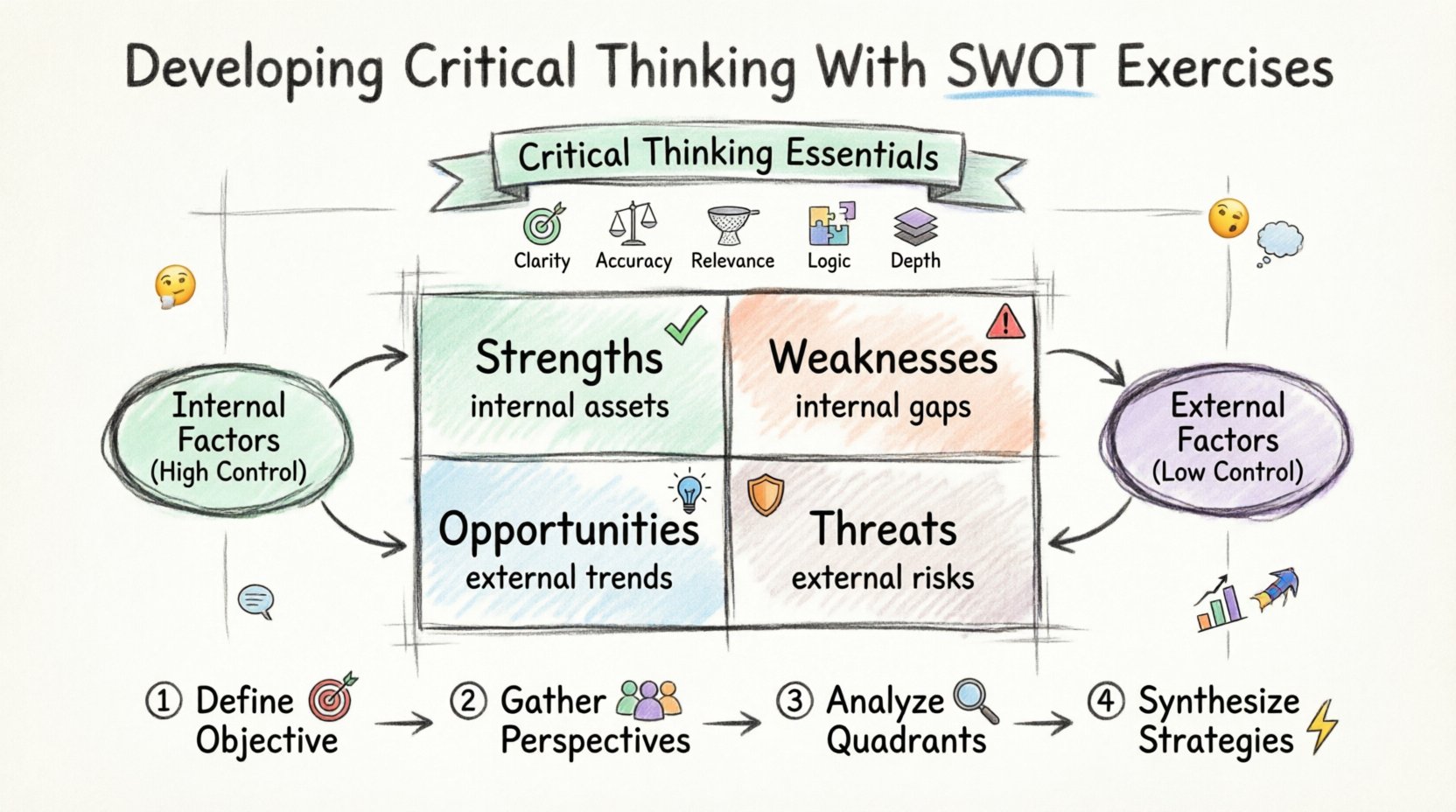
Key characteristics of critical thinking include:
- Clarity: Ensuring the problem is defined precisely.
- Accuracy: Verifying the truthfulness of the information used.
- Relevance: Focusing on data that directly impacts the decision.
- Logic: Connecting premises to conclusions without gaps.
- Depth: Addressing the complexity of the issue, not just the symptoms.
SWOT analysis supports these characteristics by forcing a structured examination of different dimensions. It separates internal capabilities from external conditions. This separation is the first step toward objective analysis.
The SWOT Framework Explained 📊
The SWOT framework stands for Strengths, Weaknesses, Opportunities, and Threats. It divides factors into internal and external categories. Strengths and Weaknesses are internal. Opportunities and Threats are external. Understanding this distinction is crucial for accurate thinking.
| Category | Focus | Control Level | Example |
|---|---|---|---|
| Strengths | Internal Assets | High | Skilled Team, Strong Brand |
| Weaknesses | Internal Gaps | High | Legacy Systems, High Costs |
| Opportunities | External Trends | Low | New Markets, Tech Shifts |
| Threats | External Risks | Low | Competitor Entry, Regulations |
When conducting exercises, treat these categories as distinct buckets. Do not mix internal issues with external factors. This discipline trains the mind to categorize data correctly, a fundamental aspect of critical thought.
Why SWOT Enhances Critical Thinking 🚀
Simply listing attributes does not constitute critical thinking. The value lies in the interrogation of each point. The framework provides a scaffold for inquiry. It forces you to consider angles you might otherwise ignore.
- Balance: It prevents over-optimism by requiring an honest look at weaknesses.
- Context: It places internal factors within an external environment.
- Strategy: It connects analysis directly to actionable outcomes.
- Clarity: It visualizes relationships between different variables.
By rigorously filling out each quadrant, you develop the habit of looking at a situation from multiple perspectives. This reduces cognitive tunneling, where one focuses only on a single aspect of a problem.
Step-by-Step Guide to SWOT Exercises 📝
Effective execution requires preparation and focus. Follow this sequence to maximize the analytical value of the exercise.
1. Define the Objective Clearly 🎯
Before listing factors, state what you are analyzing. Is it a new product? A personal career move? A departmental restructure? The scope dictates the depth of analysis. A vague goal leads to vague results.
- Write a specific statement of the situation.
- Set a time horizon (e.g., next 12 months).
- Identify the stakeholders involved in the decision.
2. Gather Diverse Perspectives 👥
Individual analysis is prone to blind spots. Critical thinking improves when challenged by different viewpoints. Include people from different functions or backgrounds.
- Invite feedback from those who do not agree with you.
- Collect data from various sources, not just memory.
- Document where each piece of information comes from.
3. Analyze Strengths Deeply 💪
Strengths are not just “good things.” They are assets that provide a competitive advantage. Question the sustainability of these strengths.
Questions to Ask:
- Why is this specific strength relevant to the objective?
- Is this strength unique to us, or do competitors have it too?
- Can this strength be leveraged in new ways?
- What resources maintain this strength?
4. Uncover Weaknesses Honestly 🛑
This is often the hardest step. It requires admitting where you fall short. Weaknesses are internal limitations that hinder performance. Avoid euphemisms.
Questions to Ask:
- What processes cause the most delays?
- Where do we consistently lose money or time?
- What skills are missing from our current team?
- How does a competitor outperform us in this area?
5. Identify External Opportunities 🌟
Opportunities are external trends you can capitalize on. They are not internal desires. They must exist in the market or environment.
Questions to Ask:
- What changes in regulations could help us?
- Is there a growing demand we are not meeting?
- Are there new technologies that lower our costs?
- Can we partner with other entities to expand reach?
6. Assess Threats Realistically ⚠️
Threats are external obstacles. They exist regardless of your actions. Acknowledging them is not pessimism; it is risk management.
Questions to Ask:
- What is the likelihood of this event occurring?
- How severe would the impact be if it happened?
- Are we prepared to respond if this happens?
- Is this a temporary fluctuation or a long-term trend?
Common Pitfalls to Avoid ⚠️
Even with a strong framework, analysis can go wrong. Being aware of these errors helps maintain critical integrity.
- Confusing Desires with Facts: Just because you want an opportunity does not mean it exists.
- Overgeneralization: Avoid broad statements like “bad management.” Be specific about processes or decisions.
- Ignoring Data: Relying on anecdotes instead of measurable metrics weakens the analysis.
- Groupthink: If everyone agrees too quickly, stop and challenge the consensus.
- Static Analysis: Treating the SWOT as a one-time checklist rather than a living document.
Advanced Techniques for Deeper Analysis 🔍
Once the basic quadrants are filled, apply advanced critical thinking techniques to synthesize the information.
Pairing Strategies
Combine elements to create actionable strategies. Match Strengths to Opportunities. Use Strengths to mitigate Threats. Use Opportunities to fix Weaknesses. This synthesis requires logical deduction.
Cross-Verification
Check if a point listed in one quadrant contradicts another. For example, a “Strength” that is actually a “Weakness” in disguise indicates a misinterpretation. Re-evaluate the evidence.
Scenario Testing
Run the analysis through different future scenarios. How does the SWOT change if the economy crashes? How does it change if a new competitor enters? This stress-tests your assumptions.
Real-World Applications 💼
SWOT exercises are versatile. They apply to business, education, and personal development.
- Business Strategy: Planning market entry or product launches.
- Personal Career: Deciding on further education or job changes.
- Project Management: Identifying risks before a project starts.
- Non-Profits: Assessing funding stability and community needs.
In each case, the goal is to replace guesswork with structured reasoning. The framework remains the same, but the context changes.
Measuring Improvement in Critical Thought 📈
How do you know your critical thinking has improved? Look for these indicators over time.
- Reduced Errors: Fewer decisions lead to unexpected negative outcomes.
- Speed: You reach conclusions faster because you have a reliable process.
- Confidence: Your decisions are backed by evidence, not just intuition.
- Communication: You can explain your reasoning clearly to others.
- Adaptability: You adjust plans quickly when new data arrives.
Keep a journal of your analyses. Review past SWOT exercises against actual results. This feedback loop is essential for growth.
Sustaining the Practice 🌱
Consistency is key. Critical thinking is a muscle that atrophies without use. Schedule regular reviews of your strategic documents. Revisit old SWOTs to see if the assumptions held true. Encourage others in your circle to use the framework.
By treating SWOT not as a form to fill but as a thinking tool, you transform how you approach problems. The structure supports the mind, allowing it to focus on logic rather than organization. This leads to more robust outcomes and a clearer path forward.
Start your next exercise with fresh eyes. Question every assumption. Validate every claim. The rigor you apply now will define the quality of your decisions later.