
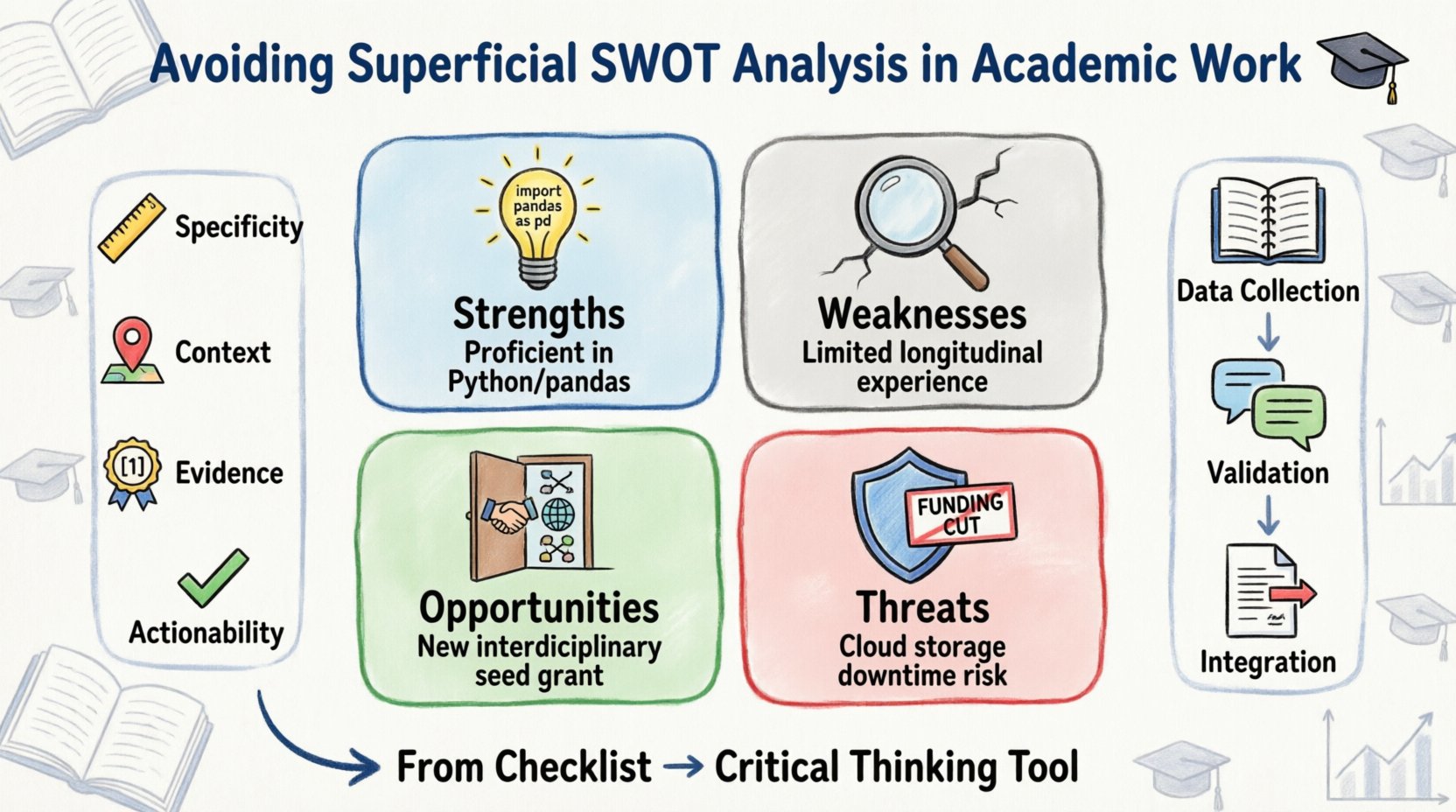
Academic research and project planning demand precision. When applying strategic frameworks like SWOT analysis (Strengths, Weaknesses, Opportunities, Threats) within a university setting, the risk of superficiality is high. Many students and researchers default to generic statements that lack evidentiary support. This approach undermines the credibility of the work.
A superficial SWOT fails to provide actionable insights. It becomes a checklist exercise rather than a tool for critical thinking. In this guide, we explore how to deepen this analysis. We will examine specific examples of weak versus robust entries. We will also outline a methodology for ensuring your academic SWOT holds up under scrutiny.
📉 The Problem with Surface-Level Analysis
Superficiality in academic SWOT analysis often stems from a lack of specific context. Instead of analyzing the unique constraints of a research project, writers default to broad generalizations. This reduces the utility of the framework. Below are common signs of a weak analysis:
- Vague Strengths: Statements like “I am smart” or “I have good resources” without defining the specific capabilities or assets.
- Generic Weaknesses: Admitting to “time management” issues without identifying the specific bottlenecks.
- Disconnected Opportunities: Listing industry trends that do not directly impact the specific research question.
- Ignored Threats: Failing to acknowledge external risks like funding cuts, ethical hurdles, or data accessibility.
When an academic paper or proposal relies on these elements, reviewers may perceive the work as underdeveloped. Rigor requires evidence. Every claim within the four quadrants must be backed by data, past performance, or verified constraints.
🔍 Defining Academic SWOT Rigor
To elevate the quality of your strategic planning, you must shift from descriptive to analytical. The goal is not just to list factors but to understand their interplay. In an academic context, this means linking personal or project capabilities to research outcomes.
Key Criteria for Depth:
- Specificity: Avoid adjectives. Use nouns and verbs that describe measurable actions.
- Context: Tie the factor to the specific discipline or research topic.
- Evidence: Where possible, cite previous studies, pilot data, or established institutional policies.
- Actionability: Each point should suggest a potential strategy or mitigation plan.
🛠 Deep Dive into the Four Quadrants
Let us break down how to approach each section of the matrix with academic rigor. We will move away from standard definitions and look at how they apply to research and study.
1. Strengths: Internal Capabilities
Strengths are not just personality traits. In research, they are tangible assets. These might include access to specific datasets, technical skills, or established networks.
- Technical Proficiency: Instead of “good at coding,” specify “proficient in Python for data cleaning and statistical analysis using pandas and numpy libraries.”
- Resource Access: Instead of “good library,” specify “unrestricted access to the university’s digital archives and specialized laboratory equipment.”
- Previous Performance: Instead of “hard worker,” specify “maintained a 3.8 GPA in quantitative methods courses over the last two semesters.”
2. Weaknesses: Internal Limitations
Identifying weaknesses is uncomfortable but necessary. In academia, honesty about limitations strengthens the methodology section of a paper. It shows awareness of potential bias or error.
- Methodological Gaps: Acknowledge if you lack experience in a specific qualitative coding technique.
- Scope Constraints: Admit if the sample size is limited by budget or time.
- Knowledge Gaps: Identify areas where literature is scarce, requiring more extensive review.
3. Opportunities: External Possibilities
Opportunities exist outside the researcher’s control but can be leveraged. These often arise from changes in the field, new funding sources, or collaborative possibilities.
- Emerging Trends: A new policy change that makes your research topic more relevant.
- Collaborative Potential: A department head looking for a research assistant in a related field.
- Technological Shifts: New open-source tools that reduce the cost of data processing.
4. Threats: External Risks
Threats are obstacles that you cannot control. In a research proposal, identifying these demonstrates risk management. It assures the reader that you have considered potential pitfalls.
- Funding Instability: Grant cycles that might pause mid-project.
- Participant Attrition: The likelihood of survey respondents dropping out before completion.
- Regulatory Changes: Ethical review boards that might tighten data privacy requirements.
⚖️ Comparison: Superficial vs. Deep Analysis
Visualizing the difference between a weak entry and a strong entry clarifies the standard required. Use the table below as a reference for your own work.
| Quadrant | Superficial Entry (Avoid) | Deep Entry (Aim For) |
|---|---|---|
| Strengths | “I have good writing skills.” | “Published two peer-reviewed articles in the last year using APA 7th edition style.” |
| Weaknesses | “I am sometimes late.” | “Limited experience with longitudinal data tracking, which may delay the timeline by 2 weeks.” |
| Opportunities | “More funding is available.” | “The university launched a new seed grant program specifically for interdisciplinary studies starting next month.” |
| Threats | “The internet might go down.” | “Reliance on cloud-based storage poses a risk if the service provider experiences downtime during the submission window.” |
🧠 Methodology for Robust Evaluation
Generating the points is only half the battle. The process of arriving at them determines the quality of the analysis. To ensure depth, follow these steps during the drafting phase.
1. Data Collection
Do not rely on memory. Gather evidence before filling the matrix.
- Review Past Work: Look at grades, feedback forms, or previous project outcomes.
- Conduct a Literature Scan: Identify where your proposed research fits in the current landscape.
- Interview Stakeholders: Ask advisors or peers about perceived gaps in your preparation.
2. Validation
Once drafted, subject your points to scrutiny.
- Peer Review: Ask a colleague to read the SWOT. Do the strengths sound genuine? Are the threats realistic?
- Fact-Checking: Ensure every statistic or claim about resources is accurate.
- Relevance Check: Does this point directly affect the success of the specific research question?
3. Integration
A SWOT analysis is useless if it sits in a separate document. It must inform the narrative of your work.
- Methodology Section: Use Strengths and Weaknesses to justify your chosen methods.
- Limitations Section: Use Weaknesses and Threats to define the boundaries of your study.
- Future Work: Use Opportunities to suggest where the research could go next.
🚫 Common Pitfalls to Avoid
Even with good intentions, errors occur. Be vigilant against these common traps.
- Confusing Internal and External: Do not list “economic downturn” as a Strength. It is an external factor (Threat or Opportunity).
- Being Too Positive: A SWOT that lists only Strengths and Opportunities is a wish list, not an analysis.
- Static Thinking: Academic environments change. A SWOT created in September might be obsolete by December. Review it periodically.
- Ignoring Interconnections: A Strength can mitigate a Threat. A Weakness can block an Opportunity. Map these relationships.
📝 Integrating SWOT into Thesis and Proposals
How do you actually write this into a formal document? You do not always need a dedicated “SWOT Chapter.” Instead, weave the insights into the structure.
In a Research Proposal:
- Use the Opportunities to justify the timeliness of the research.
- Use the Threats to outline your risk management plan.
- Use the Strengths to establish your credibility to conduct the study.
In a Final Thesis:
- Use the Weaknesses to frame the Discussion section, acknowledging limitations honestly.
- Use the Strengths to highlight the novelty of your contribution.
- Use the Opportunities to propose future research directions in the Conclusion.
🔎 Critical Thinking and Strategic Planning
The true value of this exercise lies in critical thinking. It forces you to confront the reality of your situation. It moves you from a passive student to an active researcher. When you can articulate why you chose a method or why you anticipate a specific risk, you demonstrate academic maturity.
This level of detail distinguishes high-distinction work from average submissions. It shows that you understand the ecosystem in which your research exists. You are not just answering a question; you are navigating a complex environment with specific constraints and resources.
🚀 Final Considerations
Moving beyond the template is a skill that develops over time. Start by auditing your current drafts. Replace vague adjectives with concrete nouns. Replace general statements with specific data points. Ensure every quadrant of your analysis serves the broader argument of your academic work.
By committing to this depth, you protect the integrity of your research. You create a foundation that is sturdy enough to withstand peer review and academic scrutiny. The effort invested in a rigorous SWOT analysis pays dividends throughout the entire research lifecycle.
Remember, the goal is not perfection. The goal is clarity. Clarity in your capabilities, clarity in your limitations, and clarity in the path forward. This is the essence of academic rigor.