


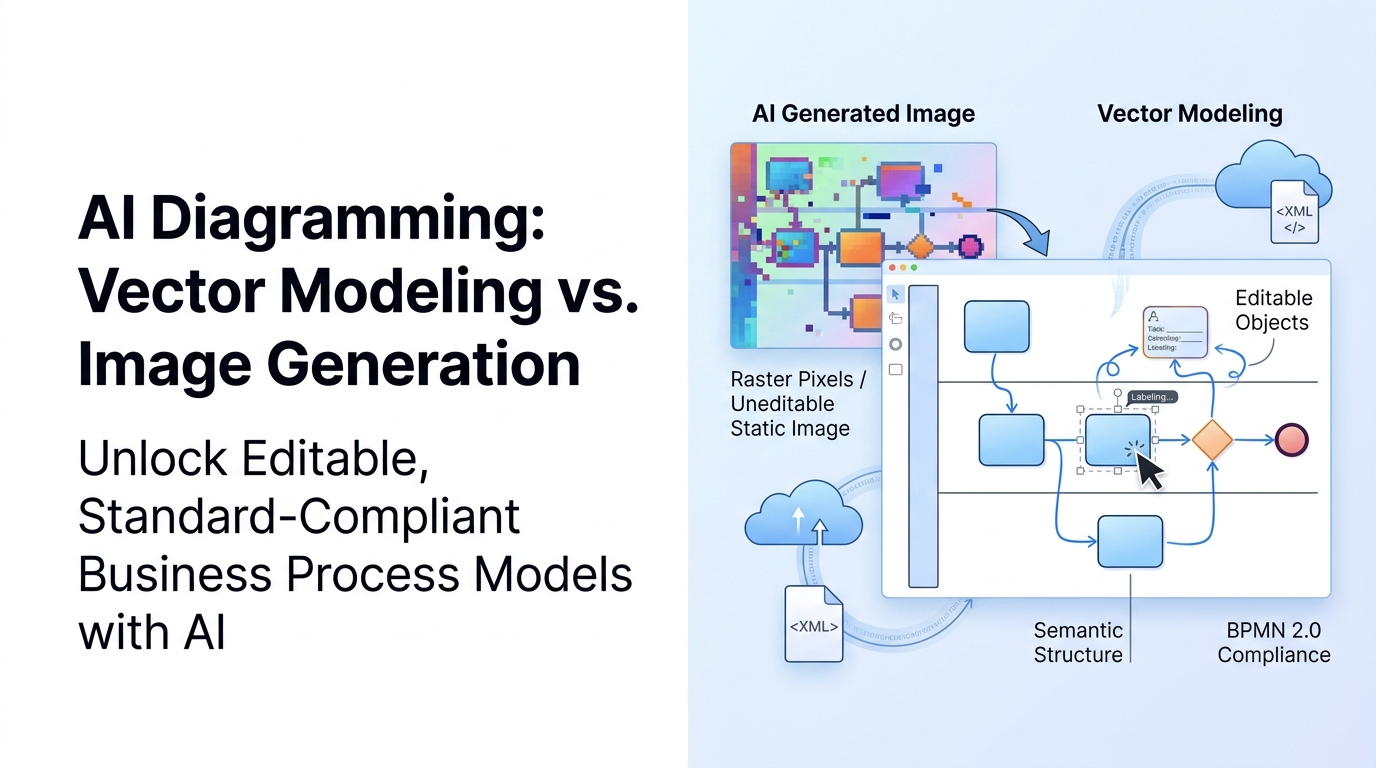
As Generative AI rapidly transforms enterprise workflows, visual diagramming has emerged as a major area of innovation. With the press of a button, modern AI models can create intricate visual outputs from simple text prompts. However, as organizations attempt to integrate AI-generated graphics into their operational and software engineering workflows, a fundamental distinction has surfaced: the difference between generic AI image generation and true vector-based visual modeling.
While basic image generators excel at creating artistic illustrations, they fail completely when applied to formal business architectures. For business analysts, systems engineers, and Enterprise Architects, adopting a purpose-built, vector-native Visual Paradigm AI BPMN Tool is essential to ensure models remain editable, standard-compliant, and fully integrated into enterprise systems.
The Critical Limit of Generic AI Image Generation in Enterprise Settings
General-purpose generative image models (such as Midjourney, DALL-E, or Stable Diffusion) interpret prompts to produce raster pixel images (like JPEG or PNG files). While these visuals can appear superficially convincing, they present insurmountable obstacles for real-world business process management (BPM) compared to the structured approach of Visual Paradigm:
- Uneditable Static Pixels: Raster images cannot be altered. If a single decision gateway or task label in an image needs updating, the entire picture must be re-generated from scratch, often producing an entirely different visual layout. In contrast, Visual Paradigm allows instant editing of individual elements.
- Zero Semantic Intelligence: An image generator treats a BPMN gateway or swimlane merely as a collection of pixels and colors. It has no structural understanding of Business Process Model and Notation (BPMN 2.0) rules, event triggers, or sequence flow logic. Visual Paradigm’s AI engine understands the semantics behind every shape.
- No Traceability or System Integration: Pixels cannot be linked to backend software code, database schemas, user stories, or compliance frameworks. They exist as isolated, static graphics. Visual Paradigm bridges this gap by linking diagrams directly to requirements, code, and test cases.
Why True Enterprise Productivity Requires Visual Paradigm’s Vector-Based AI Modeling
Unlike pixel-based image generation, Visual Paradigm’s vector-native AI modeling uses generative AI to produce structured, object-oriented diagram data. Instead of simply “drawing a picture,” the Visual Paradigm AI engine builds an underlying model structure composed of distinct, semantic XML/JSON elements, task nodes, gateway conditions, and sequence flow connections.
Adopting the Visual Paradigm AI BPMN Tool delivers critical capabilities that generic image generators simply cannot match:
1. Dynamic, Drag-and-Drop Editability
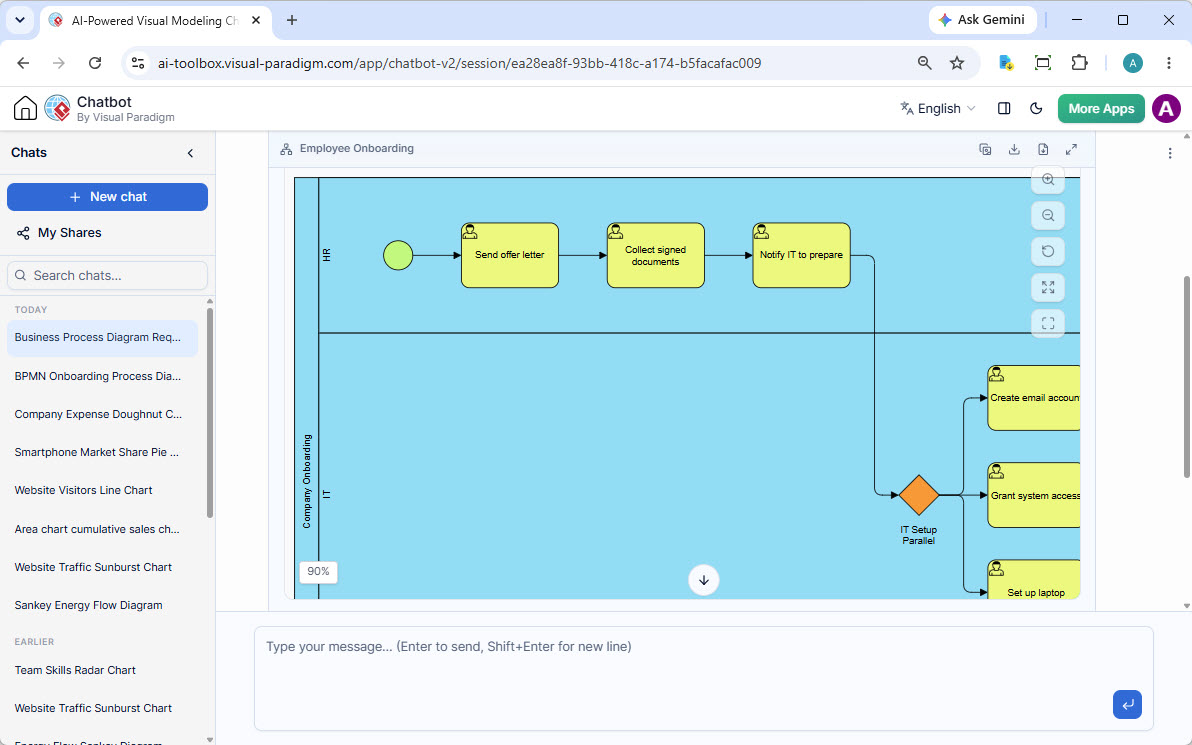
Diagrams generated by Visual Paradigm consist of independent, intelligent objects. Users can instantly move a task node, re-route a sequence flow line, adjust swimlane heights, or update text labels using intuitive drag-and-drop web or desktop editors without disturbing the rest of the model. This flexibility ensures your diagrams evolve alongside your business processes.
2. Strict Syntax and Standard Compliance
A vector-native AI modeling engine like Visual Paradigm is trained on the formal semantic rules of BPMN 2.0. It automatically enforces correct syntax—ensuring message flows only cross distinct pool boundaries, sequence flows remain within pools, and gateways split/merge paths according to standardized mathematical logic. This eliminates the ambiguity found in AI-generated art.
3. Model Traceability Across the Enterprise
Because Visual Paradigm produces structured data nodes, individual BPMN tasks can be linked directly to other enterprise artifacts. Analysts can connect a high-level business task to a UML sequence diagram, an ArchiMate application component, a user story, or a database schema, maintaining full end-to-end traceability from concept to execution.
Bridging AI Efficiency with the Visual Paradigm Ecosystem
The ultimate goal of using AI in business process management is not just to draw diagrams faster, but to elevate the entire process lifecycle. Visual Paradigm acts as an intelligent gateway into a mature, enterprise-grade modeling ecosystem, seamlessly bridging prompt-based generation with comprehensive modeling capabilities.
When selecting an enterprise AI BPMN tool, organizations should look for platforms like Visual Paradigm that offer:
- Conversational Refinement: The ability to modify generated vector diagrams through natural language chat (e.g., “Add an exception path for payment failures in the finance swimlane”) directly within the Visual Paradigm interface.
- Hierarchical Modeling: Expanding high-level task nodes into detailed, collapsed sub-process diagrams without losing parent-child model connections, all managed within a single project file.
- Automated Documentation and Publishing: Generating comprehensive PDF/HTML reports, technical specifications, and interactive web repositories directly from the vector model created by Visual Paradigm.
Frequently Asked Questions
Why can’t I just use AI canvas apps or flowchart tools for BPMN?
Basic canvas applications lack formal BPMN 2.0 semantic rules. While they may output vector shapes, they do not enforce sequence flow conventions, gateway behaviors, or model traceability, leading to non-standard and ambiguous process maps. Visual Paradigm ensures every diagram you generate is technically accurate and ready for professional deployment.
What file formats does the Visual Paradigm AI BPMN Tool export?
Enterprise vector tools like Visual Paradigm allow you to export models as standard BPMN 2.0 XML files, scalable vector graphics (SVG), high-resolution PDFs, or proprietary project files that integrate directly with desktop modeling engines and workflow execution platforms.
Can vector BPMN diagrams generated by Visual Paradigm be executed in workflow engines?
Yes. Because a true Visual Paradigm AI BPMN Tool generates syntactically correct vector and XML structure, the resulting models can be imported directly into BPMN-compliant workflow execution engines (such as Camunda, Activiti, or Bizagi) for automated process orchestration.
Conclusion
While AI image generation is impressive for creative media, enterprise process engineering requires visual modeling built on structure, precision, and standards. Static raster images cannot support modern business analysis. By investing in a dedicated, vector-native Visual Paradigm AI BPMN Tool, organizations empower their teams to rapidly generate, edit, and integrate standard-compliant process models that drive real operational transformation.