


In the modern landscape of product development, change is not an anomaly; it is a constant. Markets shift, user needs evolve, and technical realities emerge unexpectedly. Within the framework of Scrum, managing this volatility is a core competency. The challenge lies in balancing the need for flexibility with the necessity of stability. This guide explores how to navigate change requests effectively while respecting the structural integrity of the Scrum framework. 🚀
Teams that can adapt without losing momentum achieve higher predictability and better quality outcomes. Understanding where boundaries exist is crucial for maintaining a sustainable pace. This involves deep knowledge of the Product Backlog, the Sprint Goal, and the roles of the Scrum Team. By adhering to these principles, organizations can respond to change without compromising the value delivery process. 📊
The Nature of Change in Agile Environments 🌊
Agile methodologies were designed to embrace change. Unlike traditional waterfall models where scope is fixed early, Scrum expects requirements to evolve. However, “embrace” does not mean “accept anything at any time.” There is a rhythm to change that must be respected to prevent chaos. The Scrum Guide emphasizes empiricism, which relies on transparency, inspection, and adaptation. Change requests are the fuel for adaptation, but they must be filtered through the lens of value and feasibility.
- Volatility: External factors often dictate the direction of the product. Stakeholders may request new features based on competitor analysis.
- Discovery: The team may learn during a Sprint that a technical assumption was incorrect, requiring a pivot.
- Urgency: Critical bugs or compliance issues may arise that cannot wait for the next planning session.
Recognizing the source of the change helps in determining the appropriate response. Is the change driven by external market pressure, internal discovery, or a regulatory requirement? Each source carries different weight and urgency. Understanding this context allows the Product Owner to prioritize effectively. It also helps the Development Team understand why priorities shift, reducing frustration and maintaining morale. 🧠
Understanding Scrum Boundaries 🛡️
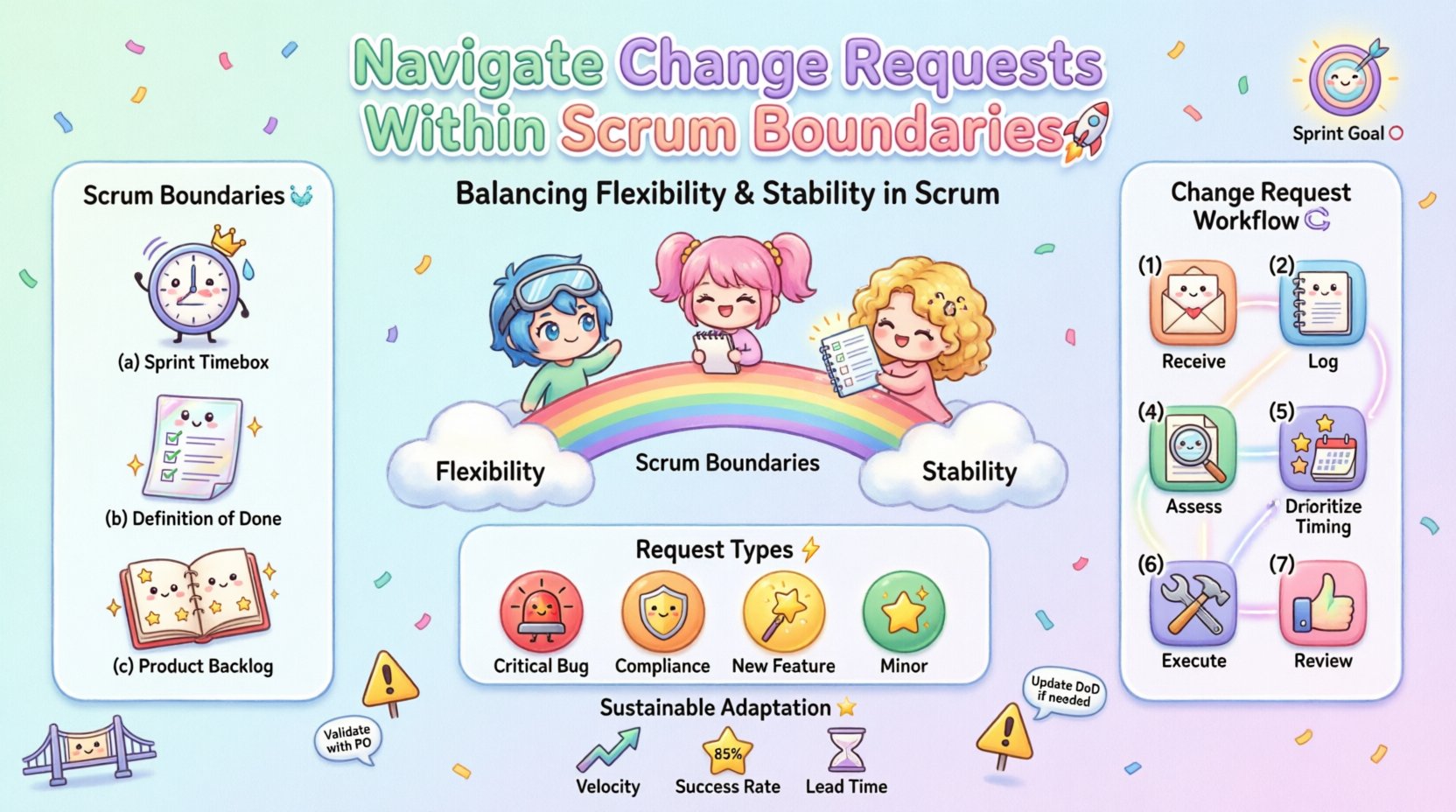
Scrum is a lightweight framework, but it is not boundary-less. The framework defines specific timeboxes, events, and artifacts. These boundaries exist to create a safe environment for the team to work. When a change request enters the system, it must be evaluated against these boundaries. Violating them often leads to burnout, technical debt, or a loss of focus.
The Sprint Timebox: A Sprint is a fixed duration, typically one month or less. During this time, the Sprint Goal should remain intact. This is the primary boundary. If a change request threatens the Sprint Goal, it cannot be added to the current Sprint without a formal review of the goal itself.
The Definition of Done: Every item must meet the Definition of Done. Adding a new request mid-Sprint might introduce risk that prevents the team from meeting this standard. The quality boundary must be maintained regardless of the pressure to deliver. 🛑
The Product Backlog: This is the single source of truth for all work. No work is done unless it is pulled from this list. This ensures that nothing is built without prior estimation and prioritization. It prevents shadow work and ensures transparency.
The Product Backlog as the Control Mechanism 📋
The Product Backlog is the primary tool for managing change. It is a living artifact that is ordered by the Product Owner. When a change request arrives, it should not bypass the backlog. Instead, it enters the backlog as a new item. This allows for proper sizing, estimation, and ordering.
- Visibility: All stakeholders can see the work that is planned, in progress, or completed.
- Ordering: Items are ordered based on value, risk, and necessity. High-priority items sit at the top.
- Refinement: The backlog is refined continuously. This is the ideal time to discuss new change requests before they become urgent.
By forcing change requests through the backlog, the team maintains control over their workflow. It prevents the “HiPPO” effect (Highest Paid Person’s Opinion) from dictating immediate work. Instead, decisions are made based on data and value. This process takes time, which is why backlog refinement sessions are critical. They ensure that when a Sprint starts, the top items are clear and ready for selection. 🕰️
Timing: When to Accept Change ⏱️
The timing of a change request is as important as the request itself. Scrum provides specific events where changes can be discussed and integrated. Understanding these windows helps in setting expectations with stakeholders.
During Sprint Planning
This is the most appropriate time to introduce new changes. The team selects items from the top of the Product Backlog. If a new request has been prioritized as the highest value item, it can be pulled into the Sprint. The Development Team commits to it. If the team feels the capacity is insufficient, they can negotiate the scope of other items. This is a collaborative decision. 🤝
During the Sprint
Once a Sprint has begun, the scope is fixed. The Sprint Backlog is protected. However, if a critical issue arises, the Product Owner and Development Team must decide together. They may choose to remove work of equal value to accommodate the change. The key is that the Sprint Goal remains achievable. If the goal is lost, the Sprint is cancelled. This is a rare event and should be avoided. 🚫
During Sprint Review
The Sprint Review is a forum for feedback. Stakeholders can request changes based on the product increment. These requests are added to the Product Backlog for the next Sprint. They are not implemented immediately. This feedback loop ensures the product stays aligned with user needs without disrupting the development rhythm. 🔄
During Sprint Retrospective
This event focuses on the process, not the product. However, if the team identifies a process change that affects how they handle requests, this is the place to discuss it. For example, the team might decide to shorten the Sprint length to respond faster to market changes. 🛠️
Preserving the Sprint Goal 🎯
The Sprint Goal is the single objective for the Sprint. It provides flexibility to the Development Team regarding the specific items they choose to complete. If they can achieve the goal using different items, they should do so. This flexibility is a feature, not a bug. However, if a change request threatens the Sprint Goal, the team must pause and assess.
Scenario 1: The Sprint Goal is still achievable. If a new request is urgent but the team can swap out lower-value work to accommodate it, the change is accepted. The Sprint Backlog is updated, but the goal remains. ⚖️
Scenario 2: The Sprint Goal is at risk. If the change requires significant rework that jeopardizes the goal, the Product Owner must decide. They can choose to cancel the Sprint or negotiate with stakeholders to delay the request. Cancelling a Sprint is costly and should be a last resort. 📉
Scenario 3: The Sprint Goal is no longer relevant. Sometimes, the market changes so much that the goal set at the beginning of the Sprint is now obsolete. In this case, cancelling the Sprint is the correct action. This allows the team to reset and plan based on the new reality. It preserves the integrity of the framework. 🔄
The Product Owner’s Responsibility 🧠
The Product Owner owns the Product Backlog. This includes managing change requests. They act as the bridge between the stakeholders and the Development Team. Their role is to maximize the value of the product. This means making tough decisions about what to build and what to delay.
- Prioritization: The Product Owner must order items based on value. A change request must be compared against existing work to determine its true worth.
- Communication: They must communicate the impact of changes clearly. If a request is added, what must be removed? What is the new estimated completion date?
- Protection: They must protect the team from distractions. Constant context switching reduces productivity. The Product Owner shields the team from noise.
Effective communication is vital. Stakeholders need to understand that “now” is not always possible. Transparency about capacity and velocity helps manage expectations. When stakeholders understand the trade-offs, they are more likely to accept delays or prioritization changes. 🗣️
Handling Urgent Requests vs. New Features ⚡
Not all change requests are equal. A critical production bug requires a different response than a new feature request. Distinguishing between the two is a key skill for the Product Owner.
| Request Type | Urgency | Typical Action | Impact on Sprint |
|---|---|---|---|
| Critical Bug | Immediate | Stop current work, fix immediately | High – May require Sprint cancellation |
| Compliance Issue | High | Swap with lower value item | Medium – Requires scope adjustment |
| New Feature | Medium | Add to Backlog, prioritize for next Sprint | Low – No immediate disruption |
| Minor Request | Low | Add to Backlog, refine later | None |
When a critical bug arises, the team may need to drop a planned item. This is not a failure; it is a reaction to reality. The key is to document why the item was dropped. This maintains transparency. If the bug is fixed, the team returns to the Sprint Goal. If the bug cannot be fixed quickly, the Sprint may need to be cancelled. ⚠️
Collaboration and Transparency 🤝
Change management is a team sport. It requires the full Scrum Team to participate. The Development Team provides technical estimates and feasibility checks. The Scrum Master facilitates the conversation and ensures the process is followed. The Product Owner brings the business context.
- Shared Understanding: Everyone must agree on what the change entails. Ambiguity leads to rework.
- Visual Management: Use boards to show work in progress. When a change enters, it should be visible to all.
- Feedback Loops: Short feedback loops allow for quicker course correction. Daily stand-ups can highlight if a change is impacting the team’s rhythm.
Transparency builds trust. When stakeholders see the work being done and the impact of changes, they become partners rather than adversaries. They understand the cost of change. This partnership leads to better decision-making and a more stable product development environment. 🏗️
Common Pitfalls and How to Avoid Them 🚧
Even with a clear framework, teams often stumble when managing change. Identifying these pitfalls early helps in avoiding them.
Pitfall 1: Scope Creep
Scope creep happens when small changes accumulate without formal approval. Over time, this erodes the Sprint Goal. To avoid this, enforce strict backlog discipline. Every item must be reviewed and prioritized. Do not allow “quick fixes” to bypass the backlog. 🛑
Pitfall 2: Ignoring the Definition of Done
In a rush to accommodate change, teams might skip testing or documentation. This creates technical debt. Always maintain the Definition of Done. If a change request makes it impossible to meet the Definition of Done, it should be rejected or postponed. Quality cannot be compromised. 🧪
Pitfall 3: Lack of Refinement
If the Product Backlog is not refined, the team cannot estimate the impact of change requests. Refinement sessions should be regular. This ensures that items are ready for selection. It reduces the time spent discussing details during Sprint Planning. 📝
Pitfall 4: Over-Committing
Teams often promise to do everything. This leads to burnout and failure. It is better to commit to a realistic amount of work. If a change comes in, remove something else. This maintains a sustainable pace. 🏃♂️
A Practical Workflow for Change Requests 🔄
To operationalize change management, follow a structured workflow. This ensures consistency and clarity.
- Receive Request: Stakeholder submits a request via a standard channel. It is not verbal.
- Log to Backlog: The Product Owner adds the item to the Product Backlog with a clear description.
- Assess Impact: The Product Owner and Development Team review the item. What is the effort? What is the value?
- Prioritize: The Product Owner orders the backlog based on the assessment.
- Decide Timing: If the request is urgent, it may enter the current Sprint. If not, it waits for the next planning session.
- Execute: The team works on the item according to the plan.
- Review: At the end of the Sprint, the work is reviewed. Feedback is gathered for future changes.
This workflow creates a predictable cadence. Stakeholders know when their requests will be considered. The team knows when to expect changes. This reduces anxiety and improves focus. 📈
Measuring Stability and Flexibility 📊
To ensure the change management process is working, track metrics. Velocity is a key indicator. If velocity drops significantly after changes, the process may be too reactive. Sprint Burndown charts can show if scope is expanding unexpectedly. 📉
- Sprint Success Rate: How often is the Sprint Goal achieved? A high rate indicates good boundary management.
- Change Frequency: How often are changes requested? High frequency may indicate poor initial planning.
- Lead Time: How long does it take to move a change request from request to delivery? Shorter times indicate better agility.
These metrics help in continuous improvement. They allow the team to adjust their boundaries and processes over time. It is not about rigid adherence; it is about finding the right balance for the specific context. ⚖️
Conclusion: Sustainable Adaptation 🏁
Navigating change requests within Scrum boundaries requires discipline and clear communication. It is not about resisting change, but about channeling it effectively. By respecting the Sprint Goal, maintaining the Product Backlog, and involving the whole team, organizations can remain agile without losing focus. The goal is sustainable delivery of value, not just speed. When change is managed well, the team remains stable, motivated, and productive. This is the essence of a mature Scrum implementation. 🌟
Remember, the framework is a guide, not a rulebook. Adapt it to your needs while keeping the core principles intact. Continuous learning and refinement of the process are key to long-term success. With the right approach, change becomes an opportunity rather than a threat. 🚀