

Strategic planning is the backbone of organizational growth, yet many businesses struggle to move past simple data collection. The SWOT analysis is a ubiquitous tool in the corporate toolkit, designed to identify Strengths, Weaknesses, Opportunities, and Threats. However, a list of bullet points is not a strategy. It is merely a snapshot. To create genuine value, leaders must transform this static inventory into dynamic, actionable strategic recommendations. This guide explores how to bridge the gap between analysis and action, ensuring every insight drives measurable business outcomes.
Why Most SWOT Analyses Fail to Drive Action 🛑
Organizations often treat the SWOT framework as a checkbox exercise. Teams gather in a conference room, generate lists, and file the document away. The result is a document that looks informative but lacks direction. The core issue lies in the separation of data from decision-making. When Strengths and Opportunities are listed without being linked, the potential for growth remains theoretical.
- Isolation: Quadrants are often analyzed independently rather than in relation to one another.
- Subjectivity: Internal assessments can become biased, focusing on perceived strengths rather than proven capabilities.
- Lack of Context: Data is gathered without understanding the broader market forces or competitive landscape.
- No Prioritization: Every item on the list is treated as equally important, diluting focus.
Transforming this tool requires a shift in mindset. The goal is not to categorize information but to synthesize it. This involves rigorous validation of data, cross-referencing internal capabilities with external market conditions, and developing specific pathways for execution.
Deep Dive: Validating the Four Quadrants 🔍
Before recommendations can be formulated, the underlying data must be robust. A recommendation based on a false premise is dangerous. Each quadrant requires a specific type of scrutiny.
1. Strengths (Internal Capabilities)
These are the assets that give your organization an advantage. However, not all strengths are created equal. A strong brand name is valuable, but a strong patent portfolio might be more defensible.
- Proven Track Record: Historical data showing consistent performance in specific areas.
- Unique Resources: Proprietary technology, exclusive partnerships, or specialized talent.
- Operational Efficiency: Lower cost structures or faster delivery times than competitors.
2. Weaknesses (Internal Limitations)
Identifying weaknesses requires honesty. These are areas where you lack competitive parity. Ignoring them leads to strategic blind spots.
- Resource Gaps: Lack of capital, technology, or human resources needed for expansion.
- Process Bottlenecks: Inefficient workflows that slow down decision-making.
- Brand Perception: Negative sentiment or low awareness in key markets.
3. Opportunities (External Possibilities)
These are favorable conditions in the environment that you can exploit. They exist regardless of your internal state, but you need the right capabilities to capture them.
- Market Trends: Shifts in consumer behavior or regulatory changes.
- Technological Advancements: New tools that can improve efficiency or product offerings.
- Competitor Errors: Mistakes made by rivals that open gaps in the market.
4. Threats (External Risks)
These are obstacles that could jeopardize your performance. They are often outside your direct control, requiring mitigation strategies rather than direct elimination.
- Economic Volatility: Inflation, currency fluctuation, or recession risks.
- Regulatory Changes: New laws that increase compliance costs or restrict operations.
- Competitive Aggression: Price wars or new entrants with disruptive models.
The Matrix: Connecting the Dots 🔗
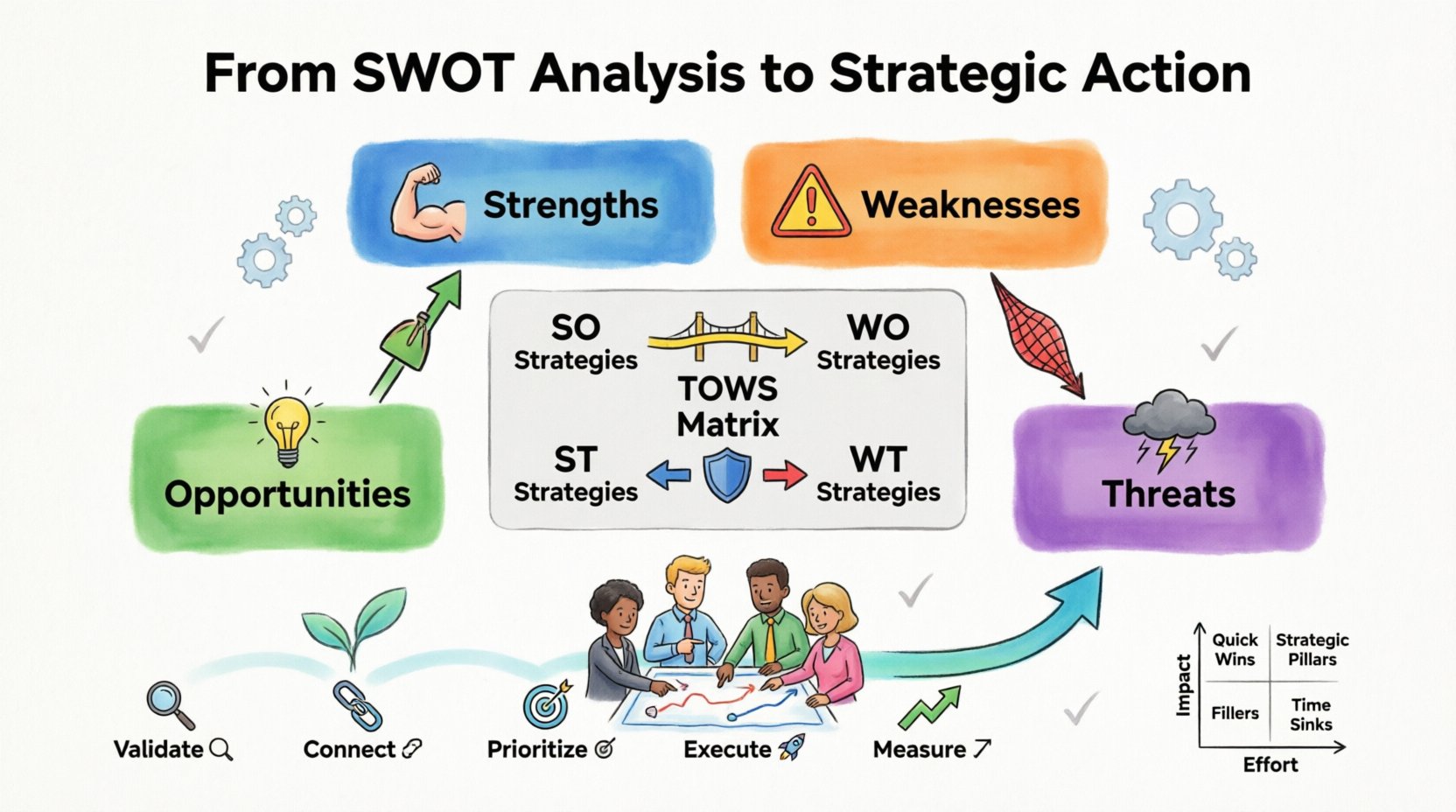
The real value emerges when you stop looking at the quadrants in isolation. You must create a matrix that forces you to answer specific questions about how internal factors interact with external factors. This is where strategic recommendations are born.
TOWS Matrix Strategy Types
The TOWS matrix expands on SWOT by actively combining elements to generate four distinct types of strategies. This structure ensures that every recommendation has a logical basis.
| Strategy Type | Focus | Goal |
|---|---|---|
| SO Strategies | Strengths + Opportunities | Maximize potential by leveraging internal assets to capture external growth. |
| WO Strategies | Weaknesses + Opportunities | Overcome internal barriers to take advantage of market openings. |
| ST Strategies | Strengths + Threats | Use internal capabilities to defend against external risks. |
| WT Strategies | Weaknesses + Threats | Minimize vulnerabilities to survive external challenges. |
Developing Specific Recommendations
Once the matrix is populated, the abstract concepts must be translated into concrete actions. Vague statements like “improve marketing” are insufficient. Recommendations must be specific, measurable, and tied to the analysis.
- Instead of: “Improve product quality.”
- Try: “Invest in quality assurance automation to reduce defect rates by 15% within six months.”
- Instead of: “Expand into new markets.”
- Try: “Launch a pilot program in the Southeast region using our existing logistics network to test demand.”
- Instead of: “Reduce costs.”
- Try: “Consolidate vendor contracts to negotiate a 10% reduction in supply chain expenses.”
Prioritization and Resource Allocation 🎯
A strategy document containing fifty recommendations is a list, not a plan. You cannot execute everything at once. Prioritization is the critical step that turns a list of ideas into a roadmap. You must evaluate each recommendation based on impact and feasibility.
The Impact vs. Effort Matrix
Visualizing recommendations on a two-axis chart helps teams decide where to focus resources. This prevents the organization from spreading itself too thin on low-value initiatives.
- High Impact, Low Effort: These are “quick wins.” Execute these immediately to build momentum and secure early victories.
- High Impact, High Effort: These are the core strategic pillars. They require significant investment and time but offer the highest return. Schedule these for the mid-to-long term.
- Low Impact, Low Effort: These are fillers. Complete them only when capacity allows, but do not rely on them for growth.
- Low Impact, High Effort: These are “time sinks.” Re-evaluate these regularly to ensure they are not consuming resources without delivering value.
Validating Recommendations Through Risk Assessment 🛡️
Even well-constructed strategies carry risk. A robust strategic plan includes a risk assessment phase. This involves asking: “What could go wrong with this specific recommendation?”
Risk Categories to Consider
- Financial Risk: Does the strategy require capital we do not have? What is the cash flow impact?
- Operational Risk: Do we have the staff to implement this? Will current workflows break?
- Market Risk: Is the market shift permanent or temporary? What if customer demand fades?
- Reputational Risk: Could this action alienate our current customer base or partners?
For each high-priority recommendation, define a mitigation plan. If the risk is too high, the recommendation may need to be adjusted or discarded. This step ensures that the strategy is resilient.
Structuring the Strategic Roadmap 🗺️
Once the recommendations are selected, validated, and prioritized, they must be presented in a format that stakeholders can understand and execute. A narrative approach works better than a spreadsheet.
Key Components of the Roadmap
- Executive Summary: A one-page overview of the top three strategic priorities and the rationale behind them.
- Contextual Analysis: Briefly recap the SWOT findings that led to these decisions. This links the action back to the data.
- Action Plans: Detailed steps for each initiative, including timelines, owners, and required resources.
- Success Metrics: Define KPIs for each recommendation. How will you know it worked?
- Review Cadence: Set a schedule for reviewing progress. Strategy is not static; it requires regular adjustment.
Common Pitfalls in Translation ⚠️
Even with a solid framework, organizations often stumble when moving from analysis to execution. Awareness of these common traps helps maintain focus.
- Analysis Paralysis: Spending too much time gathering data and not enough time making decisions. Set a deadline for the analysis phase.
- Ignoring the Weaknesses: Focusing only on strengths and opportunities while neglecting the threats and internal gaps. Balance is key.
- Lack of Buy-in: Developing the strategy in a vacuum without input from the teams who will execute it. Engage stakeholders early.
- Static Planning: Treating the document as a one-time event. Market conditions change, and the strategy must evolve.
Measuring Success and Iterating 📈
The final step is establishing a feedback loop. Once the recommendations are implemented, track the results against the defined metrics. This data feeds into the next cycle of strategic planning.
- Quarterly Reviews: Assess progress against the roadmap. Are we on track?
- Trigger Events: Define specific market events (e.g., a competitor launch) that trigger an immediate strategy review.
- Post-Mortem Analysis: After a project concludes, review what worked and what did not. Apply these lessons to future SWOT analyses.
By treating the SWOT analysis as a living component of your strategic planning process rather than a static document, you ensure that your organization remains agile and responsive. The transition from a list of factors to a set of compelling recommendations is the difference between surviving and thriving in a competitive landscape.
Final Thoughts on Strategic Execution 💡
Effective strategy is not about predicting the future with perfect accuracy. It is about preparing the organization to respond effectively to whatever comes. The SWOT analysis provides the foundation, but the recommendations provide the direction. When you connect internal strengths to external opportunities with rigorous prioritization and risk management, you create a plan that is both ambitious and achievable. This disciplined approach turns data into decisions and decisions into results.
Remember that the value of the SWOT lies in the conversation it sparks, not the document it produces. Use it to align teams, challenge assumptions, and drive the organization forward. With the right framework, the path from analysis to action becomes clear, ensuring that every strategic recommendation contributes to long-term resilience and growth.