

Strategic planning is the backbone of sustainable growth. To navigate complex markets and internal challenges, organizations need a structured method to assess their current position. The SWOT analysis serves this purpose, but a superficial list rarely yields actionable insights. Building a balanced SWOT framework from scratch ensures that every element is scrutinized, validated, and aligned with long-term goals. This guide provides a detailed roadmap for constructing a robust strategic tool without relying on pre-packaged templates or external hype.
Understanding the Core Components 🧩
A SWOT analysis divides assessment into four distinct quadrants. Each quadrant represents a specific dimension of the organization. To build a balanced framework, one must understand the nuance between these categories. Confusion often arises when internal factors are mistaken for external ones, or when strengths are confused with mere activities.
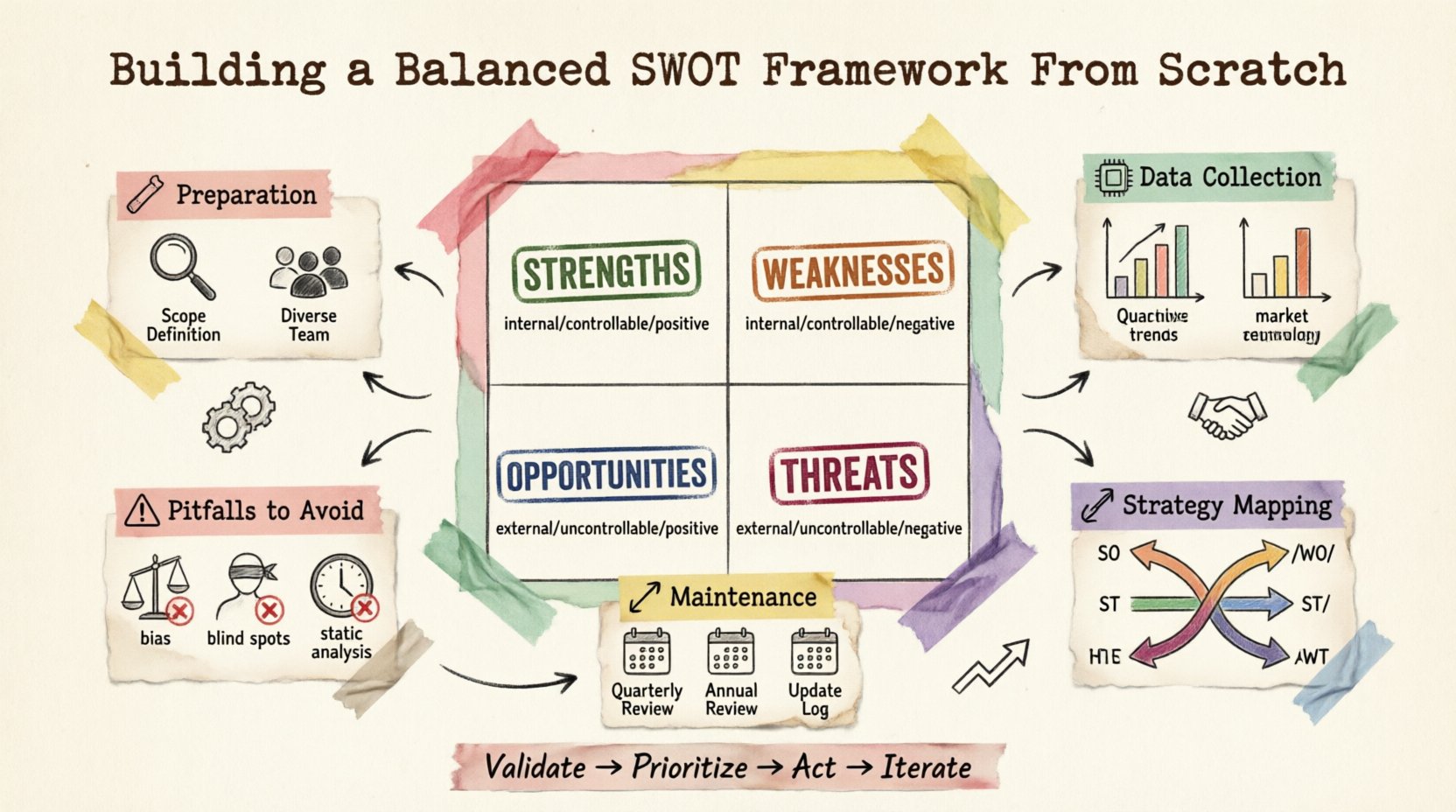
- Strengths: Internal attributes that give the organization an advantage. These are controllable and positive.
- Weaknesses: Internal attributes that place the organization at a disadvantage. These are controllable and negative.
- Opportunities: External factors that the organization could exploit to its advantage. These are uncontrollable and positive.
- Threats: External factors that could cause trouble for the business. These are uncontrollable and negative.
Internal Factors: Strengths and Weaknesses 🏢
Internal analysis requires a deep dive into resources, processes, and culture. It is not enough to list “we have good people.” A balanced framework demands specificity.
- Financial Resources: Cash flow, debt levels, and access to capital.
- Operational Efficiency: Supply chain management, production speed, and waste reduction.
- Human Capital: Skill sets, leadership quality, and employee retention rates.
- Intellectual Property: Patents, trademarks, and proprietary technology.
When identifying weaknesses, honesty is critical. Admitting a gap in expertise or a reliance on a single vendor is better than ignoring it. Ignoring internal liabilities creates blind spots that can derail strategic initiatives later.
External Factors: Opportunities and Threats 🌍
External analysis looks beyond the organization’s boundaries. It considers the market environment, regulatory landscape, and competitive dynamics.
- Market Trends: Shifts in consumer behavior or emerging demographics.
- Regulatory Changes: New laws, compliance requirements, or tax implications.
- Competitive Actions: New entrants, price wars, or product launches by rivals.
- Technological Shifts: Innovations that disrupt existing business models.
Opportunities are not just “good things.” They are specific openings that align with internal strengths. For example, a new regulation might be a threat to one firm but an opportunity for another that has the compliance infrastructure ready.
Preparation and Setup 🛠️
Before listing items, the groundwork must be laid. A framework built on assumptions is fragile. The preparation phase focuses on scope, team composition, and data availability.
Defining the Scope 📏
SWOT analysis can cover an entire corporation, a specific division, or a single product line. Defining the boundaries prevents scope creep. A project intended to analyze a new product launch should not get bogged down in corporate-wide financial restructuring unless directly relevant.
- Timeframe: Are you looking at the next quarter, year, or five years?
- Geography: Is this analysis global, regional, or local?
- Stakeholders: Who is affected by the outcomes of this analysis?
Assembling the Team 👥
Diverse perspectives prevent groupthink. Include members from different departments to ensure all angles are covered. A marketing representative sees opportunities differently than an engineer.
- Leadership: To provide strategic direction.
- Operations: To validate feasibility.
- Finance: To assess cost implications.
- Frontline Staff: To offer customer insights.
Data Collection and Validation 🔍
Raw data drives credibility. An analysis based on gut feelings lacks weight. Collecting evidence for each point strengthens the framework.
Qualitative vs. Quantitative Data 📊
A balanced approach uses both numbers and narratives. Quantitative data provides hard evidence, while qualitative data provides context.
| Data Type | Examples | Role in SWOT |
|---|---|---|
| Quantitative | Revenue growth, churn rate, market share % | Validates Strengths and Weaknesses |
| Qualitative | Customer sentiment, brand reputation, team morale | Contextualizes Opportunities and Threats |
| Market Research | Industry reports, competitor analysis | Identifies External Factors |
Validation Steps ✅
Once data is gathered, items must be vetted. Not every point belongs in the framework. Use the following criteria to filter entries:
- Relevance: Does this directly impact the defined scope?
- Accuracy: Is the data current and verified?
- Impact: How significant is this factor compared to others?
- Controllability: Can we influence this factor (internal) or must we adapt to it (external)?
Remove items that are too vague. “We need to improve marketing” is a goal, not a strength or weakness. “Our conversion rate is 20% below industry average” is a measurable weakness.
Execution and Strategy Mapping 🗺️
Listing factors is only the first step. The real value comes from connecting the dots. This phase transforms a static list into a dynamic strategy map.
Cross-Referencing Factors 🔗
Connect internal capabilities with external possibilities. This is often referred to as TOWS analysis, where you match Strengths with Opportunities, and Weaknesses with Threats.
- SO Strategies: Use strengths to take advantage of opportunities.
- WO Strategies: Overcome weaknesses by taking advantage of opportunities.
- ST Strategies: Use strengths to avoid threats.
- WT Strategies: Minimize weaknesses to avoid threats.
Prioritization Matrix 📌
Not all factors are created equal. Use a prioritization matrix to rank items based on urgency and impact. This helps focus resources on what matters most.
- High Impact, High Urgency: Address immediately.
- High Impact, Low Urgency: Plan for the long term.
- Low Impact, High Urgency: Delegate or automate.
- Low Impact, Low Urgency: Monitor but do not prioritize.
Avoiding Common Pitfalls ⚠️
Even with a solid process, bias can creep in. Recognizing these traps ensures the framework remains objective.
Internal Bias 🤦♂️
Teams often overestimate their strengths. This optimism bias can lead to unrealistic planning. Conversely, some teams focus too much on weaknesses, leading to paralysis. Balance is key. Acknowledge achievements without arrogance.
External Blind Spots 👀
It is easy to focus on known competitors and miss emerging disruptors. Look at adjacent industries. A threat might come from a sector you do not currently serve. Regularly review industry news and economic indicators to keep external factors fresh.
Static Analysis 🚫
A SWOT analysis is not a one-time event. Markets change, and so must the framework. Treating it as a static document leads to obsolescence. Schedule regular reviews to update the content.
Maintenance and Iteration 🔄
For the framework to remain useful, it must evolve. Embed the review process into the organizational calendar.
Review Cadence 📅
- Quarterly: Quick check on financial and market shifts.
- Annually: Comprehensive review and strategic reset.
- Event-Driven: Update immediately after major acquisitions, mergers, or regulatory changes.
Communication Strategy 📢
Keep the team informed. If the framework is updated, ensure all stakeholders understand the changes. Transparency builds trust and ensures alignment across departments.
- Summary Reports: Share high-level findings with leadership.
- Departmental Deep Dives: Share specific factors relevant to each team.
- Actionable Outcomes: Always link the analysis to specific tasks or projects.
Conclusion and Next Steps 🚀
Building a balanced SWOT framework from scratch requires discipline, data, and honest self-reflection. It is not about finding a perfect list, but about creating a living document that guides decision-making. By following these steps, organizations can ensure their strategic planning is grounded in reality rather than assumption.
Start by defining your scope. Gather your team. Collect your data. Validate your points. Map your strategies. Review your progress. This iterative process turns a simple matrix into a powerful engine for growth and resilience.
Remember, the goal is not just to analyze, but to act. Use the insights gained to allocate resources, mitigate risks, and seize opportunities. A well-constructed framework provides the clarity needed to navigate uncertainty with confidence.