
Moving from a Project Manager role to a Product Owner position within a Scrum framework represents a significant career pivot. This shift is not merely a change in title; it requires a fundamental transformation in how you view value, delivery, and stakeholder engagement. Many professionals enter this transition with a strong background in planning and execution, yet they often struggle to adapt to the empirical nature of product development. This guide provides a comprehensive roadmap for making this move with confidence and authority.
The journey involves unlearning traditional command-and-control habits and embracing servant leadership. You are shifting from ensuring a project is completed on time and within budget to ensuring a product delivers maximum value to users and the business. This document outlines the critical differences, essential skills, common pitfalls, and strategic actions needed to succeed in this new capacity.
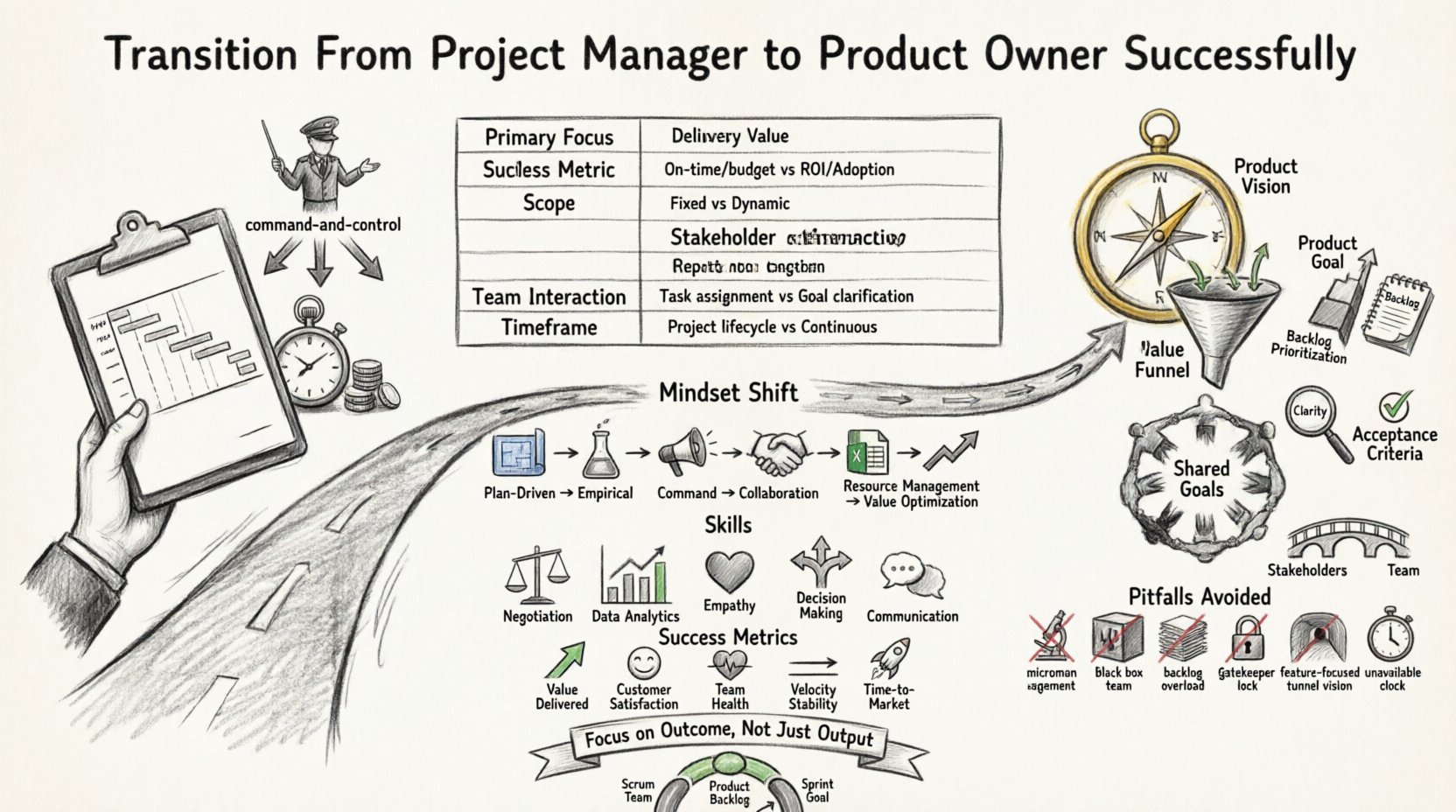
Understanding the Core Difference: PM vs. PO 🔄
Before diving into the mechanics of the new role, it is vital to understand the structural distinctions between Project Management and Product Ownership. While both roles support the delivery of work, their primary objectives and methods differ significantly.
In traditional project management, the focus is often on the constraints: time, cost, and scope. The goal is to deliver the defined scope within the allocated resources. In Scrum, the Product Owner manages the value. The scope is flexible, while the time and resources for a specific iteration are often fixed, allowing the team to negotiate what can be delivered to maximize value.
| Aspect | Project Manager | Product Owner |
|---|---|---|
| Primary Focus | Delivery of a specific project output | Maximizing value of the product |
| Success Metric | On time, on budget, to spec | Customer satisfaction, ROI, adoption |
| Scope | Fixed at the start | Dynamic, prioritized backlog |
| Stakeholder Interaction | Reporting status and risks | Collaborating on vision and requirements |
| Team Interaction | Assigning tasks and tracking progress | Removing impediments and clarifying goals |
| Timeframe | Project lifecycle (start to finish) | Continuous product lifecycle |
Recognizing these distinctions is the first step in your transition. If you continue to manage tasks like a Project Manager, you may inadvertently undermine the Self-Managing Team’s autonomy. The Product Owner does not assign tasks to Developers; they define what needs to be done, and the Developers decide how to do it.
The Mindset Shift: From Output to Outcome 🧠
The most difficult hurdle in this transition is the mental shift. Project Managers are often rewarded for efficiency and predictability. Product Owners are rewarded for effectiveness and learning.
1. Plan-Driven vs. Empirical
Project management often relies on predictive planning. You create a detailed schedule at the beginning and strive to stick to it. In Scrum, the Product Owner works within an empirical process. You make decisions based on observation and experimentation. You accept that you cannot know everything at the start. The backlog is a living document that evolves based on feedback and market changes.
2. Command vs. Collaboration
As a Project Manager, you might have been the person giving status updates and pushing for deadlines. As a Product Owner, you must collaborate with the Development Team. You cannot dictate how work is done. Instead, you clarify the what and the why, allowing the team to own the how.
3. Resource Management vs. Value Optimization
Project Managers often worry about resource utilization. Product Owners worry about the return on investment for every story. This means being willing to stop work on items that no longer provide value. It requires the courage to say no to stakeholders and even to your own team if a feature is not aligned with the current goals.
Key Responsibilities of the Product Owner 📋
The Product Owner is accountable for maximizing the value of the product resulting from the work of the Scrum Team. This accountability translates into several specific, actionable responsibilities.
- Developing and Communicating the Product Goal: You must articulate a clear vision. This is not just a slogan but a guiding principle that helps the team make decisions when priorities shift.
- Managing the Product Backlog: This is your primary artifact. It contains everything that might be needed in the product. You are responsible for its content, availability, and ordering.
- Ordering the Product Backlog: You must prioritize items to optimize value. This involves balancing business needs, technical debt, and user feedback. You must be decisive.
- Ensuring Backlog Clarity: Items in the backlog must be clear and understandable. You work with the team to ensure they are ready for development during Sprint Planning.
- Accepting or Rejecting Work: You validate the work completed by the Development Team against the definition of done and the acceptance criteria.
- Collaborating with Stakeholders: You act as the bridge between the business and the technical team. You gather feedback, manage expectations, and translate business needs into user stories.
It is important to note that the Product Owner does not manage the Developers. They do not conduct performance reviews or manage daily attendance. Their focus is strictly on the product and its value.
Essential Skills to Cultivate 🛠️
Transitioning successfully requires developing a new toolkit. You likely already possess strong organizational skills, but you will need to sharpen specific competencies.
1. Negotiation and Influence
You will constantly negotiate between stakeholders who have competing interests. You cannot simply say yes to everyone. You must use data and the product vision to justify your decisions. Influence replaces authority in this role.
2. Data-Driven Decision Making
Opinions are valuable, but data is better. You need to learn how to interpret metrics such as conversion rates, churn, and user engagement. This helps you prioritize backlog items based on actual evidence rather than the highest-paid person’s opinion.
3. Empathy and Customer Focus
You must deeply understand the user. This involves conducting user research, analyzing feedback, and staying close to the problems you are solving. If you lose touch with the user, the product loses direction.
4. Decision Making Under Uncertainty
In Scrum, you often make decisions with incomplete information. You must be comfortable with ambiguity. You make the best decision possible with the current context and adjust as you learn more.
5. Communication
Communication is the lifeblood of the Product Owner role. You must communicate clearly to the team, stakeholders, and executives. This includes writing clear acceptance criteria and explaining the value of features in business terms.
Common Pitfalls to Avoid 🚧
Many Project Managers struggle initially because they fall into old habits. Being aware of these pitfalls can help you navigate the transition more smoothly.
- Acting as a Project Manager: Do not assign tasks or track daily progress. This micro-management stifles the team’s self-organization.
- Ignoring the Team: Do not treat the Development Team as a black box. Engage with them during refinement sessions. They provide technical insight that affects your prioritization.
- Writing Too Many Stories at Once: Overloading the backlog creates noise. Focus on a manageable amount of work that is ready for the next sprint.
- Being a Gatekeeper: Do not block work by requiring your approval for every small detail. Define the what and let the team solve the how.
- Focus on Features, Not Value: A common mistake is prioritizing features based on a wish list rather than the value they deliver. Always ask why this feature matters.
- Lack of Availability: The Product Owner must be available to the team. If you are unavailable during the sprint, the team may stall. Ensure you dedicate time to the team.
Building a Strong Product Vision 👁️
One of the most significant gaps between Project Management and Product Ownership is the concept of the Product Vision. Projects have a defined end; products have a continuous life.
You must define where the product is going. This vision should be aspirational yet grounded in reality. It serves as a North Star for the team. When the team understands the vision, they can make better decisions when you are not present.
To build this vision:
- Understand the Market: Know your competitors and the landscape.
- Identify the Target Audience: Who are you building this for?
- Define the Problem: What pain are you solving?
- Articulate the Solution: What does success look like?
This vision should be revisited regularly. Markets change, and your understanding of the customer deepens. The vision evolves, but it should remain consistent enough to provide direction.
Stakeholder Management in Scrum 🤝
In traditional projects, stakeholders expect regular status reports. In Scrum, transparency is the primary mechanism. The team demonstrates working software at the end of every Sprint.
However, stakeholders still need to be engaged. You manage this relationship by:
- Regular Reviews: Invite stakeholders to Sprint Reviews. Let them see the product in action.
- Feedback Loops: Capture feedback immediately after reviews and reflect it in the backlog.
- Expectation Setting: Be honest about what can be delivered. Do not overpromise to keep stakeholders happy.
- Education: Many stakeholders do not understand Scrum. Educate them on how the process works and why flexibility is a feature, not a bug.
If a stakeholder tries to bypass you and talk directly to the Developers, you must gently redirect them back to the Product Owner. This protects the team from distraction and ensures a single voice of requirements.
Measuring Success 📊
How do you know if you are succeeding as a Product Owner? You cannot rely on the same metrics you used as a Project Manager.
- Value Delivered: Are the features being used? Are they solving the problem?
- Customer Satisfaction: Net Promoter Score (NPS) or user feedback surveys.
- Team Health: Is the team happy? Are they sustainable?
- Velocity Stability: While not a goal in itself, consistent velocity indicates predictable delivery.
- Time to Market: How quickly can you get value to the user?
Focus on outcomes. If you delivered a project on time but the product fails in the market, the value was not realized. If you delayed a feature but it significantly increased user retention, the delay was a strategic success.
Continuous Learning Path 📚
The transition from Project Manager to Product Owner is not a destination; it is a continuous journey. The Agile landscape evolves, and new tools and techniques emerge.
Commit to ongoing education. Read the Scrum Guide regularly. Engage with the community. Attend workshops. Learn about product management frameworks beyond Scrum, such as Lean Startup or Design Thinking. Understanding the broader context of product development will make you a more effective Product Owner.
Seek feedback from your team. Ask them what is working and what is not. Be open to adjusting your behavior based on their input. This humility is a sign of strength in the Product Owner role.
Final Thoughts on the Transition Journey ✨
Leaving the comfort of Project Management for the dynamic world of Product Ownership requires courage. You will face ambiguity and the weight of decision-making. However, the reward is the ability to shape products that truly matter to users.
By shifting your focus from output to outcome, embracing the Empirical Process, and committing to servant leadership, you can navigate this change successfully. Remember that you are not just managing work; you are stewarding a product. Your role is to ensure that every effort contributes to the long-term vision and immediate value.
Take it one sprint at a time. Refine your backlog. Listen to your team. Communicate clearly. With dedication and the right mindset, you will thrive in this new capacity. The path is challenging, but the impact you can have is profound.