
Time management during examinations is a critical skill that often separates high scores from mediocre ones. When facing a strategic planning question involving a SWOT analysis, the pressure to deliver a structured, insightful answer within a limited window can be intense. This guide provides a structured approach to handling SWOT exam questions efficiently. We focus on reducing cognitive load and streamlining the writing process without sacrificing depth or accuracy.
The goal here is not to rush blindly, but to work intelligently. By applying specific frameworks and prioritization strategies, you can allocate your mental energy where it matters most: the analysis itself, rather than the mechanics of answering.
📋 Understanding the Time Constraint
Examiners do not expect a five-page dissertation on every question. They look for clarity, relevance, and the ability to apply the SWOT framework correctly under pressure. A typical SWOT question asks you to evaluate a specific business scenario. You must identify internal factors (Strengths and Weaknesses) and external factors (Opportunities and Threats).
When the clock is ticking, the following principles apply:
- Read the prompt twice: Ensure you understand the specific business context before writing anything.
- Plan before writing: Spending two minutes outlining saves ten minutes of rewriting.
- Stick to the framework: Do not deviate into unrelated strategies unless asked.
- Keep it concise: Bullet points are often more effective than long paragraphs in exam settings.
🧩 Pre-Exam Preparation Strategies
Efficiency starts before the exam begins. Your preparation phase determines how quickly you can retrieve information during the test. Familiarity with the SWOT acronym is the baseline, but understanding the nuances of each quadrant is what saves time.
1. Master the Definitions Quickly
Do not waste mental cycles defining terms. Know these by heart:
- Strengths: Internal capabilities that give a competitive advantage.
- Weaknesses: Internal limitations that hinder performance.
- Opportunities: External market conditions to exploit.
- Threats: External market conditions that pose risks.
2. Practice with Timed Constraints
Simulate exam conditions during revision. Set a timer for 20 minutes and analyze a case study. This trains your brain to filter information rapidly. You learn to spot the “signal” (relevant data) from the “noise” (irrelevant details) much faster.
🔍 Decoding the Question Prompt
The first step in the exam room is reading the question carefully. Many students lose time because they misinterpret the scope of the question. If the question asks for a “brief overview,” writing a detailed history of the company is a wasted effort.
Key Indicators to Watch For
- Action Verbs: Look for words like “evaluate,” “analyze,” “discuss,” or “recommend.” These dictate the depth of your answer.
- Specific Context: Is the company a startup? A multinational? This changes the weight of “Threats” versus “Strengths.”
- Word Count Limits: If there is a limit, adhere to it strictly. Being over the limit often leads to lower marks for conciseness.
Underline key terms in the question. This creates a visual anchor that you can refer back to if you feel yourself drifting off-topic.
📝 The 4-Step SWOT Framework for Exams
Once you have read the question, move to the writing phase. Do not start writing sentences immediately. Use a quick drafting method to organize your thoughts.
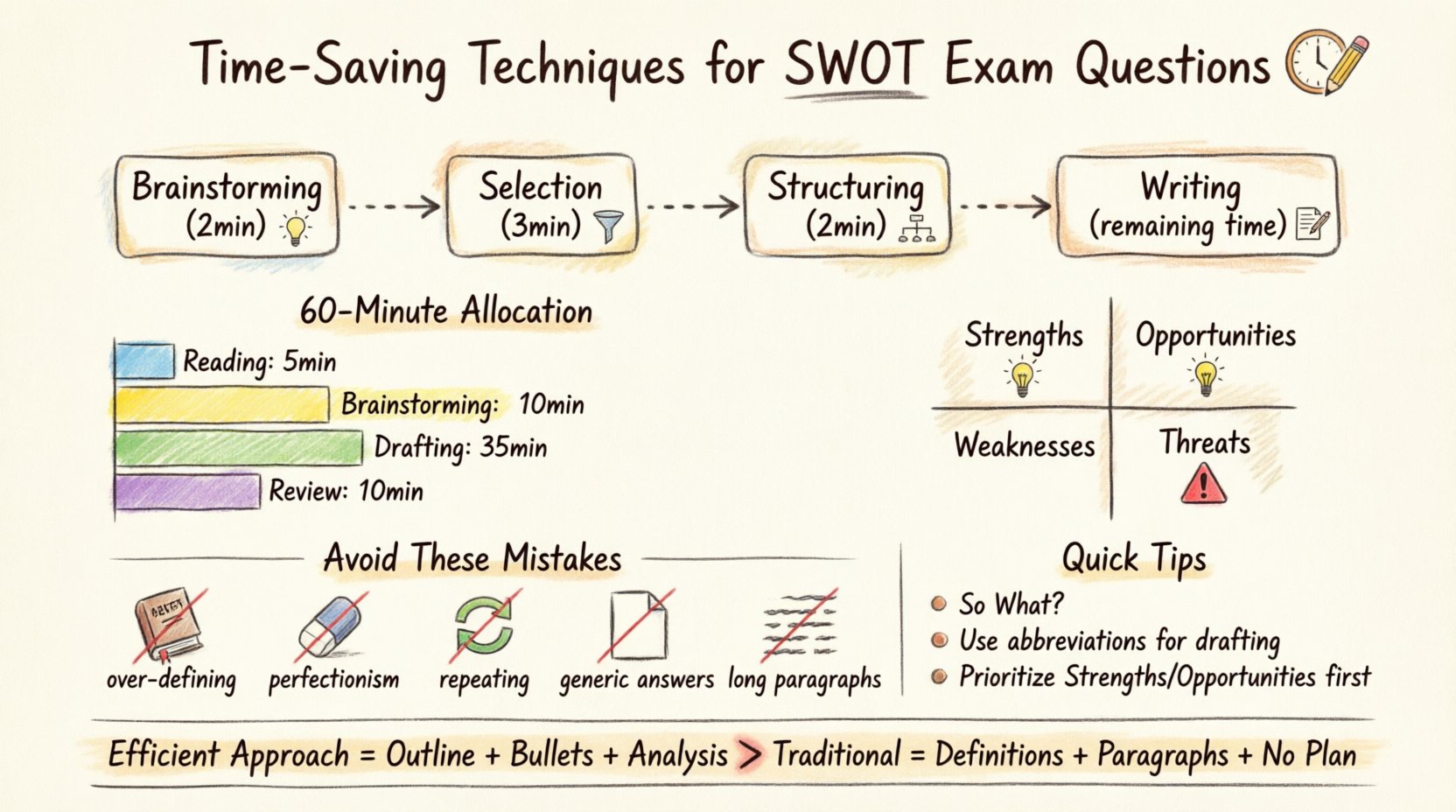
Step 1: Brainstorming (2 Minutes)
Draft a quick list of factors for each quadrant. Do not worry about grammar or sentence structure at this stage. Just get the ideas down on paper. This prevents the “blank page panic” that wastes valuable minutes.
Step 2: Selection (3 Minutes)
You cannot write about every single factor you brainstormed. Select the top three for each quadrant. Choose the ones that are most relevant to the specific question asked. This filtering process ensures your answer remains focused.
Step 3: Structuring (2 Minutes)
Arrange your selected points logically. Use headings for each quadrant. This helps the examiner follow your logic immediately, which can positively influence the grading process.
Step 4: Writing (Remaining Time)
Now, convert your bullet points into clear, concise statements. Use active voice. Keep sentences direct.
⏳ Time Allocation Breakdown
Visualizing how to spend your minutes is crucial. Below is a recommended distribution for a standard 60-minute exam section dedicated to a strategic analysis question.
| Phase | Action | Time Allocation |
|---|---|---|
| 1 | Reading & Understanding Prompt | 5 Minutes |
| 2 | Brainstorming & Filtering | 10 Minutes |
| 3 | Drafting the Answer | 35 Minutes |
| 4 | Review & Edit | 10 Minutes |
🚫 Common Mistakes That Waste Minutes
Even with a plan, specific habits can drain your time budget. Avoid these common pitfalls to maintain your pace.
- Over-Defining: Do not spend time defining SWOT in the introduction. The examiner knows what it is. Start directly with the analysis.
- Perfectionism: Do not try to find the “perfect” word. Clarity is better than vocabulary. If you get stuck on a word, move on.
- Repeating Yourself: Do not restate your points in the conclusion. It adds bulk without value.
- Ignoring the Case Study: Do not write generic SWOT points. Every point must relate to the specific company or scenario provided in the text.
- Writing in Paragraphs: Long blocks of text are hard to grade quickly. Use bullet points for the SWOT quadrants to improve readability and speed.
✍️ Writing Efficiently Under Pressure
When writing the actual response, your sentence structure plays a role in speed. Short, punchy sentences are easier to write and easier to read.
Use Template Phrases
Having a few go-to phrases can save you mental energy. Instead of constructing a complex sentence from scratch every time, use structures like:
- “The company possesses a strong advantage in…”
- “A significant challenge arises due to…”
- “Market trends suggest an opportunity to…”
- “Competitors pose a threat by…”
Focus on Impact
Instead of describing a feature, describe the impact of that feature. For example, rather than saying “The company has a large sales team,” say “The large sales team enables rapid market penetration.” This connects the factor to the business outcome, which examiners value.
🔎 Review Techniques for Speed
The final phase of the exam is review. Do not use this time to write new content. Use it to check for errors and ensure alignment with the question.
- Check the Quadrants: Did you put a Strength in the Weaknesses section? This is a common error that happens quickly.
- Verify Internal vs. External: Ensure external factors are truly external (market, regulations) and not internal (staff, culture).
- Proofread for Clarity: Check for run-on sentences. Short sentences are better than confusing long ones.
- Ensure Completeness: Did you answer all parts of the question? If there were two sub-questions, ensure both are addressed.
🧠 Advanced Tips for Speed
For those looking to refine their process further, consider these advanced techniques.
1. The “So What?” Test
For every point you write, ask yourself “So what?” If you cannot answer that question, the point is likely irrelevant. This keeps your answer tight and focused, reducing word count while maintaining quality.
2. Use Abbreviations for Drafting
During the brainstorming phase, use shorthand. “Rev” for revenue, “Reg” for regulations, “Cust” for customers. This speeds up the note-taking process. You can expand these when writing the final answer.
3. Prioritize by Weight
If you run out of time, ensure the “Strengths” and “Opportunities” are written first. These are the positive drivers of strategy. If you must cut, remove specific examples rather than the core analysis.
🛠️ Managing Cognitive Load
Exam stress increases cognitive load, making simple tasks feel harder. Managing this load is a time-saving technique in itself.
- Breathe: Take a deep breath before starting to write. It resets your focus.
- Ignore the Clock: Once you start, do not look at the clock every minute. It creates anxiety. Check the time only at the start of each phase.
- Stay in the Zone: Keep your focus on the prompt. Do not think about other questions you might get wrong.
📊 Comparing Approaches
Understanding the difference between a slow approach and a fast approach helps clarify the value of these techniques.
| Approach | Characteristics | Outcome |
|---|---|---|
| Traditional | Writes intro, defines terms, writes paragraphs, no outline. | Runs out of time, repetitive content. |
| Efficient | Outlines first, uses bullets, skips definitions, focuses on analysis. | Structured answer, complete response, clear grading. |
🌟 Final Thoughts on Efficiency
Success in SWOT exam questions relies on a balance of knowledge and speed. By preparing the framework beforehand, filtering your ideas quickly, and adhering to a strict time allocation, you can produce high-quality work without feeling rushed. The techniques outlined here are designed to reduce friction in your writing process.
Remember, the examiner is looking for evidence of strategic thinking. They want to see that you can identify key factors and understand their implications. When you remove the clutter of unnecessary definitions and long introductions, you leave more room for that strategic thinking.
Apply these methods in your practice sessions. Adjust the time allocations based on your personal speed. Over time, these steps will become automatic, allowing you to focus entirely on the content of your analysis.