
Enterprise Architecture (EA) is often misunderstood as a purely technical exercise involving complex diagrams and database schemas. In reality, it is a strategic discipline focused on aligning an organization’s business strategy with its information technology infrastructure. It serves as the blueprint for growth, ensuring that every investment supports long-term objectives. This guide explores the principles, practices, and realities of EA without the noise of marketing hype.
🧭 Understanding the Core Purpose
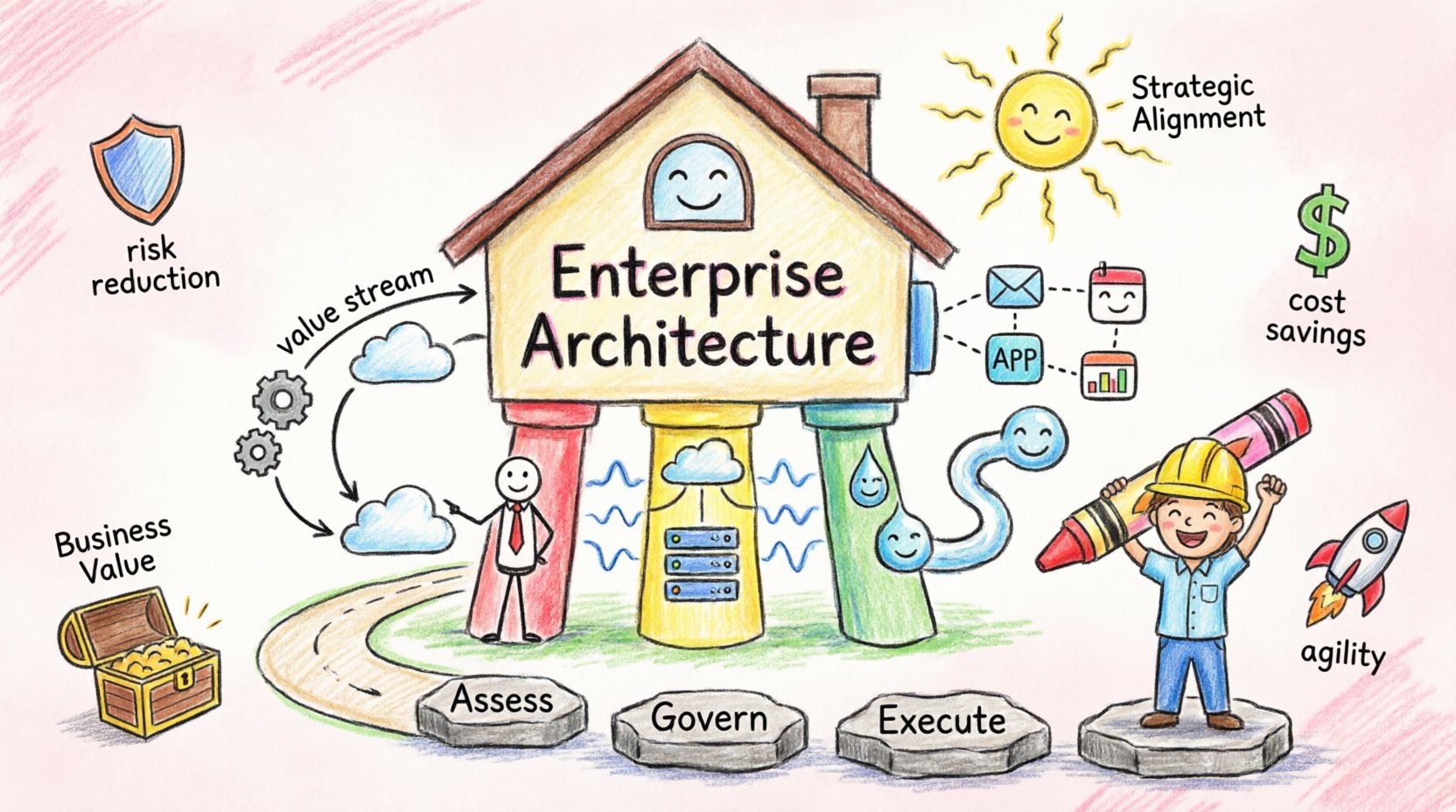
At its heart, Enterprise Architecture is about coherence. It connects the dots between what the business wants to achieve and how technology enables that vision. Without this connection, organizations often suffer from siloed systems, redundant processes, and inflated costs. The goal is to create a unified view of the organization’s capabilities.
Why Architecture Matters
- Strategic Alignment: Ensures IT projects directly support business goals.
- Agility: Allows the organization to adapt quickly to market changes.
- Risk Reduction: Identifies vulnerabilities in systems and processes before they cause failure.
- Cost Efficiency: Reduces duplication and technical debt.
- Standardization: Creates consistent processes and data definitions across departments.
🏗️ The Four Pillars of Enterprise Architecture
Most mature EA practices rely on a layered approach to model the organization. These layers provide structure and clarity when analyzing complex systems.
1. Business Architecture
This layer defines the strategy, governance, organization, and key business processes. It answers the question: “How does the organization create value?”
- Business capabilities (what the business does)
- Value streams (how value is delivered)
- Organizational structure and roles
- Stakeholder maps
2. Application Architecture
This describes the interaction between applications and how they support business capabilities. It focuses on the software landscape.
- System integration points
- Service orientation
- Application portfolio management
- Technology stack standards
3. Data Architecture
Data is the lifeblood of modern organizations. This layer defines how data is stored, managed, and utilized.
- Data models and schemas
- Data governance policies
- Information flow and security
- Master data management
4. Technology Architecture
This covers the infrastructure required to support the applications and data. It includes hardware, networks, and cloud services.
- Network topology
- Server and storage infrastructure
- Security protocols
- Disaster recovery planning
📊 Architecture Layers Overview
| Layer | Primary Focus | Key Deliverable |
|---|---|---|
| Business | Strategy & Operations | Capability Maps |
| Application | Software Systems | Integration Blueprints |
| Data | Information Assets | Data Flow Diagrams |
| Technology | Infrastructure | Network Topologies |
🔄 Frameworks and Methodologies
While there is no single “correct” way to practice EA, several frameworks provide structure and guidance. These are not software products but sets of best practices.
TOGAF (The Open Group Architecture Framework)
One of the most widely adopted approaches, TOGAF provides the Architecture Development Method (ADM). It is a cyclic process that guides architects through planning, designing, and implementing changes.
Zachman Framework
This framework offers a two-dimensional schema. One axis represents the “What, How, Where, Who, When, Why” questions, and the other represents the different perspectives of the enterprise (Planner, Owner, Designer, etc.).
ArchiMate
Often used in conjunction with other frameworks, ArchiMate provides a modeling language for describing, analyzing, and visualizing architecture artifacts.
🚀 Strategic Implementation Steps
Implementing an EA function requires careful planning and sustained effort. It is not a one-time project but an ongoing capability.
Phase 1: Assessment and Vision
- Define the scope of the architecture effort.
- Identify key stakeholders and sponsors.
- Conduct a current state analysis (“As-Is”).
- Establish the target state vision (“To-Be”).
Phase 2: Governance and Standards
- Create an Architecture Review Board (ARB).
- Define standards for technology and data.
- Establish approval workflows for new projects.
- Document decision-making processes.
Phase 3: Execution and Optimization
- Translate high-level plans into detailed roadmaps.
- Monitor progress against the strategic plan.
- Iterate based on feedback and changing market conditions.
- Maintain the architecture repository.
⚠️ Common Obstacles and Solutions
EA initiatives often face resistance or fail to deliver expected value. Understanding these pitfalls is crucial for success.
| Pitfall | Impact | Mitigation Strategy |
|---|---|---|
| Lack of Executive Support | Initiatives stall or lose funding. | Align EA goals with C-suite KPIs early. |
| Too Much Theory | Practitioners find it impractical. | Focus on actionable artifacts and real-world problems. |
| Resistance to Change | Departments ignore standards. | Involve stakeholders in the design process. |
| Outdated Documentation | Models do not reflect reality. | Automate repository updates where possible. |
| Isolation from Business | IT creates value irrelevant to the market. | Embed architects within business units. |
📈 Measuring Performance and Value
How do you know if Enterprise Architecture is working? You need metrics that reflect both efficiency and strategic impact. Avoid vanity metrics that look good on a dashboard but do not influence decisions.
Key Performance Indicators (KPIs)
- Reduction in Technical Debt: Track the ratio of legacy systems to modern applications.
- Project Delivery Speed: Measure the time from concept to deployment.
- System Integration Cost: Monitor the cost of connecting disparate systems.
- Compliance Rate: Percentage of projects adhering to architectural standards.
- Business Capability Coverage: Percentage of business capabilities supported by technology.
🌐 Looking Ahead: Future Trends
The landscape of Enterprise Architecture is evolving. New technologies and shifting business models require architects to adapt their thinking.
Cloud-Native Thinking
Moving beyond on-premise infrastructure requires a shift in how resources are allocated. Elasticity and service-based models are becoming the standard rather than the exception.
Data-Centric Design
With the rise of analytics and artificial intelligence, data is no longer a byproduct; it is a primary asset. Architecture must prioritize data quality, accessibility, and governance.
Continuous Architecture
Traditional waterfall architecture models are too slow for modern markets. The future lies in continuous adaptation, where architecture evolves alongside the business in real-time.
Security by Design
Security can no longer be an afterthought. It must be integrated into every layer of the architecture from the initial design phase to reduce vulnerability exposure.
🤝 The Human Element of Architecture
Technology is only half the equation. The people who build, manage, and use the systems are equally important. A successful EA practice must address the cultural aspect of the organization.
- Communication: Architects must translate technical constraints into business language.
- Collaboration: Break down silos between development, operations, and business units.
- Training: Invest in upskilling teams to understand architectural principles.
- Empathy: Understand the pain points of end-users and developers.
🛠️ Building the Right Repository
To maintain an effective EA practice, you need a central place to store models, documents, and decisions. This repository acts as the single source of truth.
Essential Features of a Repository
- Searchability: Easy to find specific components or standards.
- Version Control: Track changes over time to understand evolution.
- Access Control: Ensure sensitive data is protected while allowing collaboration.
- Visualization: Ability to render diagrams and views dynamically.
- Integration: Connect with project management and development tools.
🔗 Connecting Strategy to Execution
The gap between strategy and execution is where many organizations fail. Enterprise Architecture bridges this gap by ensuring that every initiative is traceable back to a strategic objective.
The Traceability Chain
- Strategic Objective: What does the business want to achieve?
- Business Capability: What ability is needed to achieve it?
- Application Service: Which software supports this capability?
- Technology Component: What infrastructure hosts the software?
By maintaining this chain, leaders can see exactly how a specific server or application contributes to the overall mission. This transparency allows for better resource allocation and decision-making.
📝 Final Thoughts on Architectural Discipline
Enterprise Architecture is a discipline of balance. It requires balancing innovation with stability, flexibility with control, and speed with quality. It is not about creating rigid constraints but about providing a structure that enables freedom within defined boundaries.
Success in this field comes from patience and persistence. It is a marathon, not a sprint. By focusing on alignment, value, and continuous improvement, organizations can build resilient architectures that withstand the test of time and change.
Remember, the goal is not perfection. The goal is progress. Every diagram created and every standard defined should serve a purpose: making the organization more effective and adaptable.