
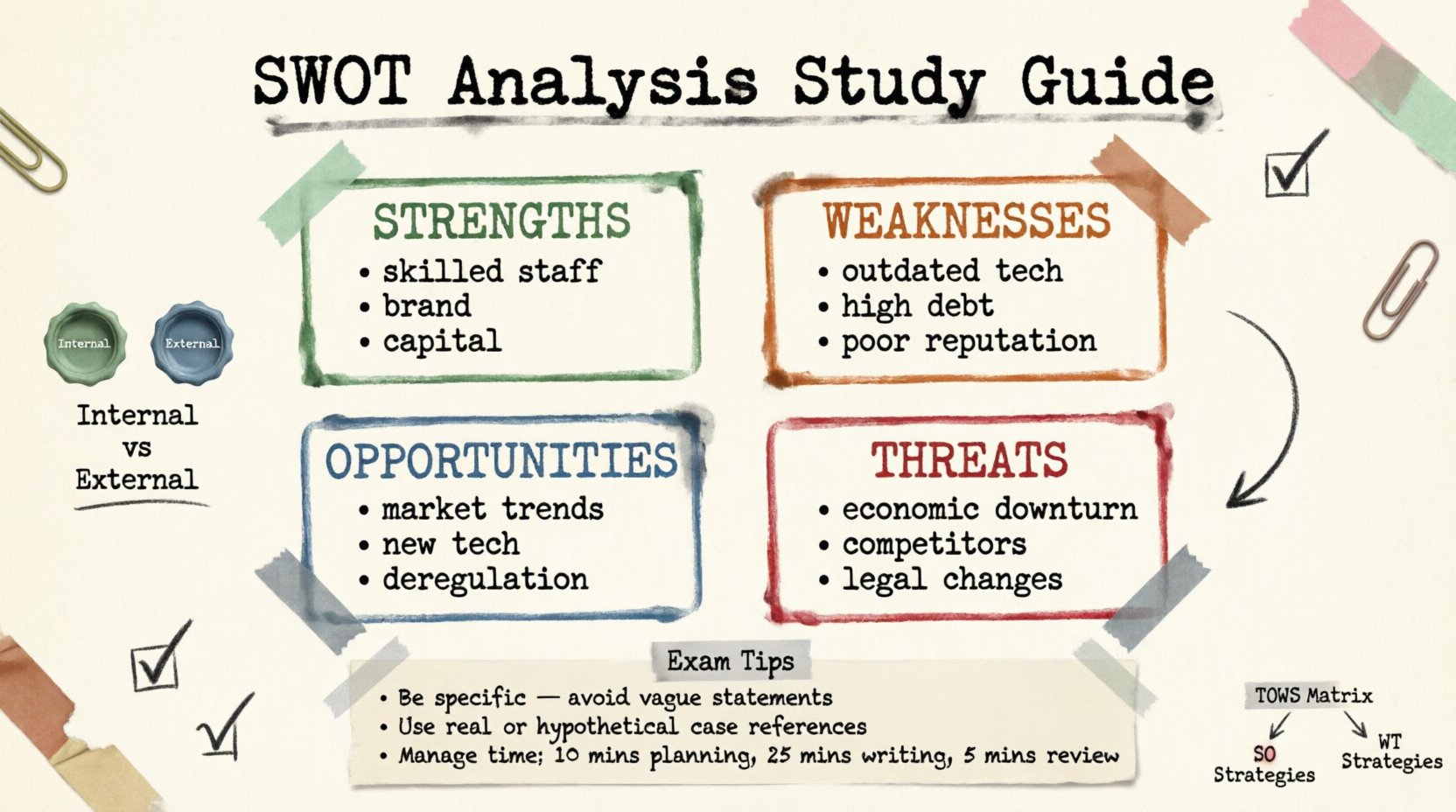
Preparing for business strategy examinations requires a solid grasp of foundational analytical frameworks. Among these, the SWOT analysis remains a cornerstone concept. Whether you are sitting for a strategic management course or a general business administration test, understanding how to construct and interpret this matrix is essential. This guide breaks down every component, providing the depth needed to answer complex scenario questions with precision.
Success in these exams does not come from memorization alone. It comes from understanding the relationship between internal capabilities and external market conditions. We will explore the four quadrants, distinguish between internal and external factors, and provide strategies for tackling case studies effectively. By the end of this study guide, you will have a clear mental model for approaching SWOT-related questions.
🔍 Understanding the SWOT Framework
SWOT stands for Strengths, Weaknesses, Opportunities, and Threats. It is a strategic planning technique used to evaluate these four elements of a project or business venture. In an exam context, you are often asked to apply this framework to a specific company or a hypothetical scenario. The goal is to identify factors that influence the organization’s ability to achieve its objectives.
The framework divides factors into two categories:
- Internal Factors: These are within the control of the organization. They include Strengths and Weaknesses.
- External Factors: These are outside the control of the organization. They include Opportunities and Threats.
Distinguishing between these categories is often where students lose marks. You must be precise about what a company can change versus what it must adapt to. For example, a company can change its pricing strategy (internal), but it cannot change government regulations (external).
🏋️ The Four Quadrants Explained
To score well, you need to know exactly what goes into each box. Examiners look for specific, relevant examples rather than generic statements.
1. Strengths (Internal & Positive)
Strengths are attributes that are helpful to achieving the objective. They are advantages the organization has over competitors. When listing strengths, think about resources that give the company a competitive edge.
- Human Resources: Highly skilled workforce, experienced management team, strong company culture.
- Physical Assets: Prime location, state-of-the-art machinery, proprietary technology.
- Financial: Strong cash flow, high credit rating, access to capital.
- Brand: High brand recognition, loyal customer base, strong reputation.
2. Weaknesses (Internal & Negative)
Weaknesses are attributes that place the organization at a disadvantage relative to others. These are areas where improvement is needed to remain competitive. Be honest in your analysis; examiners appreciate realistic assessments over overly optimistic ones.
- Operational: Outdated technology, poor supply chain management, high employee turnover.
- Financial: High debt levels, low profit margins, lack of investment funds.
- Reputational: Poor customer service record, negative media coverage, low brand awareness.
- Structural: Bureaucratic decision-making processes, lack of diversification.
3. Opportunities (External & Positive)
Opportunities are elements in the external environment that the company could exploit to its advantage. These often arise from changes in the market, technology, or regulations. Identifying opportunities shows forward-thinking.
- Market Trends: Growing demand for sustainable products, emerging markets in developing nations.
- Technology: New software to improve efficiency, e-commerce platforms to reach wider audiences.
- Regulatory: Tax incentives for green energy, deregulation of a specific sector.
- Competitor Actions: A competitor going bankrupt creates space for market share acquisition.
4. Threats (External & Negative)
Threats are elements in the external environment that could cause trouble for the business. These are risks that must be managed or mitigated. Ignoring threats is a common error in exam answers.
- Economic: Recession, inflation, fluctuating exchange rates.
- Competitive: New entrants, price wars, aggressive marketing by rivals.
- Technological: Disruptive innovations that make current products obsolete.
- Legal: New compliance requirements, changes in labor laws, stricter environmental standards.
📊 Internal vs. External Factors Table
Clarity on the distinction between internal and external factors is critical. The table below summarizes the classification for quick revision.
| Category | Control | Focus | Examples |
|---|---|---|---|
| Strengths | Internal (Controllable) | Advantages | Patents, Skilled Staff, Capital |
| Weaknesses | Internal (Controllable) | Disadvantages | High Costs, Poor Location, Debt |
| Opportunities | External (Uncontrollable) | Positive Externalities | New Markets, Tech Changes, Deregulation |
| Threats | External (Uncontrollable) | Negative Externalities | Economic Downturn, New Competitors, Laws |
📝 How to Write a SWOT for an Exam
When faced with a case study in an exam, you have a limited amount of time. You need a systematic approach to ensure you cover all bases without wasting words. Follow these steps to structure your answer effectively.
Step 1: Read the Case Study Thoroughly
Underline or note key data points. Look for financial figures, market share percentages, and statements about management goals. The data provided in the text is your evidence. Do not rely on outside knowledge unless the question explicitly allows it.
Step 2: Brainstorming Phase
Before writing the final answer, jot down ideas for each quadrant. Group them by category. If the case study mentions a new competitor, place it under Threats. If it mentions a new patent, place it under Strengths.
Step 3: Prioritize and Select
You cannot list every possible factor. Select the top three to five points for each quadrant that are most relevant to the specific question asked. Examiners prefer depth over breadth. One well-explained point is better than three vague ones.
Step 4: Link to Strategy
A SWOT analysis is not an end in itself; it is a tool for decision-making. If the question asks for recommendations, link your findings to actions. For example, if you identify a Weakness in outdated technology, recommend an investment in modernization to capitalize on an Opportunity.
🧠 Advanced Application: The TOWS Matrix
Some advanced business exams may ask you to go beyond the basic SWOT grid. This is often referred to as the TOWS Matrix. This tool takes the SWOT elements and creates strategic options by matching them.
- SO Strategies: Use Strengths to take advantage of Opportunities. (Maxi-Maxi)
- WO Strategies: Overcome Weaknesses by taking advantage of Opportunities. (Mini-Maxi)
- ST Strategies: Use Strengths to avoid Threats. (Maxi-Mini)
- WT Strategies: Minimize Weaknesses and avoid Threats. (Mini-Mini)
Understanding this connection demonstrates a higher level of strategic thinking. It shows you can not only identify factors but also formulate responses to them.
🚫 Common Pitfalls to Avoid in Exams
Even knowledgeable students can lose marks due to common errors. Be aware of these traps to protect your score.
- Confusing Internal and External: This is the most frequent mistake. Remember, if the company cannot change it directly, it is external. For example, a competitor lowering prices is a Threat (external), not a Weakness.
- Being Vague: Avoid generic statements like “good management.” Be specific. Write “management team with 20 years of industry experience.” Specificity proves you read the case study.
- Listing Symptoms, Not Causes: If a company has low profits, listing “low profits” as a weakness is a symptom. The weakness might be “high production costs.” Find the root cause.
- Ignoring the Context: A factor might be a strength in one industry but a weakness in another. Ensure your analysis fits the specific business sector mentioned in the question.
- Forgetting to Link Recommendations: If asked to recommend a strategy, do not just list the SWOT. Explain how the SWOT informs the strategy.
💡 Tips for Scoring High Marks
Examiners look for structure, logic, and application. Use the following techniques to maximize your performance.
- Use Bullet Points: Do not write long paragraphs for each quadrant. Bullet points make your answer easy to scan and mark. It shows organization.
- Label Your Sections: Clearly write “Strengths,” “Weaknesses,” etc., so the marker knows exactly where to look.
- Reference the Case: Always tie your points back to the text. Use phrases like “As stated in the case…” or “According to the financial data…”.
- Manage Your Time: Allocate time proportional to the marks available. If SWOT is worth 10 marks, spend roughly 10 to 15 minutes on it, depending on the total exam duration.
- Review for Consistency: Ensure your strengths and weaknesses do not contradict each other. Ensure your threats are indeed external threats.
📚 Sample Exam Scenario
Consider a traditional retail chain facing competition from online retailers. How would you approach this?
- Strength: Physical stores allow for immediate product pickup and personal customer service.
- Weakness: High overhead costs associated with maintaining physical locations and staff.
- Opportunity: Implement an omnichannel strategy to integrate online ordering with in-store collection.
- Threat: Rapidly growing e-commerce competitors with lower price points and delivery speed.
Notice how the analysis connects the physical nature of the business to the specific market pressure. This level of detail earns higher marks than generic statements.
🔎 Frequently Asked Questions
Is SWOT Analysis always quantitative?
No. SWOT is primarily qualitative. It deals with attributes and perceptions. However, you can support your qualitative points with quantitative data from the case study, such as market share percentages or growth rates.
Can a Strength become a Weakness?
Yes. This is known as a core rigidity. For example, a company known for its low-cost structure might find its rigid cost-cutting measures prevent it from investing in innovation when the market shifts. In an exam, acknowledge this nuance if the scenario suggests it.
How many points should I list for each quadrant?
There is no strict rule, but typically 3 to 5 strong points per quadrant is sufficient. Quality is more important than quantity. Ensure each point is distinct and not a repetition of another.
Does SWOT analysis guarantee success?
No framework guarantees success. SWOT is a diagnostic tool. It helps identify where the organization stands so that strategies can be built on reality rather than assumptions. In your exam answer, maintain this balanced perspective.
🏁 Final Thoughts
Mastery of the SWOT analysis framework is a vital skill for any business student. It provides a structured way to think about strategy, risk, and potential. By understanding the difference between internal and external factors, avoiding common pitfalls, and applying the framework rigorously to case studies, you can demonstrate a high level of competency in your exams.
Focus on clarity, precision, and relevance. Use the structure provided in this guide to organize your thoughts during the test. Remember that the goal is not just to list factors, but to understand how they interact to shape the future of the business. Good luck with your studies and your examinations.