Collaborative work environments present unique challenges that differ significantly from individual tasks. When multiple voices contribute to a single output, the risk of misalignment, duplicated effort, and unclear direction increases. To navigate these complexities, teams require more than just a deadline and a shared drive. They need a structured method to evaluate their position before acting. Strategic assessment techniques provide this necessary framework, allowing groups to move from intuition to evidence-based decision-making. Among these techniques, the SWOT analysis remains a cornerstone for understanding internal capabilities and external pressures.
Why Strategic Assessment Matters for Teams 🧠
Without a formal assessment, group projects often rely on the loudest voice or the most available resource. This leads to reactive planning rather than proactive strategy. A structured assessment forces the group to pause and examine the reality of their situation. It creates a shared vocabulary for discussing risks and opportunities. This shared understanding is critical when team members have different backgrounds or expertise levels.
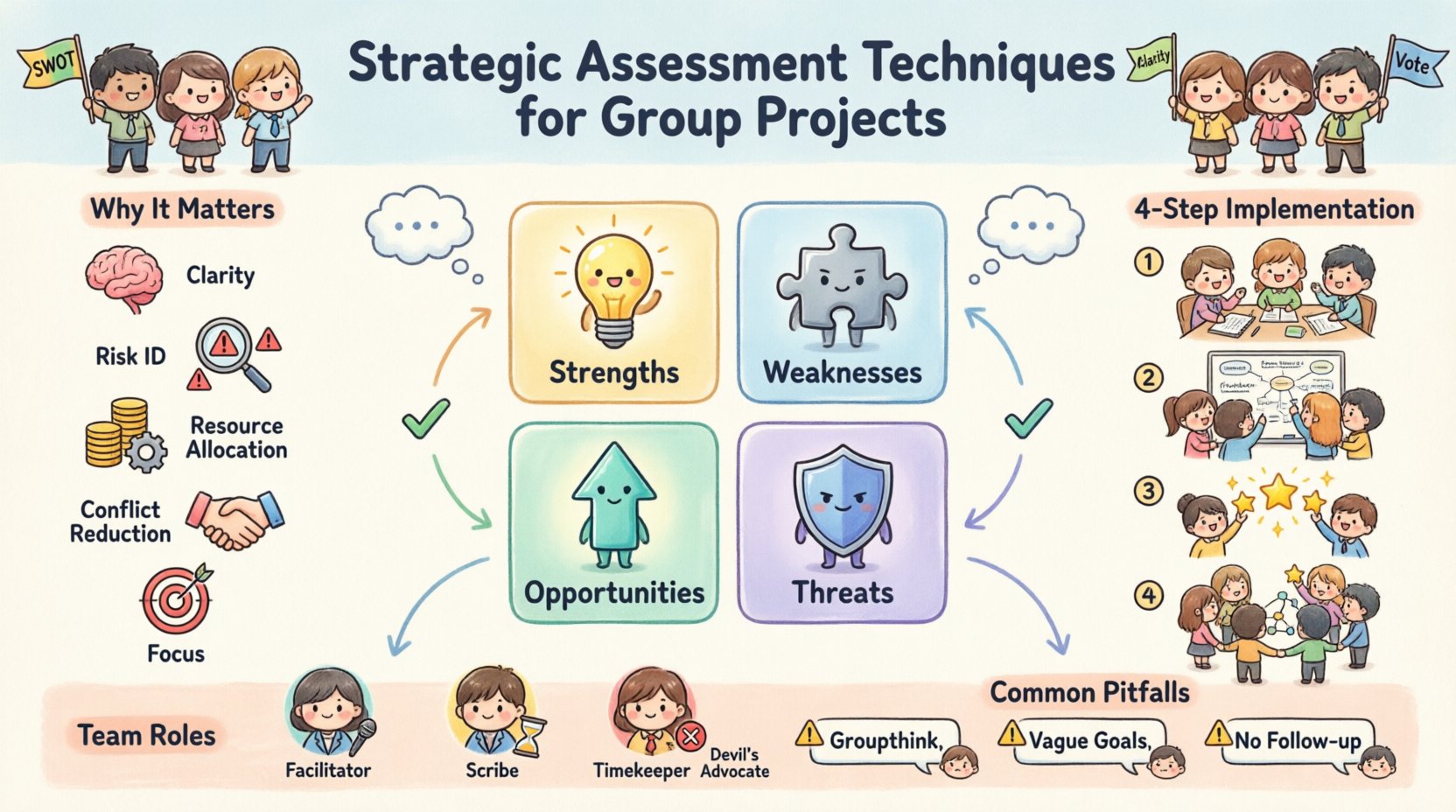
Implementing strategic assessment offers several tangible benefits:
- Clarity of Purpose: It defines what the team can actually achieve versus what they hope to achieve.
- Risk Identification: It highlights potential obstacles before they become crises.
- Resource Allocation: It ensures time and energy are spent on high-value activities.
- Conflict Reduction: It provides an objective basis for decisions, reducing personal friction.
- Focus: It helps the group ignore distractions that do not align with core objectives.
Understanding the SWOT Framework 🔍
The SWOT analysis is a foundational tool for strategic assessment. It categorizes factors into four distinct quadrants. Two of these quadrants focus on internal factors, which the team can control. The other two focus on external factors, which the team must adapt to. Understanding the distinction between these categories is the first step in using the framework effectively.
Internal Factors
Internal factors are within the group’s direct influence. They relate to the team’s current state. Assessing these honestly requires vulnerability and self-awareness.
- Strengths: What does the team do better than others? What resources are already available? This includes skills, knowledge, and access to data.
- Weaknesses: Where are the gaps in capability? What resources are missing? This includes lack of experience, time constraints, or budget limitations.
External Factors
External factors exist outside the group’s control. They represent the environment in which the project operates. Ignoring these often leads to failure, regardless of internal competence.
- Opportunities: What trends or changes can the team leverage? Are there new markets, technologies, or partnerships available?
- Threats: What external forces could hinder progress? This includes competitors, regulatory changes, or economic shifts.
Visualizing the Assessment Structure 📋
To ensure clarity during the planning phase, teams often map these factors onto a visual grid. This structure prevents the mixing of internal and external issues. The following table outlines how to categorize specific project elements.
| Category | Focus Area | Key Question | Example |
|---|---|---|---|
| Strengths | Internal | What advantages do we possess? | Team has prior experience in this subject. |
| Weaknesses | Internal | What holds us back? | One member has limited technical knowledge. |
| Opportunities | External | What can we take advantage of? | New grant funding available for this sector. |
| Threats | External | What are the risks? | Competing project launching next month. |
Step-by-Step Implementation Guide 🛠️
Conducting a SWOT analysis for a group project is a process that requires facilitation. It is not a task to be done in isolation. The goal is to reach a consensus on the assessment. This section outlines the workflow for executing the assessment without relying on specific digital tools.
1. Preparation and Setup
Begin by defining the scope. What specific project or phase is being assessed? A vague scope leads to vague data. Gather the team in a physical space or a secure virtual environment. Ensure everyone has the same context. Distribute any relevant background documents beforehand so participants arrive informed.
2. Brainstorming Sessions
Assign a dedicated time block for each quadrant. Do not mix them. Start with Strengths. This builds confidence. Then move to Weaknesses, which can be uncomfortable. Ensure the environment remains non-judgmental. Next, address Opportunities. Finally, discuss Threats. This ordering helps manage the emotional flow of the group.
- Use physical whiteboards or large sheets of paper.
- Assign a scribe to record all points.
- Encourage anonymous input if the group is hesitant.
- Limit each session to 15 minutes to maintain focus.
3. Analysis and Prioritization
Once the list is populated, it is rarely complete. Some items may be duplicates. Merge similar points. Then, prioritize. Not every strength is equally valuable, and not every threat is equally dangerous. Ask the group to vote on the top three items in each category. This forces the team to agree on what matters most.
4. Developing Actionable Strategies
The assessment is useless without action. Convert the findings into strategies. This is often called “cross-mapping.” For example, use a Strength to take advantage of an Opportunity. Use a Strength to mitigate a Threat. Acknowledge a Weakness that must be addressed to seize an Opportunity.
- Maximize: Leverage strengths to pursue opportunities.
- Improve: Address weaknesses to prevent threats from materializing.
- Monitor: Keep track of external threats that are currently low risk.
- Capitalize: Use weaknesses to identify areas for training or outsourcing.
Managing Team Dynamics During Assessment 🤝
The process of strategic assessment reveals interpersonal dynamics. Some members may dominate the conversation. Others may remain silent. A structured approach helps balance these voices. The role of the facilitator is critical in this phase. They must ensure that internal biases do not skew the results.
Consider assigning specific roles to team members during the assessment phase:
| Role | Responsibility | Key Trait |
|---|---|---|
| Facilitator | Keeps the discussion on track and manages time. | Neutrality |
| Scribe | Records all points accurately and legibly. | Detail-oriented |
| Timekeeper | Ensures each quadrant gets equal attention. | Assertiveness |
| Devil’s Advocate | Challenges assumptions and identifies blind spots. | Critical Thinking |
Common Pitfalls and How to Avoid Them ⚠️
Even experienced groups struggle with strategic assessment. Common errors can render the entire exercise ineffective. Recognizing these patterns early allows the team to course-correct.
- Being Too Vague: Statements like “We need more time” are not specific. Instead, write “Project timeline is tight due to holiday schedule.” Specificity drives action.
- Confusing Internal and External: A common mistake is listing “competitors” as a weakness. Competitors are external. Weaknesses are internal. Keep the quadrants distinct.
- Ignoring Weaknesses: Teams often gloss over weaknesses to feel good. This is dangerous. Acknowledging a weakness is the first step to fixing it.
- One-Time Exercise: Strategic assessment is not a one-off event. Conditions change. Revisit the assessment at major milestones in the project lifecycle.
- Paralysis by Analysis: Spending too much time on the assessment can delay execution. Set a time limit and move to the planning phase once the data is sufficient.
Extending the Assessment Beyond SWOT 📈
While SWOT is powerful, it is not the only tool available. Depending on the complexity of the group project, additional techniques can complement the assessment. These methods provide deeper insight into specific areas.
PESTLE Analysis
For projects involving policy, economics, or large-scale environments, a PESTLE analysis adds depth. It examines Political, Economic, Social, Technological, Legal, and Environmental factors. This is particularly useful when the “Threats” section of the SWOT feels too broad.
Risk Matrix
Once threats are identified, they need to be quantified. A risk matrix plots the probability of an event against its impact. This helps the team decide which risks require immediate mitigation plans and which can be accepted. It moves the team from qualitative discussion to quantitative planning.
Root Cause Analysis
If a Weakness is identified, it is often a symptom of a deeper issue. The “Five Whys” technique helps drill down to the root cause. By asking “why” five times, the team can find the fundamental reason behind a capability gap.
Final Thoughts on Execution ✅
Strategic assessment is the bridge between intention and result. For group projects, it serves as the glue that holds diverse perspectives together. When a team invests time in understanding their position, they reduce the likelihood of unexpected failures. The process requires discipline, honesty, and a willingness to adapt.
Remember that the goal is not perfection. It is clarity. A clear map is better than a perfect map. As the project progresses, the team should refer back to their assessment to ensure they are still on the right path. This continuous feedback loop ensures that the strategy remains relevant. By adhering to these techniques, groups can transform chaotic collaboration into coordinated execution.
Success in group work is rarely accidental. It is the result of deliberate planning and honest evaluation. Utilizing these assessment frameworks provides the structure needed to turn collective effort into tangible outcomes.