
Strategic planning is often portrayed as a forward-looking exercise, a celebration of potential and a roadmap to success. However, the most critical part of any strategic framework often goes unaddressed because it feels uncomfortable. That part is the honest assessment of internal weaknesses. When organizations conduct a SWOT analysis, the focus frequently drifts toward Strengths and Opportunities, leaving Weaknesses as an afterthought. This bias leads to fragile strategies that crumble under pressure.
To build resilience, leaders must confront the uncomfortable truth: identifying what is broken is the first step toward fixing it. This guide explores how to recognize weaknesses without bias, ensuring your strategic plan is built on reality rather than optimism.
🧠 The Psychology of Blind Spots
Why do we hide our weaknesses? It is rarely out of malice. It is often a psychological defense mechanism. In a business context, admitting a weakness can feel like admitting failure. This creates a cultural barrier where information is filtered before it reaches the decision-making table.
Several cognitive biases interfere with objective analysis:
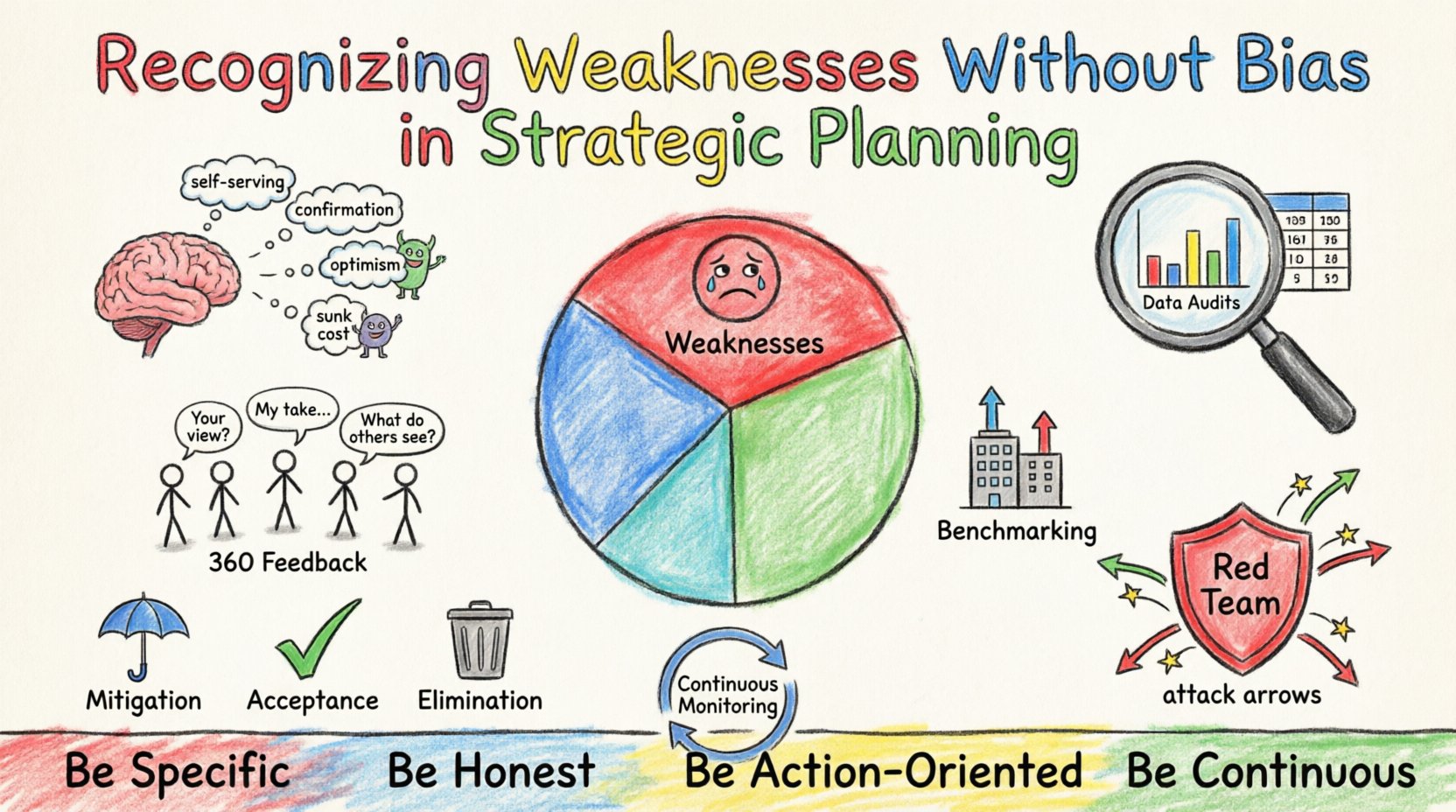
- Self-Serving Bias: The tendency to attribute success to internal factors and failures to external factors. Teams claim credit for wins but blame market conditions for losses.
- Confirmation Bias: We seek information that supports our existing beliefs. If a leader believes the product is superior, they will ignore data points suggesting customer dissatisfaction.
- Optimism Bias: The belief that we are less likely to experience negative events than others. This leads to underestimating risks and overestimating capacity.
- Sunk Cost Fallacy: Continuing a project because of past investment, even when the current reality suggests it is a weakness or liability.
Recognizing these mental traps is the first step toward neutralizing them. Without this awareness, any strategic document is merely a collection of wishes.
📉 Defining Weaknesses in a SWOT Context
In a SWOT framework, a Weakness is defined as an internal attribute that hinders performance. It is controllable, unlike a Threat, which is external.
Common examples of internal weaknesses include:
- Lack of skilled personnel in critical departments
- Outdated technology infrastructure
- Inefficient workflow processes
- High employee turnover rates
- Limited access to capital
- Poor brand reputation in specific markets
The distinction is crucial. You cannot plan for a competitor’s action (Threat), but you can plan to fix a skill gap (Weakness). Confusing the two leads to misallocated resources.
🛠 Methodologies for Objective Assessment
To move from subjective opinion to objective fact, you need structured methodologies. Relying on a single meeting where leadership speaks for an hour is insufficient. You need data, external perspectives, and rigorous questioning.
1. Data-Driven Audits
Numbers do not have feelings. They do not lie. Financial reports, customer satisfaction scores, and operational metrics provide a baseline. If a department’s efficiency has dropped by 15% year-over-year, that is a weakness, regardless of how confident the manager feels.
Focus on these metrics:
- Customer churn rates
- Project completion timelines vs. estimates
- Cost per acquisition trends
- System downtime frequency
- Employee engagement survey results
2. The 360-Degree Feedback Loop
Leadership often operates in an echo chamber. To break this, gather feedback from every level of the organization. Engage with frontline staff, clients, and partners. They see the friction points that management does not.
Ask specific questions:
- Where do you waste the most time?
- What tools do you wish you had?
- Which internal processes slow you down?
- What keeps you from achieving your goals?
3. External Benchmarking
Comparison creates clarity. How do your processes compare to industry standards? If competitors are shipping products in 24 hours and you take 5 days, that is a weakness. It is not a competitive advantage waiting to happen; it is a structural deficit.
📊 Common Biases and Mitigation Strategies
The following table outlines specific biases that appear during planning and how to counteract them without relying on software tools.
| Bias Type | Symptom in Planning | Mitigation Strategy |
|---|---|---|
| Confirmation Bias | Ignoring negative feedback | Assign a “Devil’s Advocate” to challenge every premise |
| Halo Effect | Assuming strength in one area equals strength in all | Audit each department independently |
| Survivorship Bias | Focusing only on successful cases | Analyze failed projects to find root causes |
| Groupthink | Everyone agrees too quickly | Conduct anonymous voting or surveys before discussion |
| Overconfidence | Underestimating time and cost | Use historical data to set realistic baselines |
🚩 The Red Teaming Approach
One of the most effective ways to identify weaknesses is to simulate failure. This is known as Red Teaming. In this exercise, a specific group is tasked with attacking the strategy. Their goal is to find the holes.
This approach changes the dynamic. Instead of defending the plan, the team defends the weaknesses. This psychological shift allows for honest critique without personal repercussions.
Steps for a Red Team Exercise:
- Assemble a Diverse Group: Include people who are not part of the core strategy team. They bring fresh perspectives.
- Define the Rules: Make it clear that attacking the idea is not attacking the person. The goal is to break the plan to save the outcome.
- Simulate Scenarios: Create worst-case scenarios. What if a key supplier fails? What if a major client leaves?
- Document Findings: Record every vulnerability identified. These become your list of weaknesses.
- Review and Integrate: Bring the findings back to the main team to adjust the strategy.
💡 Turning Weaknesses into Actionable Plans
Identifying a weakness is useless if it sits on a list. You must categorize how to handle each weakness. There are three primary strategies:
- Mitigation: Reduce the impact of the weakness. If you have a small cash reserve, create a cost-saving plan to preserve it.
- Acceptance: Acknowledge the weakness and plan around it. If you are in a remote area with poor internet, do not build a strategy that requires constant high-bandwidth connectivity.
- Elimination: Fix the root cause. If the weakness is outdated software, budget for an upgrade.
For each weakness identified, assign a metric. How will you measure improvement? Without a metric, you cannot know if you have fixed it.
🔄 Continuous Monitoring and Adjustment
A SWOT analysis is not a one-time event. Weaknesses change over time. A strength today might become a weakness tomorrow if the market shifts. For example, a large physical footprint was a strength in the 90s; today, it may be a liability due to high overhead.
Establish a quarterly review process. Ask:
- Has this weakness grown or shrunk?
- Has a new weakness emerged?
- Are our current mitigation strategies working?
This keeps the organization agile. It prevents the stagnation that comes from assuming a plan is set in stone.
⚠️ Common Pitfalls to Avoid
Even with the best intentions, teams often stumble. Here are common mistakes to watch out for:
- Confusing Symptoms with Causes: Low morale is a symptom. Poor leadership is the cause. Fixing morale without fixing leadership is temporary.
- Being Too Vague: “Poor communication” is not a weakness. “Lack of documented meeting minutes leading to missed deadlines” is a weakness.
- Overloading the List: If every item is a weakness, nothing is. Focus on the critical few that will derail the strategy if ignored.
- Lack of Ownership: Every weakness must have an owner. If everyone owns it, no one owns it.
🌟 Summary of Best Practices
Building a strategy without bias requires discipline. It requires the courage to look at the organization’s reflection without turning away. By using data, external feedback, and structured challenge methods, you can strip away the optimism that clouds judgment.
Remember the following principles:
- Be Specific: Vague weaknesses cannot be fixed.
- Be Honest: Do not hide data that contradicts your vision.
- Be Action-Oriented: Every weakness needs a plan.
- Be Continuous: Revisit the analysis regularly.
When you face your weaknesses directly, you build a strategy that can withstand reality. This is the foundation of sustainable growth.