
Enterprise Architecture (EA) is often viewed as a complex discipline reserved for large corporations with vast IT budgets. In reality, it is a strategic planning practice that aligns business goals with technology capabilities. Whether you are leading a startup or managing a legacy system in a multinational firm, understanding the core principles of EA provides clarity amidst complexity. This guide breaks down the essentials into actionable concepts, focusing on structure, strategy, and execution without the fluff.
Understanding the Core Concept 🧩
Enterprise Architecture is the practice of analyzing, designing, planning, and implementing enterprise analysis to successfully execute on business strategies. It serves as the blueprint for the organization. Just as a city planner designs roads and zoning before construction begins, an EA practitioner designs the flow of information, the structure of applications, and the infrastructure required to support the business.
The primary objective is not to create documentation for documentation’s sake. Instead, it is to enable agility. When the business model shifts, the architecture must adapt. Without this alignment, organizations often face:
- Redundant systems: Multiple tools performing the same function across departments.
- Data silos: Information trapped in one area, inaccessible to others.
- High costs: Maintenance of legacy systems that no longer add value.
- Security risks: Inconsistent standards across the technology landscape.
By establishing a clear architectural view, leaders can make informed decisions about where to invest resources. This process requires a balance between stability and innovation. You cannot move fast if your foundation is unstable, but you cannot stay stable if you refuse to evolve.
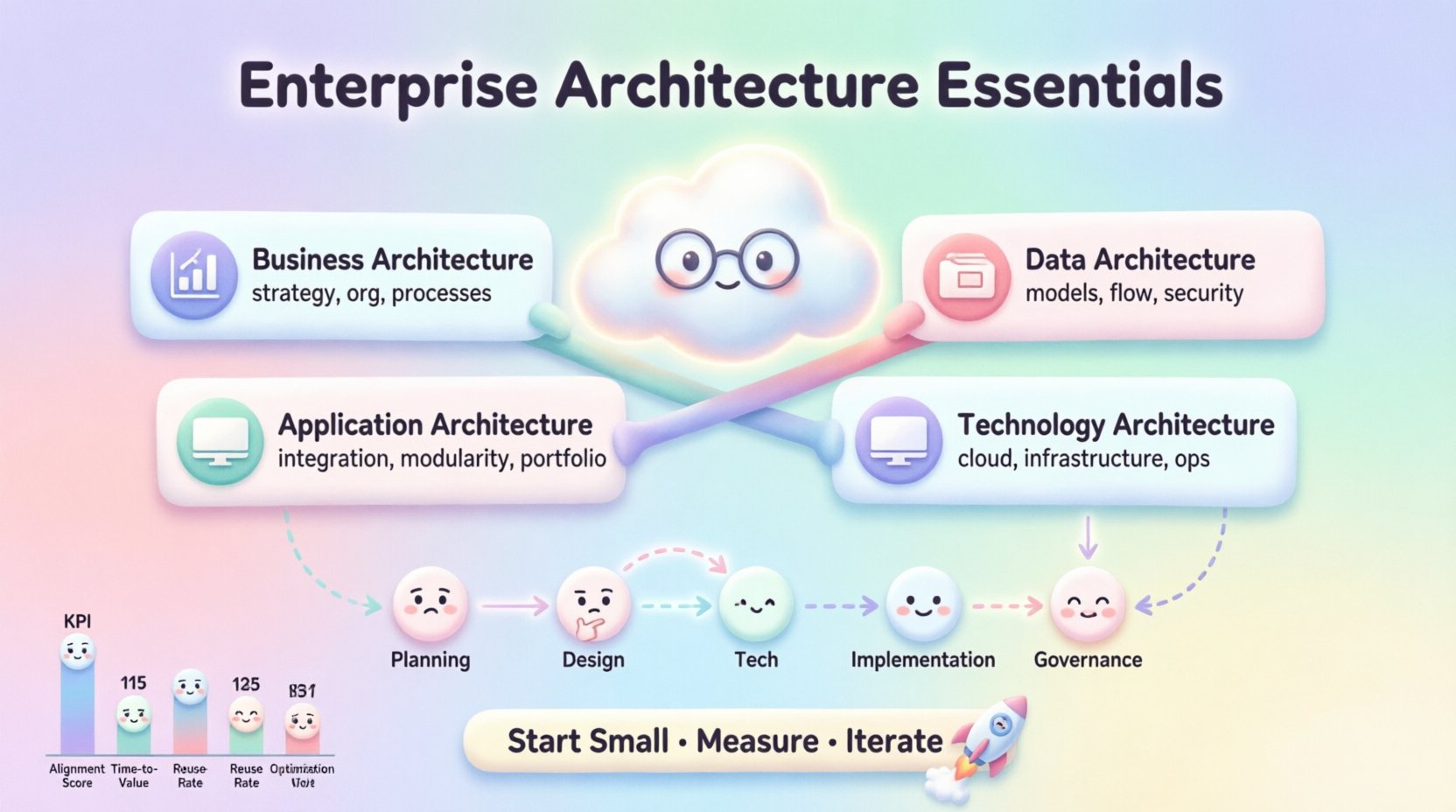
The Four Key Domains of Enterprise Architecture 🏛️
Enterprise Architecture is typically divided into four distinct domains. These domains are interconnected, meaning a change in one often impacts the others. Understanding the relationship between these areas is crucial for effective planning.
1. Business Architecture 📊
This is the foundation. It defines the strategy, governance, organization, and key business processes. It answers the question: “How does the business operate?”
- Strategy: Long-term goals and market positioning.
- Organization: Organizational structure, roles, and responsibilities.
- Processes: The end-to-end workflows that deliver value to customers.
- Capabilities: What the organization must be able to do to succeed.
2. Data Architecture 🗄️
Data is the lifeblood of modern organizations. This domain defines how data is stored, organized, and managed. It ensures that data is accurate, accessible, and secure.
- Data Models: Logical and physical representations of data structures.
- Standards: Naming conventions and data types.
- Flow: How data moves between systems.
- Security: Protection of sensitive information.
3. Application Architecture 💻
This domain describes the individual applications and their interactions. It focuses on the software solutions that support business processes.
- Integration: How applications talk to each other (APIs, middleware).
- Modularity: The degree to which applications are independent.
- Functionality: The specific business needs each application meets.
- Portfolio: The collection of all software assets owned by the enterprise.
4. Technology Architecture 🖥️
This is the infrastructure layer. It includes the hardware, networks, and cloud services required to run the applications.
- Infrastructure: Servers, storage, and networking equipment.
- Cloud: Public, private, or hybrid cloud environments.
- Performance: Scalability and reliability requirements.
- Operations: Maintenance and support teams.
Interconnectivity Table
| Domain | Primary Focus | Key Question |
|---|---|---|
| Business | Strategy & Process | What do we do and how do we organize? |
| Data | Information & Knowledge | What information do we need and where does it live? |
| Application | Software & Services | What software supports our processes? |
| Technology | Infrastructure & Hardware | What hardware runs our software? |
Frameworks and Methodologies 📐
To structure this work, organizations often adopt established frameworks. These provide a common language and set of practices. You do not need to adopt a framework entirely, but understanding their components helps standardize your approach.
TOGAF (The Open Group Architecture Framework)
TOGAF is one of the most widely used frameworks. It focuses on the Architecture Development Method (ADM), a cyclical process for developing architecture. It is highly adaptable and covers business, data, application, and technology layers.
Zachman Framework
The Zachman Framework is an ontology. It organizes architectural artifacts based on interrogatives (What, How, Where, Who, When, Why) and stakeholders (Planner, Owner, Designer, Builder, Subcontractor, User). It ensures no perspective is missed.
ArchiMate
ArchiMate is a modeling language used to describe, analyze, and visualize business architecture, enterprise architecture, and IT architecture. It provides the visual syntax to represent the concepts defined in frameworks like TOGAF.
Roles and Responsibilities 👥
Successful EA requires a team effort. No single person can hold all the knowledge. Here are the critical roles involved:
- Chief Enterprise Architect: Sets the vision and strategy. Ensures alignment with business goals.
- Domain Architects: Specialists in Business, Data, Application, or Technology. They dive deep into specific areas.
- Enterprise Architect: Bridges the gap between domains. Focuses on integration and cross-functional consistency.
- Stakeholders: Business leaders who define requirements and approve investments.
- Developers & Engineers: Implement the architecture in code and infrastructure.
Communication is the most important skill for these roles. Architects must translate technical constraints into business language and business requirements into technical specifications.
The Architecture Development Lifecycle 🔄
Building architecture is not a one-time event. It is a continuous cycle. The following phases outline the standard approach:
Phase 1: Planning and Scope
Define the boundaries of the project. What business units are involved? What is the budget? What are the success criteria? Clear scoping prevents scope creep and ensures resources are allocated efficiently.
Phase 2: Business Architecture Design
Map the current state of the business. Identify gaps between the current state and the desired future state. Define the target business capabilities and processes.
Phase 3: Information and Technology Design
Design the data models, application interfaces, and infrastructure. Ensure that the technical solutions support the business processes defined in the previous phase.
Phase 4: Implementation Planning
Create a roadmap. This includes identifying quick wins and long-term initiatives. It involves prioritizing projects based on value and risk. It also includes budgeting and resource planning.
Phase 5: Governance and Implementation
Execute the plan. This is where the actual work happens. However, governance ensures that the implementation stays true to the design. Architecture Review Boards (ARBs) often meet to review project proposals against the architecture standards.
Phase 6: Monitoring and Optimization
The work is never finished. Systems degrade, and business needs change. Continuous monitoring identifies deviations from the plan. Optimization ensures the architecture remains efficient and relevant.
Common Barriers to Success 🚧
Even with a solid plan, organizations face hurdles. Recognizing these early allows for better mitigation strategies.
- Lack of Executive Support: If leadership does not value architecture, it will not get the budget or attention it needs. Architects must prove ROI early.
- Resistance to Change: Departments often protect their own systems. Changing a system can mean losing control or changing habits. Change management is essential.
- Over-Engineering: Creating architecture that is too rigid slows down development. The goal is flexibility, not bureaucracy.
- Disconnected Teams: If the business team and IT team do not speak the same language, the architecture will fail. Collaboration tools and regular meetings help bridge this gap.
- Legacy Debt: Old systems are expensive to maintain and hard to integrate. A clear strategy for modernization or retirement is necessary.
Measuring Value and Success 📊
How do you know if Enterprise Architecture is working? It is difficult to measure directly, but several indicators provide insight.
Key Performance Indicators (KPIs)
- Time to Market: Are new products or services reaching the market faster due to better reuse of components?
- Cost Reduction: Is the cost of maintaining the IT landscape decreasing due to consolidation?
- System Availability: Is the infrastructure more stable and reliable?
- Compliance: Are we meeting regulatory requirements more easily?
- Project Success Rate: Are projects delivered on time and within budget?
Qualitative Measures
Quantitative data is not everything. Stakeholder satisfaction is equally important. Do business leaders feel supported by IT? Do developers have clear guidelines to follow? Feedback loops help adjust the approach.
Future Trends and Considerations 🚀
The landscape of enterprise architecture is evolving. Architects must stay informed about emerging technologies and trends.
- Cloud-Native Architectures: Moving away from monolithic structures to microservices and serverless computing. This requires a shift in how applications are designed and deployed.
- AI and Automation: Artificial intelligence can assist in analyzing architecture models and predicting risks. Automation can handle routine governance tasks.
- Security by Design: Security cannot be an afterthought. It must be integrated into the architecture from the start. Zero Trust models are becoming standard.
- Sustainability: Energy efficiency is becoming a key metric. Architects are considering the carbon footprint of data centers and cloud usage.
- Agility: The ability to pivot quickly is more valuable than rigid planning. Architecture must support iterative development and continuous delivery.
Practical Steps to Begin 🛠️
If you are ready to start or improve your EA practice, follow these practical steps.
- Assess the Current State: Inventory your assets. What systems exist? What data flows between them? What is the current organizational structure?
- Define the Vision: Where do you want to be in three to five years? What are the strategic goals?
- Identify Gaps: Compare the current state to the vision. Where are the deficiencies?
- Create a Roadmap: Prioritize initiatives. Start with high-value, low-risk projects to build momentum.
- Establish Governance: Set up a review process. Ensure new projects align with the architecture.
- Communicate: Share the vision and progress with stakeholders. Transparency builds trust.
Final Thoughts on Discipline and Adaptability 🤝
Enterprise Architecture is a discipline that requires patience and precision. It is not about controlling every decision, but about enabling the right decisions. By focusing on the core domains, utilizing proven frameworks, and maintaining a focus on business value, organizations can navigate complexity with confidence.
The goal is to create an environment where technology serves the business, not the other way around. This requires constant communication, a willingness to adapt, and a commitment to long-term thinking. When done correctly, Enterprise Architecture provides the stability needed for innovation and the flexibility needed for growth.
Start small, measure progress, and iterate. The journey to a mature architecture is a marathon, not a sprint. With the right approach, the return on investment becomes clear in the form of reduced costs, improved speed, and better alignment across the enterprise.