
Strategic planning relies heavily on structured frameworks, and few tools are as ubiquitous as the SWOT analysis. Whether you are a student preparing for a business exam or a professional drafting a corporate strategy, recalling the four core components accurately is essential. This guide provides a comprehensive approach to memorizing SWOT components, ensuring you can retrieve this information instantly when it matters most.
The acronym stands for Strengths, Weaknesses, Opportunities, and Threats. While the concept seems simple, distinguishing between internal and external factors often causes confusion during high-pressure situations. By breaking down the logic behind each letter and applying specific memory retention techniques, you can solidify this knowledge without relying on rote repetition alone.
🔍 The Foundation: What Are SWOT Components?
Before diving into memory tricks, it is necessary to understand the architecture of the framework. A SWOT analysis is a strategic planning technique used to evaluate the position of an organization, project, or individual. The goal is to identify factors that help or hinder success. The four pillars are distinct in their origin and nature.
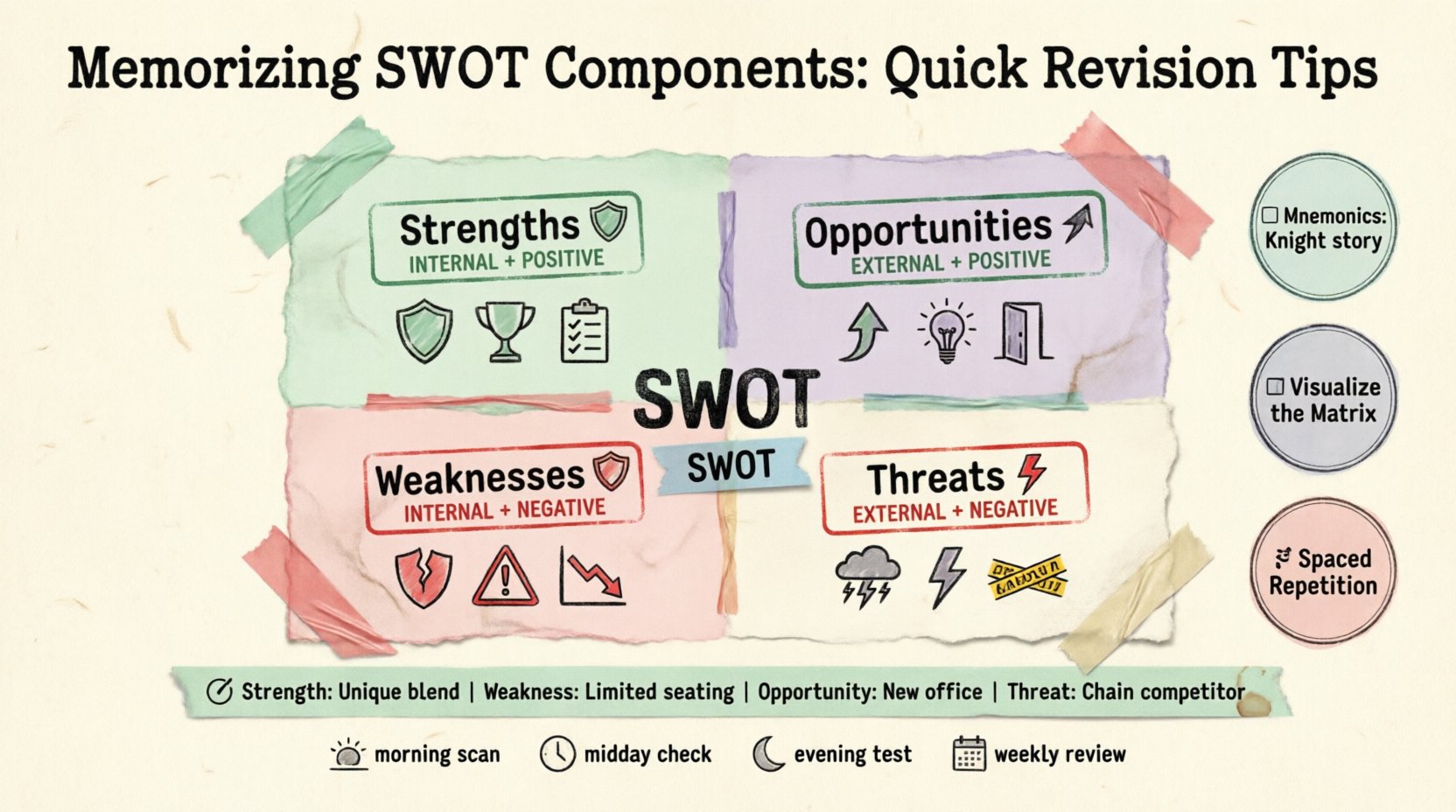
- Strengths: Attributes that are helpful to achieving the objective. These are internal.
- Weaknesses: Attributes that are harmful to achieving the objective. These are internal.
- Opportunities: External chances to make greater profits. These are external.
- Threats: External elements that could cause trouble for the business or objective.
Understanding the distinction between internal and external is the key to accurate recall. If you can remember the axis of control, you can remember the quadrant.
🏗️ Deep Dive into Each Quadrant
To memorize these effectively, we must associate meaning with each letter. Abstract letters fade; concrete concepts stick.
1. Strengths (S) 🛡️
Strengths represent the advantages you possess. Think of this as your defensive armor. These are factors within your direct control. Examples include proprietary technology, a strong brand reputation, or a skilled workforce. When reviewing, ask yourself: “What do I do better than others?” The “S” can be linked to “Superior” or “Support.” It is the foundation you build upon.
- Focus on positive internal attributes.
- Consider resources, skills, and market position.
- Ask: What gives us an edge?
2. Weaknesses (W) 📉
Weaknesses are the internal limitations. They are the holes in your armor. Unlike threats, which come from outside, weaknesses are problems you must fix yourself. This could be outdated technology, a lack of expertise, or poor location. The “W” connects to “Waning” or “Watch.” You must watch this area closely to prevent failure.
- Focus on negative internal attributes.
- Identify areas needing improvement.
- Ask: What prevents us from succeeding?
3. Opportunities (O) 🚀
Opportunities are external chances for growth. They are the wind at your back. You cannot control the market trends, new regulations, or competitor errors, but you can capitalize on them. The “O” stands for “Open” doors. These are positive external factors.
- Focus on positive external factors.
- Look for market gaps or emerging trends.
- Ask: What external changes can we use?
4. Threats (T) ⚡
Threats are external risks. These are the storms approaching from the horizon. You cannot stop a new competitor from entering the market or a recession from starting, but you can plan for them. The “T” links to “Trouble” or “Time.” Time is often a factor here as threats often escalate.
- Focus on negative external factors.
- Monitor industry risks and changes.
- Ask: What external factors could cause harm?
📊 Internal vs. External Factors Matrix
To aid visual memory, a table structure helps categorize the components clearly. Use this reference during revision sessions to reinforce the internal/external divide.
| Component | Factor Type | Control Level | Key Association |
|---|---|---|---|
| Strengths | Internal | High | Assets & Advantages |
| Weaknesses | Internal | High | Gaps & Limitations |
| Opportunities | External | Low | Chances & Growth |
| Threats | External | Low | Risks & Dangers |
🧠 Cognitive Techniques for Retention
Memorization is not just about reading; it is about processing. Here are proven methods to lock these concepts into long-term memory.
Mnemonic Devices 🧩
Acronyms are useful, but associations work better. Consider the phrase “SWOT” itself. You can visualize a shield (Strengths) with a crack (Weaknesses), a ladder reaching up (Opportunities), and a falling rock (Threats). Creating a vivid mental image makes the abstract concrete.
Another technique is the “S.W.O.T.” story method. Imagine a knight (S) with a weak sword (W) seeing a castle gate open (O) while a dragon approaches (T). The narrative links the four letters in a sequence that is easy to recall.
Visualization and Mind Mapping 🗺️
Drawing the matrix helps. Sketch a cross. Label the top left and bottom left as Internal. Label the top right and bottom right as External. Put Strengths and Weaknesses on the left (Internal). Put Opportunities and Threats on the right (External). The act of drawing engages motor memory, reinforcing the cognitive memory.
- Draw the box once a day for a week.
- Fill in the quadrants from memory, then check.
- Add color codes (Green for positive, Red for negative).
🔄 Practical Revision Routines
Consistency beats intensity. Short, frequent review sessions are more effective than cramming before an exam or meeting.
Spaced Repetition 📅
Review the components at increasing intervals. Study the framework today. Review it tomorrow. Then review it in three days. Then in a week. This method combats the forgetting curve. Each time you recall the information, the neural pathway becomes stronger.
The Feynman Technique 🗣️
Teach the concept to someone else, or pretend to teach it. Explain what SWOT is without using jargon. If you stumble when explaining the difference between a weakness and a threat, you know where your memory gap is. Simplifying the explanation forces you to understand the core logic.
Flashcard Drills 🃏
Create physical or digital cards. On one side, write “Internal Negative.” On the other, write “Weakness.” Shuffle them and test yourself. This active recall method is far superior to passive reading.
⚠️ Common Pitfalls in Recall
Even with memorization techniques, confusion arises. Be aware of the common traps that lead to errors during analysis.
- Confusing Weakness with Threat: A weakness is internal (e.g., poor management). A threat is external (e.g., poor management in a competitor). If you can fix it, it is a weakness. If you cannot, it is a threat.
- Confusing Strength with Opportunity: A strength is what you have now. An opportunity is what you could get in the future. Strengths are assets; Opportunities are potential.
- Listing Generic Items: Avoid listing “Good Quality.” Instead, specify “ISO 9001 Certification.” Specificity aids memory and accuracy.
- Overlooking the Matrix: Always ensure the placement is correct. Left side = Internal. Right side = External. Top/Bottom depends on positive/negative.
🌍 Real-World Application Examples
Applying the concepts in a real context cements the memory. Let us look at a hypothetical scenario involving a local coffee shop.
Scenario: A Local Coffee Shop ☕
- Strength: Unique blend recipes owned by the owner.
- Weakness: Limited seating capacity compared to chains.
- Opportunity: A new office building opening nearby.
- Threat: A major coffee chain opening across the street.
By mapping these specific items to the SWOT framework, the abstract letters become tangible business realities. When you review the framework later, this story helps you retrieve the definitions.
📝 Daily Revision Checklist
To ensure long-term retention, incorporate these steps into your routine.
- Morning Scan: Spend 2 minutes visualizing the SWOT matrix.
- Midday Check: Read the definitions of S, W, O, T.
- Evening Test: Write down one example for each quadrant from memory.
- Weekly Review: Revisit the internal vs. external table.
🏁 Final Thoughts on Strategic Memory
Retaining the components of a SWOT analysis is about understanding the logic of the tool rather than just memorizing letters. The distinction between internal control and external influence is the anchor that holds the framework together. By using mnemonics, visualization, and spaced repetition, you ensure this knowledge remains accessible.
Strategic planning requires clarity. When you can recall the four pillars instantly, you free up mental energy to focus on the strategy itself. Practice these techniques regularly, and the framework will become second nature in your professional toolkit.