
In the modern digital landscape, organizations face a paradoxical challenge. They must innovate faster while maintaining stability. The friction between these two demands often leads to operational bottlenecks, wasted resources, and strategic misalignment. This is where Enterprise Architecture (EA) becomes critical. It is not merely a documentation exercise or an IT function; it is a strategic discipline that orchestrates the complex interplay between business goals and technology capabilities.
Operational efficiency is the measure of how effectively an organization uses its resources to produce outputs. When operations are inefficient, costs rise, response times slow, and customer satisfaction drops. Enterprise Architecture provides the blueprint to identify redundancies, streamline processes, and align technology investments with actual business needs. By implementing a robust EA framework, companies can transform chaotic systems into cohesive, manageable assets that drive value.
📋 Understanding Enterprise Architecture
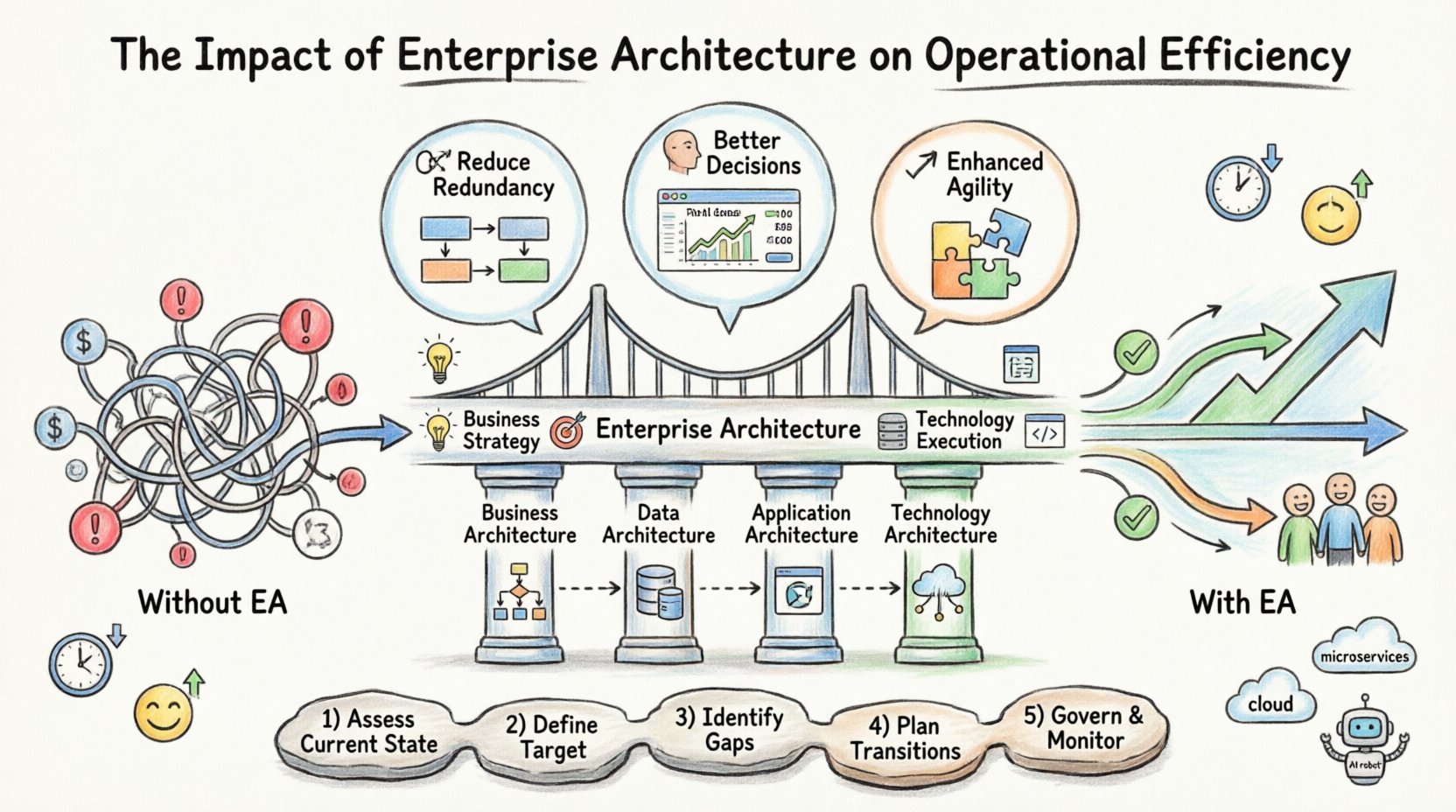
Enterprise Architecture is the practice of translating business strategy into technology and process execution. It acts as the bridge between the executive vision and the technical reality. Without this bridge, IT projects often proceed in isolation, creating silos that hinder collaboration and data flow.
A comprehensive EA framework typically covers four distinct domains:
- Business Architecture: Defines the business strategy, governance, functions, and processes. It answers the question, “What does the business need to do to succeed?”
- Data Architecture: Describes the structure of an organization’s logical and physical data assets. It ensures data is accessible, consistent, and secure across the enterprise.
- Application Architecture: Provides a blueprint for individual applications, their interactions, and their relationships to core business processes.
- Technology Architecture: Describes the hardware, software, and network infrastructure required to support the deployment of business, data, and application services.
When these domains are integrated, they create a holistic view of the organization. This visibility allows leaders to make informed decisions that reduce complexity and enhance performance.
⚙️ Defining Operational Efficiency
Before analyzing the impact, we must define what operational efficiency entails in a corporate context. It is not simply about cutting costs. It is about maximizing output with minimal input. Key indicators include:
- Reduced cycle times for business processes.
- Lower total cost of ownership (TCO) for technology assets.
- Higher employee productivity through better tooling.
- Improved accuracy and reduced error rates in data handling.
- Enhanced agility in responding to market changes.
Enterprises that lack architectural oversight often suffer from “technical debt.” This refers to the implied cost of additional rework caused by choosing an easy, limited solution now instead of using a better approach that would take longer. Technical debt accumulates interest in the form of maintenance headaches, security vulnerabilities, and integration failures.
🔗 The Intersection of EA and Operations
The relationship between Enterprise Architecture and operational efficiency is direct and measurable. EA influences operations by standardizing environments, eliminating redundancy, and ensuring that technology serves the business rather than dictating it.
1. Reduction of Redundancy
Without a centralized view, different departments often procure similar tools or build similar systems. One team might build a customer portal while another builds a billing system that requires the same data entry. EA identifies these overlaps. By consolidating platforms, organizations reduce licensing costs, simplify training, and minimize data entry errors.
2. Improved Decision Making
When data architecture is well-defined, information flows freely between departments. Executives can access real-time metrics rather than waiting for weekly reports. This speed allows for quicker course corrections. If a supply chain process is lagging, EA ensures the necessary data exists to diagnose the root cause immediately.
3. Enhanced Agility
Modern markets require rapid adaptation. A rigid IT landscape makes change expensive and slow. Enterprise Architecture promotes modular design and standard interfaces. When a new market opportunity arises, the architecture team can assess how to integrate new capabilities without dismantling the entire system. This modularity is essential for long-term operational resilience.
📊 Comparing Operational States
To visualize the difference EA makes, consider the following comparison of organizational states.
| Feature | Without Enterprise Architecture | With Enterprise Architecture |
|---|---|---|
| System Integration | Manual data transfers, high error rate | Automated API integration, seamless flow |
| Cost Management | Reactive spending, hidden vendor costs | Strategic budgeting, consolidated licensing |
| Time-to-Market | Months of development for new features | Weeks using existing reusable components |
| Compliance | Audits are stressful and reactive | Continuous monitoring and governance |
| Employee Experience | Fragmented tools, high friction | Unified platforms, intuitive workflows |
🤝 Aligning IT and Business Strategy
The most significant barrier to operational efficiency is the disconnect between business leaders and technology teams. Business units speak in revenue and growth; IT speaks in servers and code. Enterprise Architecture creates a shared language.
Through the use of capability maps and value stream modeling, EA translates business goals into technical requirements. For example, if the business goal is “Increase customer retention by 10%,” the EA team maps this to specific capabilities like “Personalized Recommendation Engine” or “24/7 Support Ticketing System.” This alignment ensures that every dollar spent on technology directly supports a business outcome.
This alignment also prevents scope creep. Projects are evaluated against the architectural blueprint. If a new feature request does not fit the strategic direction or requires a fundamental redesign of the data model, it is flagged early. This prevents wasted effort on initiatives that do not contribute to operational goals.
🛡️ Risk Management and Compliance
Operational efficiency is not possible if systems are frequently disrupted by security breaches or regulatory fines. Enterprise Architecture plays a pivotal role in risk mitigation.
- Security Standards: EA defines security protocols that apply across the organization. Instead of each department building its own firewall rules, a centralized security architecture ensures consistent protection.
- Data Governance: Regulations like GDPR or CCPA require strict data handling. EA establishes the rules for where data lives, who can access it, and how long it is retained. This reduces legal risk and operational friction during audits.
- Disaster Recovery: A well-architected system has built-in redundancy. EA ensures that critical systems have backup plans, minimizing downtime during unexpected events.
📈 Measuring the Success of EA
To validate the impact of Enterprise Architecture, organizations must track specific Key Performance Indicators (KPIs). These metrics should reflect both financial and operational improvements.
- IT Spend as a Percentage of Revenue: A decreasing trend often indicates better efficiency in technology utilization.
- System Downtime: Reduced downtime correlates with better architectural planning and monitoring.
- Project Delivery Time: Faster delivery of new capabilities suggests a more agile and reusable architecture.
- Application Retirement Rate: A healthy EA program actively retires legacy systems, reducing maintenance burdens.
- User Satisfaction Scores: When tools are streamlined, employee frustration decreases, leading to higher productivity.
🚧 Implementation Challenges
While the benefits are clear, implementing Enterprise Architecture is not without challenges. It requires a shift in culture and mindset. Organizations must be prepared for the following hurdles.
Resistance to Change
Departments often guard their systems as proprietary assets. They may resist standardization if it feels like a loss of autonomy. EA leaders must communicate that standardization is about empowerment, not restriction. Showing quick wins helps build trust.
Lack of Visibility
Many organizations do not know what systems they own. Building the initial inventory requires significant effort. It is often a “garbage in, garbage out” scenario if the initial data is incomplete.
Sustaining Momentum
EA is not a one-time project. It requires continuous governance. If the architecture team loses influence, technical debt will accumulate again. Leadership must remain committed to the architectural vision over the long term.
🔄 Future Trends in Architecture
The landscape of Enterprise Architecture is evolving. As businesses become more digital-native, the architecture function must adapt.
- Cloud-Native Design: Architecture is shifting from on-premise infrastructure to cloud services. This requires new thinking regarding scalability and cost models.
- Microservices: Moving away from monolithic applications to microservices allows teams to update parts of the system independently. This supports operational efficiency by reducing the risk of full-system outages.
- AI and Automation: As artificial intelligence integrates into operations, EA must govern how these tools are deployed. Ensuring ethical AI and data privacy becomes a core architectural responsibility.
🧭 Strategic Roadmap for Efficiency
For organizations looking to leverage Enterprise Architecture for better operations, a structured approach is necessary.
- Assess Current State: Inventory all assets, processes, and pain points. Understand the “as-is” architecture.
- Define Target State: Create a vision of the “to-be” architecture that supports strategic goals.
- Identify Gaps: Determine what is missing to move from current to target. This includes skills, technology, or processes.
- Plan Transitions: Develop a roadmap that sequences changes logically. Avoid disrupting critical operations during the transition.
- Govern and Monitor: Establish a governance board to review projects and ensure adherence to the architectural blueprint.
💡 The Bottom Line
Enterprise Architecture is the backbone of operational efficiency. It transforms chaos into order and ambiguity into clarity. By aligning technology with business strategy, organizations can reduce costs, improve speed, and enhance resilience.
It is not about creating documents for the sake of documentation. It is about making decisions that enable the business to operate smoothly. When an organization invests in its architecture, it invests in its future capability to execute. The return on this investment is visible in every streamlined process, every saved dollar, and every successful market launch.
Leadership must view EA not as a cost center, but as a value driver. The complexity of modern business demands a disciplined approach to structure. Without it, growth becomes unsustainable. With it, organizations gain the agility to navigate uncertainty and the stability to deliver consistent results.