
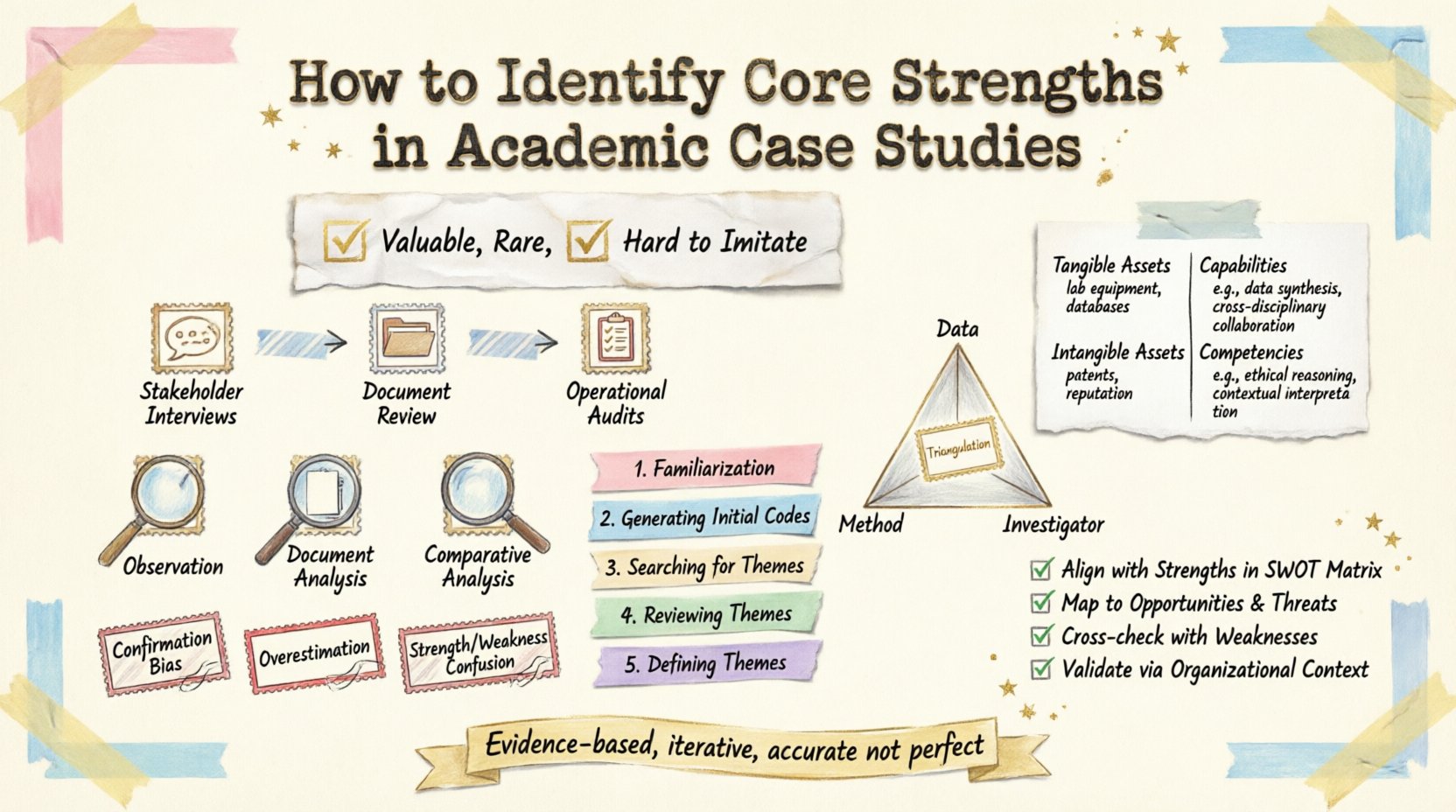
Identifying core strengths within academic case studies requires a rigorous approach to data interpretation and internal analysis. This process is fundamental to the SWOT framework, specifically focusing on the ‘S’ component. Researchers often struggle to distinguish between superficial advantages and genuine core competencies. This guide provides a structured methodology for uncovering these internal assets without relying on proprietary tools or software products.
When conducting qualitative research or business analysis within an academic setting, the ability to pinpoint what makes a subject successful is critical. It involves moving beyond surface-level observations to understand the underlying capabilities that drive performance. By systematically evaluating internal factors, scholars can produce more accurate and actionable findings.
Understanding Core Strengths in Research Contexts 🧠
In the context of academic inquiry, a core strength is not merely a positive attribute. It represents a distinct capability, resource, or advantage that provides a competitive edge or a unique position within the studied environment. Identifying these elements requires a deep dive into the operational and structural elements of the case.
Many students and researchers confuse strengths with simple successes. A success is an outcome, whereas a strength is the capacity to achieve that outcome repeatedly. For instance, high revenue is a success; efficient supply chain management is a strength that generates that revenue. Distinguishing between the two is the first step in accurate analysis.
- Definition: A core strength is an internal factor that contributes significantly to the achievement of objectives.
- Characteristics: It should be valuable, rare, and difficult to imitate by competitors or other entities.
- Scope: Strengths can be tangible (physical assets) or intangible (reputation, culture).
Methodologies for Internal Analysis 📋
Systematic identification of strengths relies on established analytical frameworks. While the SWOT matrix is the most common tool, the actual extraction of data requires specific research techniques. These methods ensure that the identified strengths are grounded in evidence rather than assumption.
1. Stakeholder Interviews and Surveys
Direct engagement with key personnel provides qualitative data that documents often miss. When conducting interviews, questions should focus on perceived advantages and operational efficiencies. Open-ended questions allow respondents to highlight areas where they feel the organization excels.
- Ask about resources that are consistently available and reliable.
- Inquire about processes that save time or reduce costs.
- Request examples of past successes attributed to specific internal capabilities.
2. Document Review and Archival Analysis
Historical records offer a longitudinal view of performance. By examining annual reports, meeting minutes, and strategic plans, researchers can identify patterns of success. Consistency over time is a strong indicator of a core strength.
- Look for recurring themes in strategic planning documents.
- Analyze financial statements for consistent margins or growth areas.
- Review customer feedback logs for positive sentiment regarding specific features.
3. Operational Audits
Observing the actual workflow reveals strengths that are not always articulated. Researchers should look for smooth processes, low error rates, and high employee morale. These observable metrics serve as concrete evidence of internal health.
Distinguishing Assets from Capabilities 🏗️
Not all internal factors are created equal. A clear distinction must be made between what an entity possesses (assets) and what it can do (capabilities). Both contribute to strength, but they function differently in a case study analysis.
Tangible assets are physical or financial resources. Intangible assets are non-physical, such as brand equity or intellectual property. Capabilities refer to the skills and processes used to deploy assets effectively.
| Category | Description | Example in Academic Case |
|---|---|---|
| Tangible Assets | Physical or financial resources owned. | State-of-the-art laboratory equipment. |
| Intangible Assets | Non-physical resources like reputation. | Strong alumni network and donor relations. |
| Capabilities | Skills to utilize resources. | Agile curriculum development process. |
| Competencies | Deeply embedded skills. | Interdisciplinary research collaboration. |
Data Collection Strategies for Strength Identification 📥
Gathering the necessary evidence requires a multi-faceted approach. Relying on a single data source can lead to bias. Triangulation, or using multiple sources to verify information, is essential for academic rigor.
Observation
Direct observation allows the researcher to see strengths in action. This is particularly useful for operational strengths. For example, watching a team meet and noting how quickly they resolve conflicts can highlight a strength in communication.
Document Analysis
Internal documents often contain self-reported strengths. While these can be biased, they provide a baseline for what the organization believes it excels at. Cross-referencing these claims with external data validates their accuracy.
Comparative Analysis
Comparing the subject against industry benchmarks or peer institutions highlights relative strengths. If the subject performs better than the average in a specific metric, that metric is likely a strength.
- Identify key performance indicators relevant to the field.
- Collect benchmark data from public databases or industry reports.
- Calculate variance to determine areas of superior performance.
Analyzing Qualitative Data Patterns 🔎
Once data is collected, the next step is analysis. Coding qualitative data is a standard method for identifying themes. Researchers categorize responses or observations into themes that align with potential strengths.
The process involves reading through transcripts or notes and tagging recurring positive concepts. These tags are then grouped into broader categories such as “Leadership,” “Technology,” or “Culture.”
Thematic Coding Steps
- Familiarization: Read all data multiple times to understand the context.
- Generating Codes: Label interesting features of the data that relate to strengths.
- Searching for Themes: Collate codes into potential themes.
- Reviewing Themes: Check if the themes work in relation to the coded extracts.
- Defining Themes: Refine the specifics of each theme and generate clear definitions.
Validating Findings Through Triangulation ✅
Validation ensures that the identified strengths are real and not artifacts of the research method. Triangulation involves checking findings against different data sources, methods, or investigators.
If interview data suggests high employee morale, but turnover rates are high, there is a contradiction. This discrepancy requires further investigation. A true strength should be consistent across different forms of evidence.
- Data Triangulation: Compare interviews with documents and observations.
- Methodological Triangulation: Use both qualitative and quantitative methods.
- Investigator Triangulation: Have multiple researchers review the data.
Common Analytical Pitfalls to Avoid ⚠️
Even with a structured approach, researchers can make errors. Recognizing these pitfalls helps maintain the integrity of the analysis.
1. Confirmation Bias
Researchers may look for evidence that supports their initial hypothesis while ignoring contradictory data. It is vital to remain objective and consider evidence that challenges the perceived strengths.
2. Overestimation
There is a tendency to view internal factors more favorably than they deserve. External benchmarks and critical feedback are necessary to keep assessments realistic.
3. Confusing Strengths with Weaknesses
Sometimes, what looks like a strength is actually a double-edged sword. For example, a highly specialized skill set might be a strength but creates vulnerability if that skill becomes obsolete. Context matters.
Integrating Strengths into SWOT Frameworks 🔄
The ultimate goal of identifying strengths is to utilize them within the broader SWOT analysis. The strengths identified should directly inform the strategies for leveraging opportunities and mitigating threats.
When writing the SWOT matrix, strengths should be specific and actionable. Vague statements like “Good team” should be refined to “Highly skilled engineering team with 10 years of experience.” Specificity adds value to the academic output.
- Ensure strengths are internal to the organization.
- Ensure strengths are relevant to the specific case study objectives.
- Ensure strengths are sustainable over the relevant timeframe.
Presenting Strengths in Academic Writing 📝
The final step is communicating the findings effectively in a thesis or paper. Clarity and precision are key. Avoid jargon where possible, and use evidence to support claims.
Structuring the Findings Section
Organize the strengths logically. Group them by category, such as human resources, infrastructure, or financial health. Use subheadings to guide the reader through the analysis.
Using Visual Aids
Tables and charts can effectively summarize complex data. A radar chart, for instance, can show the relative magnitude of different strengths compared to industry averages. Visual representation aids comprehension.
Application in Specific Academic Disciplines
Different fields require slightly different approaches to identifying strengths.
Public Health Case Studies
In health research, strengths might include access to patient data, strong community partnerships, or advanced diagnostic tools. The focus is often on capacity and reach.
Business and Management Studies
Here, strengths often revolve around market share, proprietary technology, or brand loyalty. The emphasis is on competitive advantage and profitability.
Sociology and Anthropology
Strengths may be social capital, cultural cohesion, or institutional trust. The metrics are often qualitative and relational rather than financial.
Final Thoughts on Rigorous Identification 🔬
Accurate identification of core strengths is the backbone of a credible case study. It requires patience, critical thinking, and a commitment to evidence-based analysis. By following the methodologies outlined above, researchers can ensure their findings are robust and valuable.
The process is iterative. As new data emerges, strengths may be re-evaluated. This flexibility ensures the analysis remains relevant and accurate. Ultimately, a well-defined set of strengths provides a solid foundation for strategic planning and academic contribution.
Remember that the goal is not to create a perfect picture but an accurate one. Acknowledging limitations and focusing on genuine capabilities leads to the most impactful research outcomes.