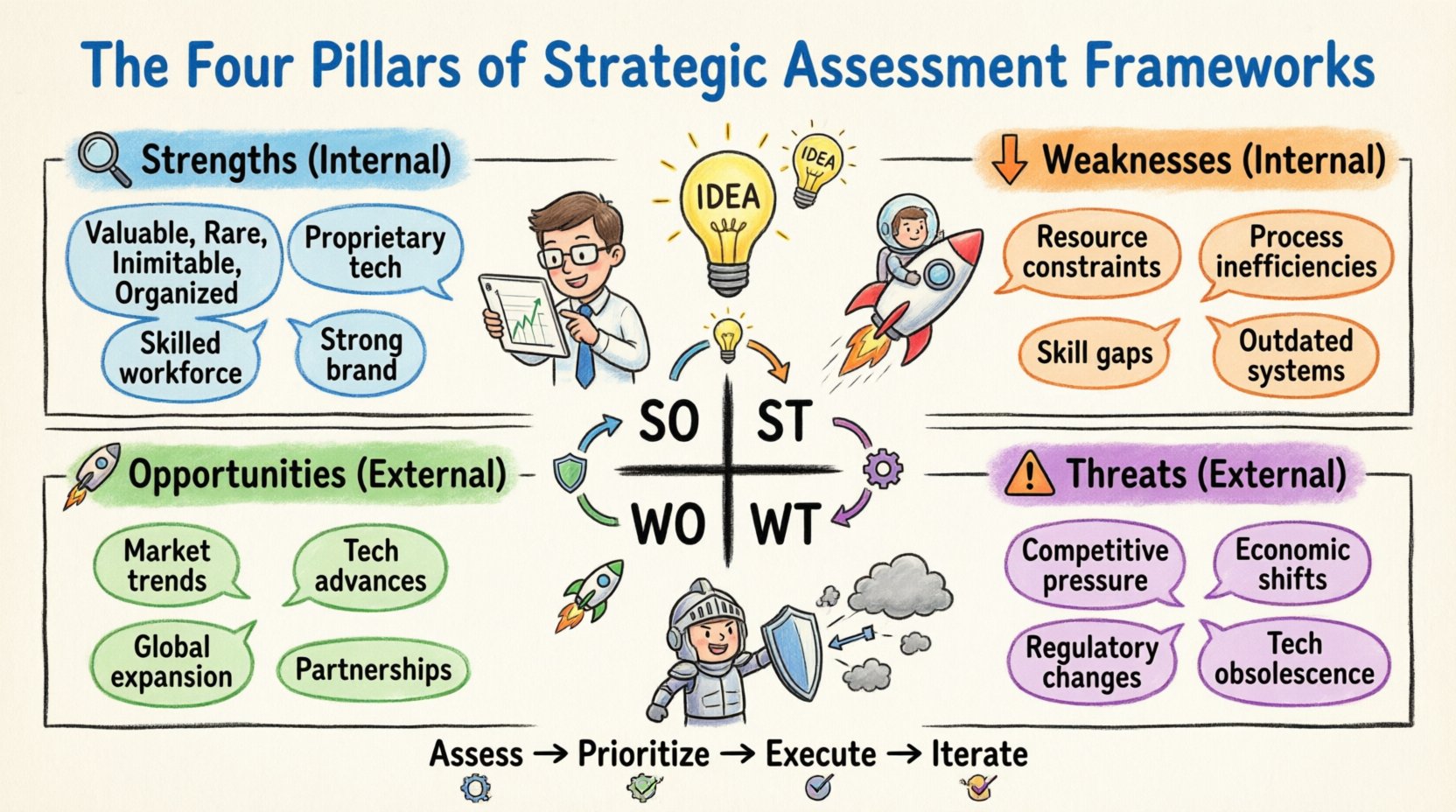
Strategic planning is often mistaken for a simple exercise in goal setting. In reality, it is a rigorous process of environmental scanning, internal auditing, and resource allocation. At the heart of this discipline lies the Strategic Assessment Framework, a structured method for evaluating an organization’s position. Among these methodologies, the SWOT Analysis stands as a foundational tool. It breaks down complex business dynamics into four distinct categories, providing a clear lens through which leadership can view their trajectory.
Understanding these four pillars is not merely about filling out a grid. It is about cultivating a mindset of clarity. When an organization fails to assess its internal capabilities against external market forces, it operates on assumptions rather than data. This article explores the depth of these four components: Strengths, Weaknesses, Opportunities, and Threats. We will examine how they function individually and how their intersection creates actionable strategy.
🔍 Pillar 1: Internal Strengths
Strengths represent the internal attributes that give an organization a competitive advantage. These are factors within the control of the entity. They are the reasons why customers choose your offering over another’s. Identifying strengths requires honest introspection about what the organization does exceptionally well.
To categorize a strength effectively, it must meet specific criteria:
- Valuable: Does it provide value to the customer or the market?
- Rare: Is it possessed by few competitors?
- Inimitable: Is it difficult for others to copy?
- Organized: Is the company structured to exploit this advantage?
Examples of internal strengths often include:
- Proprietary technology or intellectual property
- A highly skilled and experienced workforce
- Strong brand reputation and customer loyalty
- Efficient supply chain management
- Robust financial reserves and cash flow
When documenting strengths, avoid vague terms like “good service.” Instead, specify the metric. For instance, “99.9% uptime reliability” or “industry-leading response time of under two hours.” Quantifiable data anchors the assessment in reality. This pillar answers the question: What are we doing right that we can leverage?
🔻 Pillar 2: Internal Weaknesses
Weaknesses are internal factors that place the organization at a disadvantage relative to others. Unlike strengths, these are areas where improvement is necessary. Acknowledging weaknesses is often the most difficult part of the process because it requires admitting limitations. However, identifying them early prevents strategic failure.
Weaknesses can stem from various sources, including:
- Resource Constraints: Lack of funding, technology, or human capital.
- Process Inefficiencies: Bureaucratic hurdles that slow down decision-making.
- Skill Gaps: Missing expertise in critical areas like digital transformation or data analytics.
- Market Position: Low brand awareness in key segments.
- Infrastructure: Outdated facilities or legacy systems.
The goal is not to dwell on negatives but to recognize them as areas for mitigation or outsourcing. A weakness is only a liability if it is not addressed. For example, if a team lacks coding expertise, the strategy might involve hiring contractors or investing in training rather than attempting to build the solution internally without support. This pillar answers the question: What must we fix to remain viable?
🚀 Pillar 3: External Opportunities
Opportunities are external elements in the environment that the organization could exploit to its advantage. These are not created by the company but discovered through market analysis. They represent potential growth avenues that align with the organization’s strengths.
Common sources of opportunities include:
- Market Trends: Shifts in consumer behavior or regulatory changes that favor new products.
- Technological Advances: New tools that can improve efficiency or create new revenue streams.
- Competitor Mistakes: A rival withdrawing from a specific segment creates a vacuum.
- Global Expansion: Entering untapped geographic regions.
- Partnerships: Collaborations that expand reach without heavy capital investment.
Opportunities require timing. A good opportunity that is acted upon too late may become a threat or disappear entirely. The assessment must determine if the organization has the capacity to seize the moment. This pillar answers the question: Where is the market moving, and how can we be there first?
⚠️ Pillar 4: External Threats
Threats are external challenges that could cause trouble for the business. These are factors outside the organization’s control that could erode market share or profitability. Ignoring threats is a common cause of strategic blindness.
Threats often originate from:
- Competitive Pressure: New entrants with disruptive business models.
- Economic Shifts: Inflation, recession, or currency fluctuations.
- Regulatory Changes: New laws that increase compliance costs.
- Supply Chain Disruptions: Dependence on single-source vendors.
- Technological Obsolescence: Solutions becoming outdated due to innovation.
Managing threats involves risk mitigation. Strategies might include diversifying suppliers, hedging against currency risk, or lobbying for favorable policy changes. This pillar answers the question: What external forces could stop us from succeeding?
⚖️ The Matrix of Interaction
While analyzing the four pillars individually is useful, the true power of the Strategic Assessment Framework lies in the interaction between them. This is often visualized through a TOWS Matrix, which cross-references internal factors with external factors to generate specific strategies.
| Internal | Opportunities (External) | Threats (External) |
|---|---|---|
| Strengths | SO Strategies (Maxi-Maxi) Use strengths to maximize opportunities. |
ST Strategies (Maxi-Mini) Use strengths to minimize threats. |
| Weaknesses | WO Strategies (Mini-Maxi) Overcome weaknesses by taking advantage of opportunities. |
WT Strategies (Mini-Mini) Minimize weaknesses and avoid threats. |
Consider a scenario where a company has a strong brand (Strength) but faces new regulations (Threat). An ST strategy would involve using the brand’s influence to lobby for favorable interpretations of the law. Conversely, if the company lacks technology (Weakness) but a new market emerges (Opportunity), a WO strategy would involve partnering with a tech firm to fill the gap.
🛠️ Implementation and Execution
Once the assessment is complete, the data must translate into action. A framework that sits in a report without execution is merely an academic exercise. The following steps ensure the assessment drives results:
- Prioritize Findings: Not every point is equal. Focus on the high-impact items that affect the core mission.
- Assign Ownership: Every action item needs an owner. Ambiguity leads to inaction.
- Set Timelines: Define clear deadlines for addressing weaknesses and seizing opportunities.
- Monitor Metrics: Establish KPIs to track the effectiveness of the strategic moves.
- Iterate Regularly: The environment changes. The assessment should be a living document, reviewed quarterly or annually.
Communication is also vital. Stakeholders need to understand the rationale behind strategic shifts. If the workforce does not understand the “why” behind the strategy, resistance will hinder progress. Transparency builds alignment.
⚠️ Common Pitfalls in Assessment
Even with a robust framework, organizations frequently stumble during the process. Awareness of these common errors helps maintain the integrity of the analysis.
1. Vagueness and Generalization
Statements like “we need to improve sales” are not actionable. The assessment requires specific problems. “Sales in the APAC region dropped 15% due to competitor pricing” is a precise problem statement that leads to a specific solution.
2. Internal Bias
Teams often overestimate strengths and underestimate weaknesses due to optimism bias. External validation is crucial. Customer feedback and third-party market research can correct internal blind spots.
3. Static Analysis
A snapshot of the current state is useful, but strategy is forward-looking. The assessment must account for projected changes in the market, not just current conditions.
4. Lack of Follow-Through
Conducting the analysis without a plan to act on it wastes time and resources. The output must be a roadmap, not just a list.
🔎 Maintaining Strategic Momentum
Strategic assessment is not a one-time event. It is a continuous cycle of evaluation and adaptation. As markets evolve, the relative importance of the four pillars shifts. A strength today may become a weakness tomorrow if the technology changes. A threat today may become an opportunity for those who adapt quickly.
Leadership must foster a culture of strategic awareness. This means encouraging data-driven decision-making at all levels of the organization. When employees at every tier understand the four pillars, they can identify opportunities and threats in their daily work. This decentralization of strategic thinking accelerates execution.
Furthermore, the framework serves as a communication tool. It aligns different departments around a shared understanding of the business landscape. Marketing, finance, operations, and product development can all see how their specific roles contribute to the broader strategic goals defined by the assessment.
🔮 Looking Forward
The future of strategic planning lies in agility. While the four pillars remain constant, the speed at which they change is accelerating. Organizations that embed this framework into their regular operating rhythm will be better positioned to navigate uncertainty. The goal is not to predict the future with perfect accuracy, but to build resilience against any future that arrives.
By rigorously applying the four pillars of strategic assessment, leaders can move from reactive management to proactive shaping of their destiny. The process demands honesty, discipline, and a willingness to confront difficult truths. But the payoff is a clear path forward, grounded in reality and oriented toward sustainable growth.
Strategic clarity is the difference between drifting and steering. With a solid assessment of Strengths, Weaknesses, Opportunities, and Threats, the direction becomes visible. The work begins now.