
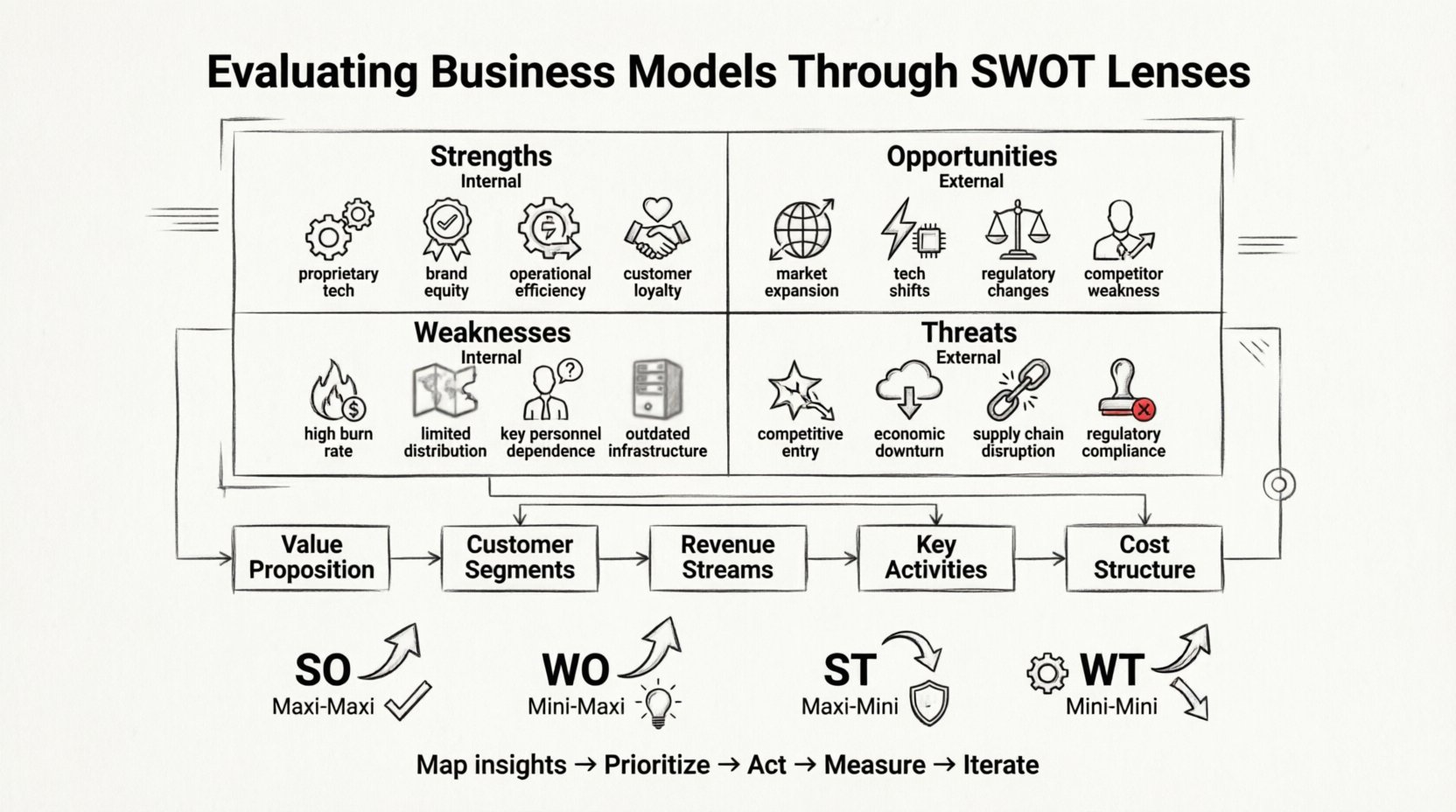
Strategic planning requires more than intuition. It demands a structured approach to understanding where an organization stands today and where it can go tomorrow. The SWOT analysis framework offers a foundational lens for this evaluation. When applied specifically to business models, it moves beyond general corporate strategy into the mechanics of value creation and capture.
Business models define how an enterprise delivers value to customers, captures revenue, and sustains operations. Evaluating these models requires looking inward at capabilities and outward at market conditions. The SWOT matrix provides a disciplined method to organize these insights. This guide explores how to dissect business models using internal and external lenses to ensure long-term viability.
The Intersection of Strategy and Structure 🏗️
A business model is the architecture of how a company works. It includes elements like value propositions, customer segments, revenue streams, and cost structures. Without a clear evaluation of these components, growth can become unstable. SWOT analysis bridges the gap between high-level strategy and operational reality.
Applying SWOT to business models involves asking specific questions about each quadrant:
- Internal Focus: What capabilities do we have that others do not? Where are we falling short?
- External Focus: What market shifts can we leverage? What competitive pressures threaten our position?
This dual focus ensures that internal strengths are not wasted on irrelevant opportunities, and external threats are not ignored due to internal overconfidence.
Deconstructing the SWOT Framework 🧩
The SWOT acronym stands for Strengths, Weaknesses, Opportunities, and Threats. While often used generically, its application to business models requires precision. Each category represents a distinct type of variable affecting the organization.
Internal Factors: Strengths & Weaknesses ⚖️
Internal factors are within the control of the organization. They relate directly to the resources and processes that make up the business model.
Strengths
Strengths are attributes that give the business an advantage over others. In the context of a business model, these often relate to efficiency and differentiation.
- Proprietary Technology: Patents or unique algorithms that competitors cannot replicate.
- Brand Equity: Strong recognition that reduces customer acquisition costs.
- Operational Efficiency: Lower cost structures due to optimized supply chains.
- Customer Loyalty: High retention rates indicating a sticky product or service.
Weaknesses
Weaknesses are attributes that place the business at a disadvantage relative to others. These are areas requiring improvement or mitigation.
- High Burn Rate: Operational costs exceed revenue generation capabilities.
- Limited Distribution: Inability to reach key customer segments effectively.
- Dependence on Key Personnel: Critical knowledge held by a few individuals.
- Outdated Infrastructure: Legacy systems that slow down innovation or scaling.
External Factors: Opportunities & Threats 🌍
External factors are outside the control of the organization. They relate to the market environment, regulatory landscape, and economic conditions.
Opportunities
Opportunities are favorable conditions in the environment that the business can exploit.
- Market Expansion: Entering new geographic regions or demographic segments.
- Technological Shifts: Adopting new tools that improve value delivery.
- Regulatory Changes: New laws that favor the business model over competitors.
- Competitor Weakness: Rivals facing crises that open market share gaps.
Threats
Threats are unfavorable conditions that could cause trouble for the business model.
- Competitive Entry: New entrants with better pricing or features.
- Economic Downturn: Reduced consumer spending power.
- Supply Chain Disruption: External events affecting material availability.
- Regulatory Compliance: Stricter laws increasing operational costs.
Mapping SWOT to Business Model Components 🗺️
To make SWOT analysis actionable, map the findings directly to the components of the business model. This ensures that strategic insights translate into operational changes.
| Business Model Component | SWOT Application |
|---|---|
| Value Proposition | Do strengths support the core promise? Are threats eroding perceived value? |
| Customer Segments | Are opportunities aligning with target demographics? Are weaknesses limiting reach? |
| Revenue Streams | Do strengths enable premium pricing? Do threats suggest a need for diversification? |
| Key Activities | Do weaknesses slow down execution? Do opportunities require new processes? |
| Cost Structure | Can strengths lower fixed costs? Do threats increase variable costs? |
Internal Analysis: Digging Deeper ⚙️
Internal analysis requires honesty. It is easy to overestimate capabilities when surrounded by internal teams. A rigorous evaluation involves data-driven assessment rather than perception.
Evaluating Strengths
When identifying strengths, consider sustainability. Is the advantage temporary or structural?
- Resource-Based View: Assess tangible assets like cash reserves and inventory.
- Capability-Based View: Assess intangible assets like culture and intellectual property.
- Process-Based View: Assess the speed and quality of delivery mechanisms.
Evaluating Weaknesses
Weaknesses are often hidden in plain sight. They may be tolerated because they have not yet caused a crisis.
- Bottlenecks: Identify where work piles up or slows down.
- Gaps: Identify skills or technologies missing from the team.
- Inefficiencies: Identify processes that consume time without adding value.
External Analysis: Scanning the Horizon 🔭
External analysis requires looking beyond the organization’s walls. It involves monitoring the market ecosystem to anticipate change.
Evaluating Opportunities
Opportunities must be viable. Not every market trend is a viable opportunity for every business.
- Market Fit: Does the opportunity align with current capabilities?
- Timing: Is the market ready, or is it too early or too late?
- Profitability: Will the opportunity generate sustainable returns?
Evaluating Threats
Threats require mitigation strategies. Ignoring them leads to reactive management rather than proactive planning.
- Probability: How likely is the threat to materialize?
- Impact: How severe would the damage be if it occurs?
- Timeline: When will the threat become relevant?
Step-by-Step Evaluation Process 🚀
Conducting a SWOT analysis for a business model follows a logical sequence. This ensures consistency and completeness.
- Gather Stakeholders: Include representatives from product, sales, finance, and operations.
- Define Scope: Determine which part of the business model is being evaluated.
- Brainstorm Factors: List potential items for each quadrant without judgment.
- Categorize: Sort items into the correct quadrant (Internal vs. External).
- Prioritize: Select the top three to five items for each quadrant.
- Analyze Interactions: Determine how strengths can exploit opportunities (SO strategies).
- Document: Record findings in a structured format for future reference.
Common Analytical Pitfalls ⚠️
Even with a solid framework, analysis can go astray. Awareness of common errors helps maintain rigor.
Vagueness
Generic statements like “good service” are not useful. Specificity is required.
- Bad: “Our customer service is strong.”
- Good: “Support response time averages under two hours, exceeding industry standards.”
Confusion of Internal and External
Placing external factors in the internal quadrant leads to flawed strategy.
- Mistake: Listing “market demand” as a Strength.
- Correction: Market demand is an Opportunity or Threat. Internal demand handling is a Strength.
Static Analysis
Business models evolve. A SWOT analysis from last year may be obsolete today.
- Recommendation: Schedule regular reviews (quarterly or biannually).
From Analysis to Actionable Strategy 🛠️
The value of SWOT lies not in the list, but in the action derived from it. Strategies should connect the quadrants.
SO Strategies (Maxi-Maxi)
Use internal strengths to maximize external opportunities.
- Example: Leverage proprietary technology (Strength) to enter a new emerging market (Opportunity).
WO Strategies (Mini-Maxi)
Overcome internal weaknesses by taking advantage of external opportunities.
- Example: Partner with a distributor (Opportunity) to fix poor market reach (Weakness).
ST Strategies (Maxi-Mini)
Use internal strengths to minimize external threats.
- Example: Use strong cash reserves (Strength) to survive a price war (Threat).
WT Strategies (Mini-Mini)
Minimize internal weaknesses to avoid external threats.
- Example: Cut costs in non-core areas (Weakness) to prepare for a recession (Threat).
Measuring Impact and Adjusting 📏
Once strategies are implemented, metrics must track progress. Without measurement, the SWOT analysis remains theoretical.
- KPI Alignment: Ensure key performance indicators reflect SWOT priorities.
- Feedback Loops: Collect data from the field to validate assumptions.
- Iterative Process: Update the SWOT matrix as new data becomes available.
Final Considerations for Business Evaluation 🔍
Evaluating business models is an ongoing discipline. It requires balancing optimism with realism. The SWOT framework provides the structure, but the team provides the insight.
By systematically analyzing strengths, weaknesses, opportunities, and threats, organizations can build resilient business models. This approach reduces risk and highlights potential for growth. The goal is not perfection, but continuous adaptation to changing conditions.
Remember that no single analysis provides all the answers. Combine SWOT with other tools, such as market research and financial modeling, for a complete picture. Stay focused on the core question: does the model sustain value creation over time?
Use this framework to guide decision-making. Let the data inform the strategy. And always remain open to revisiting the assessment as the business environment shifts.