
Enterprise Architecture (EA) serves as the strategic bridge between business goals and technology execution. It is not merely about drawing diagrams or managing assets; it is about understanding the complex web of capabilities that drive an organization forward. For professionals seeking to enter this field, the requirement extends far beyond technical proficiency. It demands a holistic view of the enterprise ecosystem, combining deep technical knowledge with strong business acumen.
This guide outlines the core competencies required to succeed in this discipline. We will explore the necessary skills, the mindset shifts required, and the practical application of architectural thinking. Success in this role depends on your ability to translate abstract strategy into concrete implementation plans.
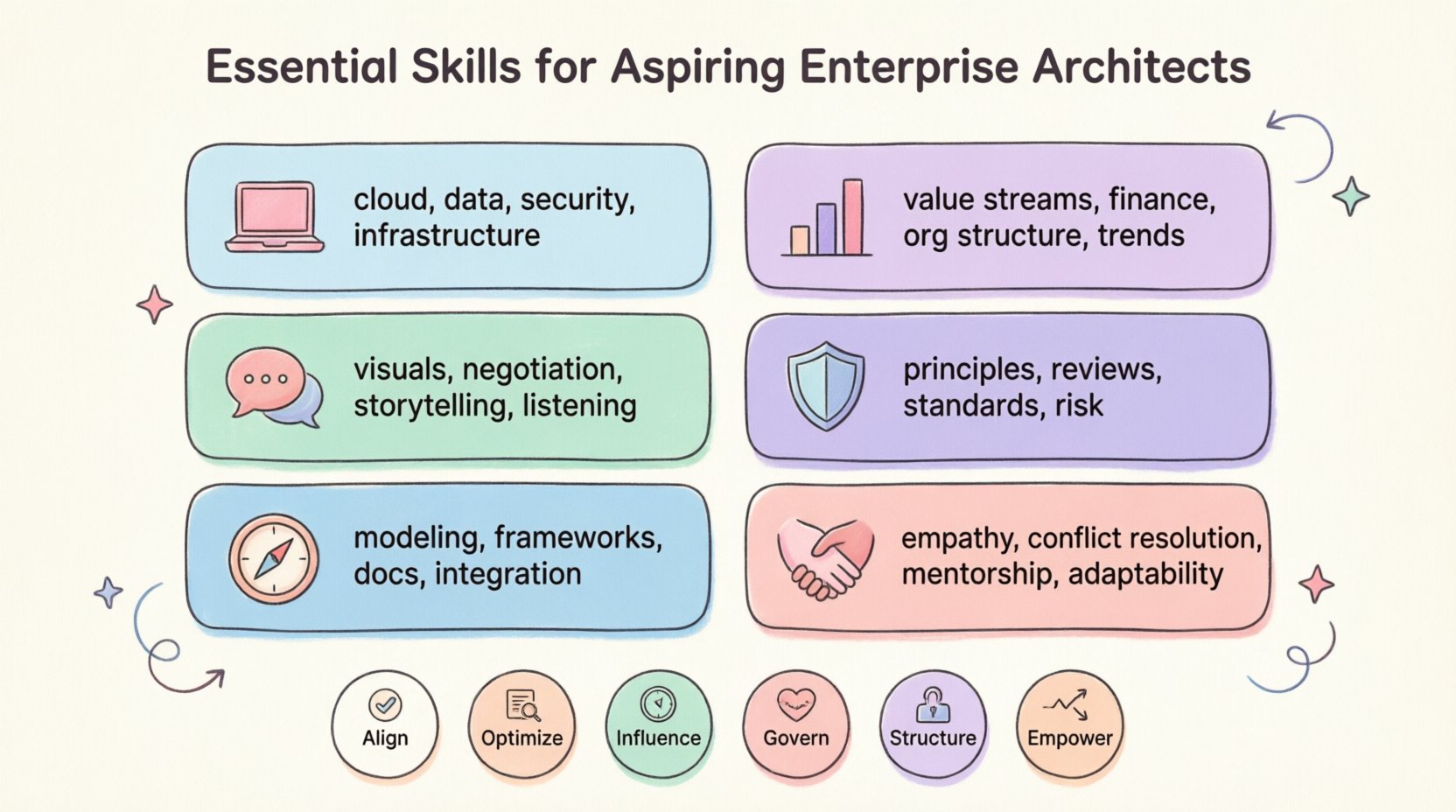
1. Technical Foundation and Infrastructure Knowledge 💻
While an Enterprise Architect does not need to be a hands-on coder, a solid understanding of the underlying technology stack is non-negotiable. You must understand how systems talk to each other, where data flows, and where bottlenecks typically occur.
- Cloud Computing Concepts: Understand the trade-offs between public, private, and hybrid deployments. Knowledge of scalability, elasticity, and cost models is essential.
- Data Architecture: Grasp the principles of data governance, data quality, and data lineage. You need to know how data is stored, processed, and secured across the organization.
- Security and Compliance: Security cannot be an afterthought. You must understand identity management, encryption standards, and regulatory requirements that impact system design.
- Network and Infrastructure: Familiarity with networking protocols, latency issues, and hardware limitations helps in creating realistic deployment strategies.
Without this foundation, architectural decisions risk becoming theoretical exercises that fail when implemented. You must be able to critique technical proposals and identify risks before they become issues.
2. Business Acumen and Strategic Alignment 📊
The most critical differentiator between a good architect and a great one is business understanding. You are not building technology for technology’s sake; you are building it to solve business problems.
- Value Stream Mapping: Learn to identify the steps an organization takes to deliver value to a customer. This helps in spotting waste and inefficiencies in processes.
- Financial Literacy: Understand Total Cost of Ownership (TCO), return on investment (ROI), and budgeting cycles. You need to justify architectural decisions in financial terms to executives.
- Organizational Structure: Know how the company is structured, who holds decision-making power, and how different departments interact. This political landscape is as important as the technical landscape.
- Market Trends: Stay informed about industry shifts. If your industry is moving towards AI or automation, your architecture must accommodate that trajectory.
Aligning IT with business strategy requires constant dialogue. You must be able to speak the language of the CFO and the CEO, not just the CTO.
3. Communication and Stakeholder Management 🗣️
Architecture is a social discipline. You will spend a significant amount of time influencing people rather than writing code. Your ability to communicate complex ideas simply is vital.
- Visual Communication: Use diagrams effectively. A well-crafted view can convey more than a thousand words of text. Ensure your visuals are consistent and understandable by non-technical audiences.
- Negotiation: You will often face conflicting requirements. The ability to negotiate trade-offs between teams while maintaining the integrity of the architecture is a key skill.
- Storytelling: Frame architectural decisions as narratives. Explain the “why” behind the “what.” This helps stakeholders buy into the vision.
- Active Listening: Understand the underlying concerns behind stakeholder requests. Sometimes a request for a specific feature is actually a symptom of a process problem.
4. Governance, Standards, and Compliance 🛡️
Uncontrolled growth leads to technical debt. Governance ensures that the architecture remains consistent, secure, and maintainable over time.
- Architecture Principles: Define and enforce high-level rules that guide decision-making. For example, “Buy before Build” or “Data as an Asset.”
- Review Processes: Establish clear gates where designs are reviewed before implementation begins. This prevents rogue projects from diverging from the standard.
- Standards Management: Maintain a library of approved patterns, technologies, and services. This reduces fragmentation and simplifies integration.
- Risk Management: Proactively identify potential points of failure. Create mitigation plans for single points of failure, data breaches, or vendor lock-in.
5. Methodologies and Modeling Techniques 📐
There are various frameworks and methodologies used to structure architectural thinking. While specific tools vary, the underlying logic remains consistent.
- Modeling Languages: Familiarity with standard modeling notations helps in creating clear blueprints. These visual languages allow teams to see the system from different perspectives.
- Framework Adaptation: Do not adopt a framework blindly. Adapt the methodology to fit the size and culture of the organization. A large enterprise needs different governance than a startup.
- Documentation: Create documentation that is living and useful. Outdated documentation is worse than no documentation because it creates false confidence.
- Integration Patterns: Understand how systems connect. Whether through APIs, event-driven architectures, or service buses, the integration strategy defines system resilience.
6. Soft Skills and Leadership Qualities 🤝
Leadership in architecture is often about influence without authority. You rarely manage the teams that build the systems, but you must guide them.
- Empathy: Understand the constraints and pressures faced by developers and business users. This builds trust and cooperation.
- Conflict Resolution: Disagreements will happen. Address them directly and focus on the best outcome for the organization, not personal ego.
- Mentorship: As you grow, you will guide junior architects. Sharing knowledge strengthens the entire function.
- Adaptability: Requirements change rapidly. Be willing to pivot strategies when the business context shifts without losing sight of the long-term vision.
Core Skill Matrix for Enterprise Architects 📋
To visualize how these skills interact, consider the following breakdown of competencies and their impact on the organization.
| Domain | Key Skill | Practical Application | Impact |
|---|---|---|---|
| Technical | Cloud Strategy | Designing scalable environments | Reduces operational costs |
| Business | Value Streams | Optimizing customer delivery | Increases revenue efficiency |
| Soft Skills | Influence | Driving adoption of standards | Ensures consistency |
| Governance | Risk Assessment | Identifying security gaps | Protects brand reputation |
| Methodology | Modeling | Visualizing system changes | Improves team alignment |
7. Continuous Learning and Evolution 🔄
The technology landscape changes faster than ever. What is relevant today may be obsolete tomorrow. A sustainable career in this field requires a commitment to lifelong learning.
- Stay Curious: Explore emerging technologies like containerization, serverless computing, and AI integration. Understand their architectural implications.
- Community Engagement: Participate in professional groups and forums. Learning from others’ experiences prevents you from repeating mistakes.
- Certifications: Consider recognized credentials that validate your knowledge. These provide structure to your learning journey.
- Reflection: Regularly review past projects. Analyze what worked and what didn’t. This reflection turns experience into wisdom.
Building Your Career Path 🛤️
Transitioning into Enterprise Architecture often starts within an existing IT role. Developers, system administrators, and project managers can pivot by taking on architectural responsibilities within their current teams.
- Start Small: Volunteer to document processes or review designs for your current team. This builds a portfolio of work.
- Find a Mentor: Identify an experienced architect who can provide guidance and feedback on your progress.
- Expand Scope: Move from technical design to business analysis. Broaden your perspective to include financial and operational constraints.
- Network: Connect with peers outside your organization. External perspectives help you see patterns that are invisible internally.
Common Pitfalls to Avoid 🚫
Even experienced professionals can stumble. Being aware of common mistakes helps you navigate the role more effectively.
- Analysis Paralysis: Do not spend too much time designing before building. Iteration is often better than perfection.
- Over-Engineering: Avoid creating complex solutions for simple problems. Simplicity reduces maintenance overhead.
- Ignoring the People: Technology is implemented by people. Ignoring cultural resistance guarantees failure.
- Isolation: Do not work in a silo. Architecture must be a collaborative effort involving all stakeholders.
Final Thoughts on Professional Growth 🌟
Becoming an Enterprise Architect is a journey of continuous development. It requires balancing the immediate needs of the business with the long-term health of the technology landscape. By focusing on these essential skills, you position yourself to add significant value to any organization.
The path involves constant learning and adaptation. You must remain flexible while holding firm to core principles. As you develop these competencies, you will find that your role evolves from a gatekeeper to a strategic partner. This shift is where the true impact lies.
Focus on delivering value, fostering collaboration, and maintaining a clear vision. With dedication and the right skill set, you can build architectures that stand the test of time and drive meaningful business outcomes.