
Building complex digital ecosystems requires more than just code. It demands a structured approach to design, decision-making, and long-term maintenance. Enterprise Architecture (EA) serves as the blueprint for this complexity. Within EA, patterns and reuse strategies play a pivotal role in ensuring systems remain manageable, scalable, and cost-effective over time. This guide explores the fundamental concepts, implementation methods, and strategic considerations involved in leveraging architecture patterns and maximizing reuse across the organization.
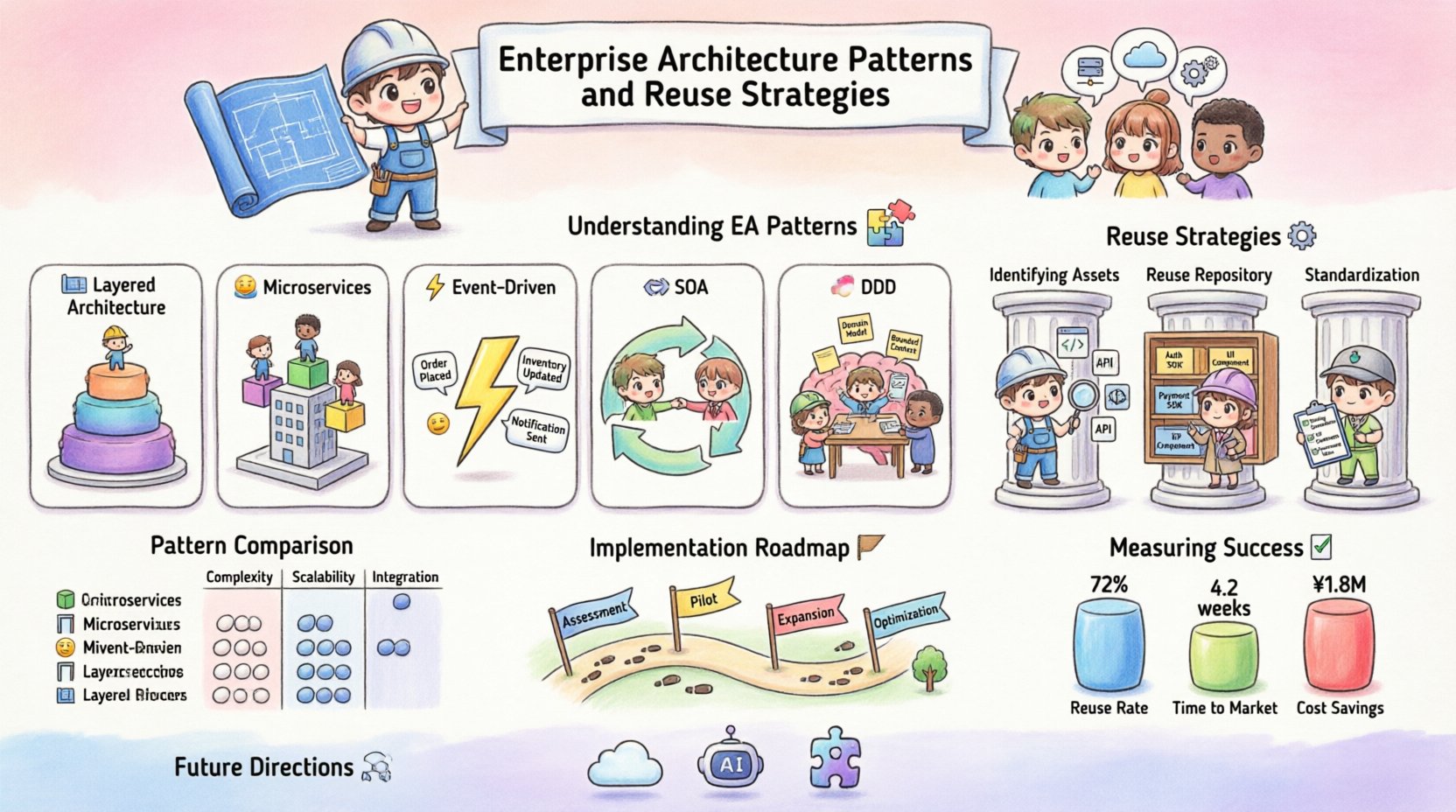
Understanding Enterprise Architecture Patterns 🧩
Enterprise Architecture patterns are proven solutions to recurring problems within an enterprise context. They provide a standardized way to describe how different components interact, ensuring consistency across various projects and departments. Without these patterns, organizations risk creating siloed systems that are difficult to integrate or modify.
Patterns serve several critical functions:
- Communication: They provide a shared vocabulary for architects, developers, and business stakeholders.
- Consistency: They ensure that similar problems are solved in similar ways across different teams.
- Quality: They incorporate lessons learned from past implementations, reducing the likelihood of repeating mistakes.
- Speed: They accelerate development by providing pre-designed templates for common scenarios.
It is important to distinguish between architectural patterns and design patterns. While design patterns focus on code-level structures, architectural patterns operate at a higher level, dealing with system boundaries, deployment models, and data flow.
Common Architecture Patterns Explained 📐
Several patterns dominate the landscape of modern enterprise systems. Selecting the right one depends on business requirements, technical constraints, and organizational maturity.
Layered Architecture 🏛️
The Layered Architecture pattern divides the system into distinct horizontal layers. Each layer has a specific responsibility, and communication typically flows in one direction. A common implementation includes:
- Presentation Layer: Handles user interaction and display.
- Business Logic Layer: Processes rules and workflows.
- Data Access Layer: Manages database interactions.
- Database Layer: Stores persistent data.
This approach is widely used because it is intuitive and separates concerns effectively. However, it can introduce latency if layers call each other excessively.
Microservices Architecture 🧱
Microservices structure an application as a collection of loosely coupled services. Each service runs in its own process and communicates with lightweight mechanisms. This pattern allows teams to develop, deploy, and scale individual components independently.
- Decoupling: Services do not share memory or execution threads.
- Technology Diversity: Different services can use different languages or frameworks.
- Resilience: Failure in one service does not necessarily crash the entire system.
The trade-off involves increased operational complexity. Managing distributed transactions and data consistency requires careful planning.
Event-Driven Architecture ⚡
In this pattern, components communicate by producing and consuming events. An event represents a change in state or an occurrence that has taken place. Producers emit events without knowing which consumers will receive them.
- Asynchronous Processing: Reduces waiting times for users.
- Scalability: Consumers can be scaled independently based on event volume.
- Decoupling: Producers and consumers are independent of each other.
This is ideal for systems requiring high responsiveness, such as real-time analytics or notification services.
Service-Oriented Architecture (SOA) 🔄
SOA is a precursor to microservices, focusing on interoperability between services over a network. It relies heavily on middleware to manage communication. While less popular than microservices today, its principles of service reuse remain relevant.
Domain-Driven Design (DDD) 🧠
DDD focuses on modeling software to match the business domain. It emphasizes understanding the core business logic and translating it into technical structures.
- Bounded Contexts: Defines clear boundaries where specific models apply.
- Ubiquitous Language: Ensures developers and business users speak the same language.
- Aggregates: Groups related data and logic for consistency.
Strategies for Effective Reuse ♻️
Reuse is not merely about copying and pasting code. It is about identifying commonalities and standardizing them to reduce effort and risk. A robust reuse strategy involves three main pillars.
1. Identifying Reusable Assets
Organizations must systematically identify what can be reused. This includes:
- Business Rules: Policies that apply across multiple systems.
- APIs: Interfaces that expose functionality to other applications.
- Components: Reusable code modules or libraries.
- Designs: UI templates or layout standards.
Asset identification requires collaboration between business analysts and technical leads. It ensures that the reusable elements actually solve business problems.
2. Creating a Reuse Repository
A centralized repository is essential for managing reusable assets. It acts as a catalog where teams can search, discover, and access approved components.
- Metadata: Each asset should have tags, descriptions, and version history.
- Access Control: Permissions ensure only validated components are used.
- Feedback Loops: Users should be able to report issues or suggest improvements.
Without a repository, assets become scattered, and teams often reinvent the wheel.
3. Standardization and Governance
Standards define how assets should be built. Governance ensures adherence to these standards.
- Interface Contracts: APIs must follow defined schemas and protocols.
- Security Policies: Authentication and authorization must be consistent.
- Documentation: Usage guidelines must be clear and up-to-date.
Governance and Management 🛡️
Implementing patterns and reuse strategies requires a governance framework. Without oversight, patterns become obsolete, and repositories fill with unused or broken code.
Architecture Review Boards
A review board evaluates proposed designs against enterprise standards. Their responsibilities include:
- Validating that new solutions align with existing patterns.
- Identifying opportunities for reuse in new projects.
- Resolving conflicts between different architectural decisions.
This board should include representatives from development, operations, security, and business units.
Pattern Lifecycle Management
Patterns, like software, have a lifecycle. They are introduced, adopted, maintained, and eventually retired.
- Introduction: Define the pattern and publish documentation.
- Adoption: Train teams and provide support tools.
- Maintenance: Update the pattern as technology evolves.
- Retirement: Communicate end-of-life dates and migration paths.
Balancing Reuse and Flexibility ⚖️
One of the biggest risks in reuse is over-engineering. Creating a highly generic component that fits every scenario can lead to unnecessary complexity.
Risks of Over-Reuse
- Complexity: Generic solutions often require complex configuration logic.
- Performance: Abstraction layers can introduce latency.
- Maintenance: Changing a core asset affects all dependent systems.
Risks of Under-Reuse
- Cost: Duplication increases development and licensing expenses.
- Inconsistency: Different teams build different solutions for the same problem.
- Technical Debt: Proprietary solutions become difficult to replace later.
The goal is to find a balance. Reuse should be driven by actual need, not theoretical potential. If a solution is used three times, it is a strong candidate for extraction into a shared asset.
Measuring Success 📊
To justify the investment in architecture and reuse, organizations need metrics. These measurements track efficiency, quality, and cost.
Key Performance Indicators
- Reuse Rate: Percentage of new features built using existing assets.
- Time to Market: Reduction in development cycles due to reused components.
- Defect Density: Bug rates in reused versus custom code.
- Cost Savings: Reduction in licensing and development hours.
Feedback Mechanisms
Quantitative data must be supplemented with qualitative feedback. Regular surveys with development teams can reveal friction points in the reuse process.
Future Directions 🔮
The landscape of enterprise architecture is evolving. Several trends are shaping how patterns and reuse strategies are applied.
Cloud-Native Shifts
As organizations move to cloud platforms, architecture patterns adapt to leverage elasticity and managed services. Serverless computing and container orchestration are becoming standard considerations in pattern selection.
Automation and AI
Artificial intelligence is beginning to assist in architecture design. Tools can analyze existing codebases to suggest patterns or identify opportunities for refactoring. Automated governance can enforce standards without manual review for every change.
Low-Code and No-Code
These platforms abstract away much of the underlying code. Patterns in this space focus on component composition rather than implementation details. This shifts the burden of architecture to the platform provider, requiring new strategies for integration and data management.
Comparison of Architecture Patterns 📋
The table below summarizes the characteristics of common patterns to assist in selection.
| Pattern | Best Use Case | Complexity | Scalability | Integration Effort |
|---|---|---|---|---|
| Layered | Monolithic applications | Low | Medium | Low |
| Microservices | Distributed, scalable systems | High | High | High |
| Event-Driven | Real-time, asynchronous workflows | Medium | High | Medium |
| SOA | Legacy integration, interoperability | High | Medium | High |
| DDD | Complex business logic domains | High | Variable | Variable |
Implementation Roadmap 🗺️
Adopting these strategies does not happen overnight. A phased approach ensures stability and adoption.
Phase 1: Assessment
- Audit existing systems for commonalities.
- Identify pain points in current development.
- Define initial set of standards.
Phase 2: Pilot
- Select a low-risk project to apply patterns.
- Establish the reuse repository.
- Train the core team.
Phase 3: Expansion
- Roll out to additional projects.
- Refine standards based on feedback.
- Automate governance checks.
Phase 4: Optimization
- Review metrics and adjust strategy.
- Retire outdated patterns.
- Invest in developer tooling.
Conclusion 🎯
Enterprise Architecture Patterns and Reuse Strategies are foundational to building sustainable technology ecosystems. They provide the structure needed to manage complexity while enabling speed and innovation. By focusing on standardization, governance, and measurable outcomes, organizations can reduce technical debt and align technology with business goals.
The journey requires commitment. It involves changing mindsets, updating processes, and investing in tools. However, the long-term benefits of a well-architected enterprise are clear: systems that are easier to maintain, cheaper to operate, and faster to adapt to market changes.