
In the dynamic landscape of Agile development, the sprint commitment serves as the cornerstone of predictability and trust. It represents the agreement between the development team and the Product Owner regarding what value can be delivered within a fixed timeframe. However, this agreement rests on a fragile foundation if the underlying requirements are vague, incomplete, or ambiguous. When teams commit to work without clear understanding, the result is often technical debt, missed deadlines, and frustrated stakeholders.
Ensuring requirement clarity before sprint commitment is not merely a procedural step; it is a strategic necessity. It shifts the focus from simply filling a calendar to delivering verified value. This guide explores the mechanics, strategies, and cultural shifts required to achieve this clarity, reducing risk and enhancing team velocity.
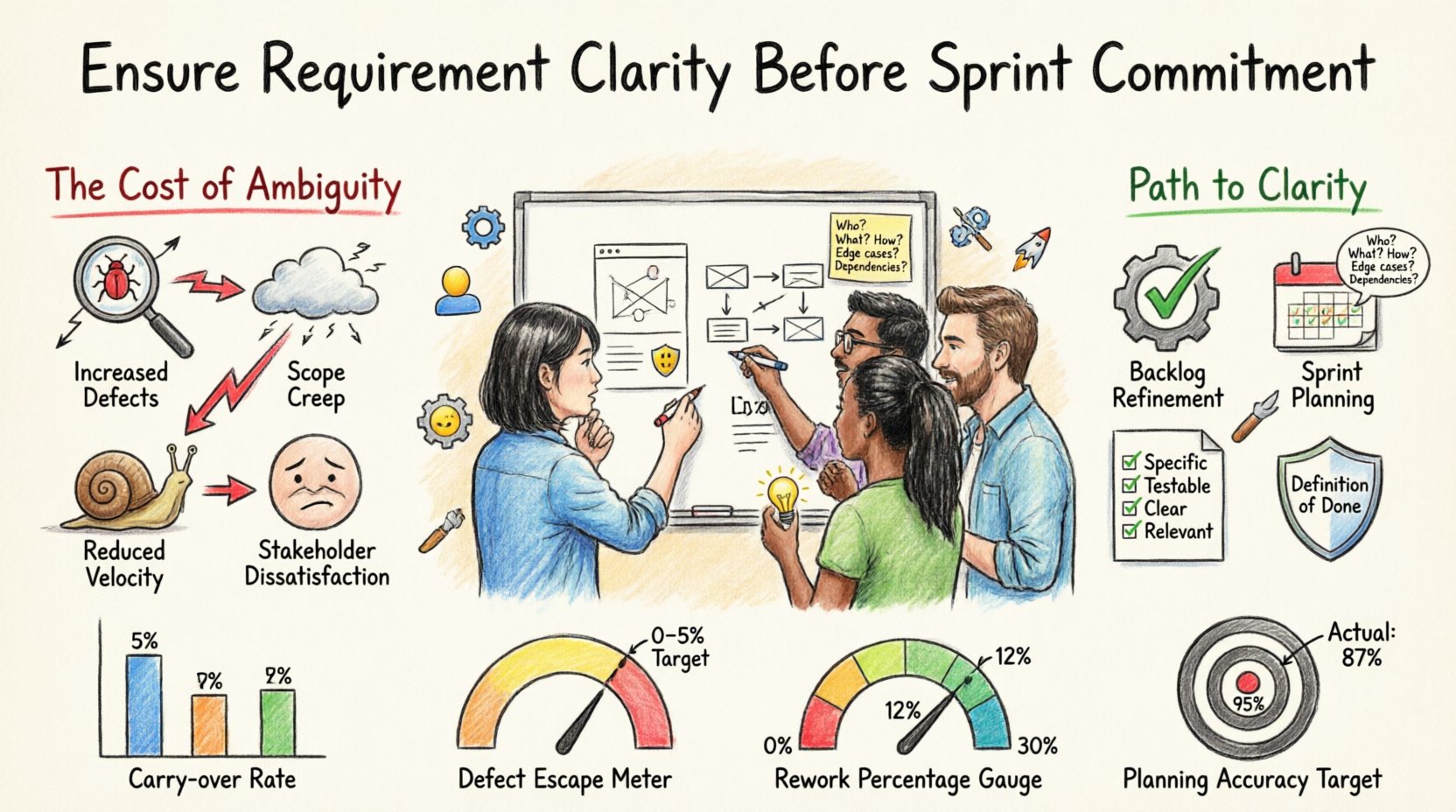
The High Cost of Ambiguity 💸
Ambiguity in requirements acts as a silent tax on productivity. When a developer interprets a user story differently than the stakeholder intended, the cost is not just time spent coding, but time spent reworking, testing, and communicating. This rework compounds over a sprint, leading to burnout and a decline in quality.
Consider the following impacts of unclear requirements:
- Increased Defect Rates: Code written based on assumptions is more likely to fail acceptance criteria.
- Scope Creep: Without clear boundaries, new ideas slip into the sprint without proper prioritization.
- Reduced Velocity: Time spent asking clarifying questions during the sprint reduces time available for development.
- Stakeholder Dissatisfaction: Delivering a feature that does not match the mental model of the business owner damages trust.
By addressing clarity early, teams mitigate these risks. The goal is to move from a mindset of “we will figure it out later” to “we understand the problem before we propose a solution.”
The Role of the Sprint Planning Event 📅
Sprint planning is the primary venue where clarity is either established or missed. This event is divided into two distinct parts: defining what can be done and deciding how to get it done. The first part relies entirely on the quality of the input data—the backlog items.
During this session, the team must engage in deep discussion. Passive reading of user stories is insufficient. Active interrogation is required. The following questions should be answered before an item is pulled into the sprint:
- Who is the end user for this feature? 👤
- What specific problem does this solve? 🛠️
- How will we know the feature is complete? ✅
- Are there any edge cases or constraints? ⚠️
- Does this depend on external systems or third-party services? 🔗
If the answer to any of these is “I don’t know,” the item should not be committed. It belongs back in refinement until it is ready. Committing to unknowns is a gamble, not a plan.
Defining Acceptance Criteria and the Definition of Done 📝
Clarity is often the difference between a vague description and a testable condition. Acceptance criteria provide the boundary conditions for a user story. They define the specific conditions that must be met for the story to be considered complete.
Effective acceptance criteria should be:
- Specific: Avoid words like “fast” or “easy.” Use metrics like “loads in under 2 seconds.”
- Testable: A tester must be able to write a test case based on the criteria.
- Clear: The language should be unambiguous and accessible to all team members, not just developers.
- Relevant: They must directly relate to the user need, not implementation details.
Furthermore, the Definition of Done (DoD) applies to the entire sprint, not just individual items. The DoD ensures consistency. If the DoD includes “code review completed,” “unit tests passed,” and “documentation updated,” then a feature is not considered done until these are met, regardless of the specific user story.
Backlog Refinement: The Engine of Clarity ⚙️
Sprint planning cannot fix a broken backlog. Backlog refinement, often called grooming, is the ongoing process of preparing work items for future sprints. This is where the heavy lifting of clarity occurs.
Teams should dedicate a portion of their sprint capacity to refinement. This ensures that upcoming sprints are not discovered for the first time during the planning meeting. The refinement process involves:
- Breaking down Epics: Large initiatives must be split into smaller, manageable stories.
- Estimating Effort: Using relative sizing to understand complexity.
- Identifying Dependencies: Mapping out where work relies on other teams or systems.
- Clarifying Business Value: Ensuring every item has a clear reason for existence.
When refinement is done well, sprint planning becomes a confirmation of the work rather than a discovery session. This shift saves time and reduces cognitive load for the team during the sprint.
Common Pitfalls in Requirement Definition 🚧
Even experienced teams fall into traps that obscure clarity. Recognizing these patterns is the first step to avoiding them. The table below outlines common pitfalls and their corresponding remedies.
| Common Pitfall | Impact | Remedy |
|---|---|---|
| Assuming shared context | Developers build based on incorrect assumptions. | Document context explicitly in the story description. |
| Too much detail upfront | Stifles creativity and innovation. | Provide enough detail to understand value, leave implementation open. |
| Missing acceptance criteria | Unclear definition of success. | Require criteria for every story before refinement. |
| Ignoring non-functional needs | Performance or security issues post-release. | Include technical requirements alongside functional ones. |
| Stakeholder unavailability | Questions go unanswered during sprint. | Schedule dedicated availability windows for the Product Owner. |
Communication Strategies for Clarity 🗣️
Clarity is not just about documentation; it is about communication. Written text can be misinterpreted. Verbal communication adds nuance. The most effective teams utilize a combination of both.
One-on-one conversations between developers and the Product Owner are invaluable. These discussions allow for immediate feedback and clarification. However, these insights must be captured. If a clarification happens verbally but is not written down, it is lost when the person moves on.
Visual aids also play a crucial role. Wireframes, flowcharts, and mockups can convey spatial and interaction requirements better than text alone. When a story involves complex user flows, a diagram is often worth a thousand words.
The Culture of Questioning 🧠
For requirements to be clear, team members must feel safe asking questions. A culture of silence often masks confusion. If a developer feels they will be judged for not understanding a requirement, they will nod and proceed, leading to errors.
Leadership must foster an environment where “I don’t understand” is a valid and encouraged statement. This requires:
- Psychological Safety: Ensuring no negative repercussions for asking for help.
- Active Listening: Leaders must listen to understand, not just to reply.
- Transparency: Admitting when requirements are unknown is better than pretending they are known.
When the team feels empowered to challenge assumptions, the quality of the output improves significantly. The goal is collaboration, not just execution.
Measuring Clarity and Predictability 📊
How do you know if your requirements are clear? Metrics provide feedback. While velocity is a common measure, it can be misleading if not contextualized. A more accurate indicator of requirement clarity is the rate of work carry-over.
If a high percentage of committed stories are not completed by the end of the sprint, it is a strong signal that the requirements were not understood or the scope was underestimated. Tracking this metric over time helps identify trends.
Other indicators include:
- Defect Escape Rate: How many bugs are found in production that should have been caught during testing?
- Rework Percentage: How much time is spent fixing work that was already done?
- Planning Accuracy: How close is the actual effort to the estimated effort?
Reviewing these metrics during the retrospective allows the team to adjust their refinement process. If clarity is low, the team must dedicate more time to preparation before the next sprint begins.
Handling Changing Requirements 🔄
Agile embraces change, but this does not mean requirements should be fluid during a sprint. Once a sprint commitment is made, the scope should be stable. If a requirement changes mid-sprint, it must be evaluated carefully.
Removing an item from a sprint is preferable to adding a new one without removing an old one. This maintains the balance of effort and ensures the team does not become overwhelmed. If a new high-priority item emerges, it must replace an existing item of similar size.
This discipline protects the team from context switching. Context switching is one of the biggest killers of productivity. Keeping the scope stable allows developers to maintain their flow state, leading to higher quality work.
Technical Debt and Requirement Clarity 🏗️
Unclear requirements often lead to technical debt. When developers are unsure of the long-term goal, they may choose the path of least resistance. This shortcuts the architecture, creating a fragile system that is hard to change later.
Clarity helps manage technical debt by providing a clear vision of the destination. When the goal is clear, developers can make informed decisions about architecture that align with future needs. They can invest in refactoring knowing it supports the broader objective.
Product Owners should also be aware of technical requirements. Sometimes, the “work” is purely infrastructure or refactoring. These items must be treated with the same rigor as feature work, with clear acceptance criteria regarding performance or stability.
Integrating Testing Early 🧪
Testing should not wait until the code is written. Testers should be involved during the refinement and planning phases. Their perspective on edge cases and validation logic is vital for clarity.
When testers help define acceptance criteria, the resulting stories are more robust. They can identify scenarios that developers might overlook. This collaboration ensures that the definition of done includes all necessary verification steps.
This approach is known as shift-left testing. By moving testing activities earlier, teams catch ambiguities sooner. Catching a requirement gap during planning is exponentially cheaper than catching it after deployment.
Final Thoughts on Execution 🚀
Ensuring requirement clarity is a continuous journey, not a destination. It requires discipline, communication, and a commitment to quality. Teams that prioritize this aspect of their workflow see higher morale, better predictability, and greater stakeholder satisfaction.
The effort spent clarifying requirements upfront pays dividends throughout the sprint. It reduces the need for emergency meetings, minimizes rework, and allows the team to focus on building value. In the end, the most efficient way to move fast is to understand where you are going before you start running.
Adopt these practices consistently, and watch your team’s performance transform. The path to predictability begins with a single, clear question: Do we truly understand what we are building?