
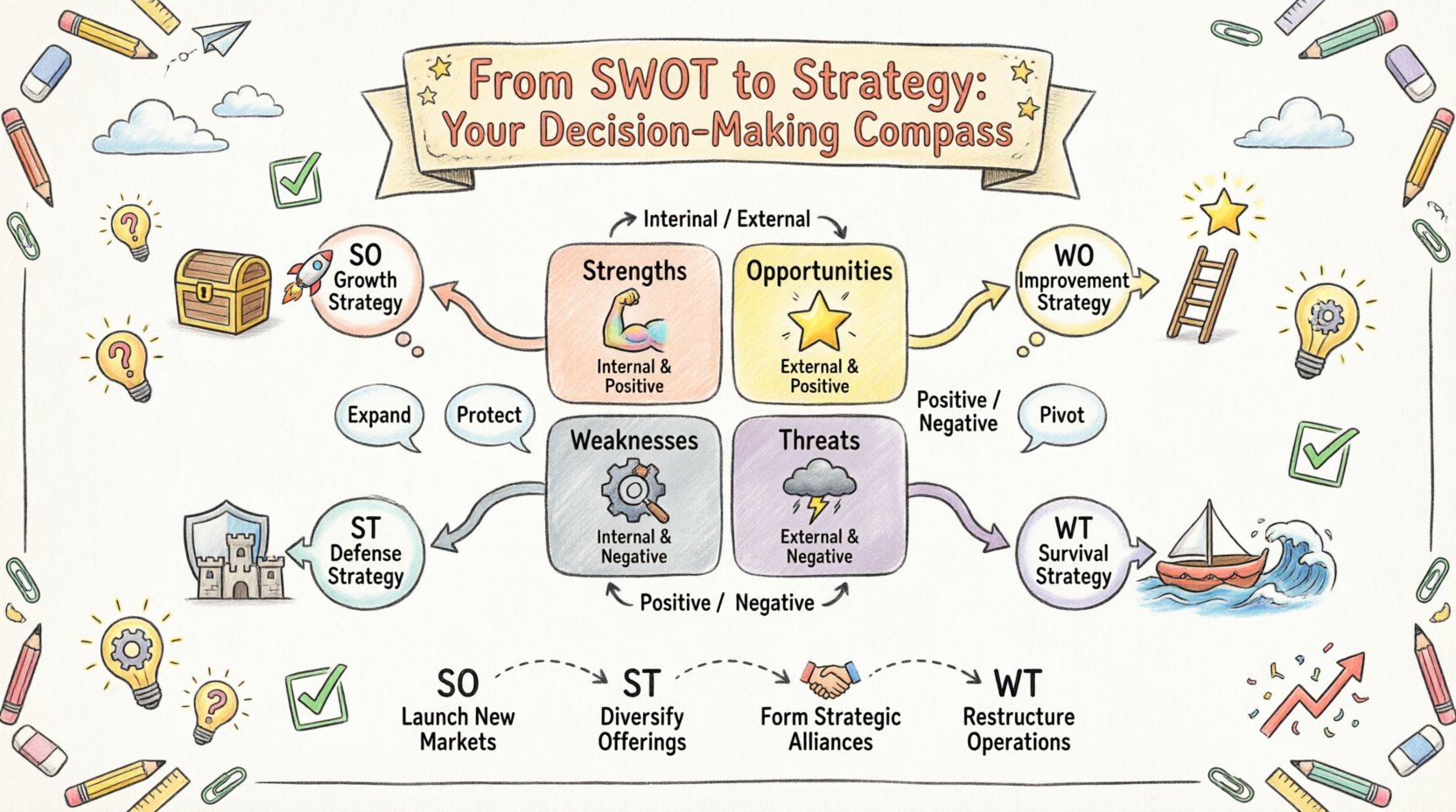
Strategic planning often begins with data collection. Organizations gather market research, financial reports, and customer feedback. However, raw data does not equal strategy. The bridge between information and action lies in structured analysis. The SWOT framework remains a cornerstone for this process. It categorizes internal and external factors that influence organizational outcomes. Connecting these elements to actual decision-making requires more than just listing items. It demands a rigorous mapping of capabilities to market realities.
This guide explores how to move beyond a static list. We will examine how Strengths, Weaknesses, Opportunities, and Threats drive concrete choices. The goal is practical application. We avoid fluff and focus on the mechanics of strategic alignment. Let us build a clear path from analysis to execution.
Understanding the Foundation 🏗️
SWOT stands for Strengths, Weaknesses, Opportunities, and Threats. It is a matrix. It divides factors into two dimensions: internal versus external. It also divides them into two states: positive versus negative. This structure simplifies complexity. It allows leaders to see the landscape without getting lost in details.
- Internal Factors: These are within your control. They include resources, culture, and processes.
- External Factors: These are outside your control. They include market trends, regulations, and competitors.
- Positive Factors: Assets that help you succeed. These are Strengths and Opportunities.
- Negative Factors: Obstacles that hinder progress. These are Weaknesses and Threats.
When teams treat SWOT as a box-checking exercise, value is lost. The power comes from the intersection of these quadrants. A Strength can only become an advantage if it targets an Opportunity. A Weakness becomes critical if it exposes the organization to a Threat. This logic drives the decision-making engine.
Internal Factors: Strengths & Weaknesses 💪
Internal analysis requires honesty. It is often easier to highlight what goes well than what does not. However, strategic decisions fail when they ignore internal limitations. You must assess resources objectively.
Identifying Strengths
Strengths are attributes that give you an advantage over others. They are the reasons customers choose you. They are the reasons you can execute faster than competitors. Examples include:
- Proprietary technology or patents 🧬
- Strong brand recognition and loyalty 🏆
- Efficient supply chain logistics 🚚
- Talented workforce with specialized skills 👥
- Robust cash flow and financial reserves 💰
When making a decision, ask: “How does this strength enable us to do something others cannot?” If a decision relies on a strength that is not currently active, plan for its activation. Do not assume strength exists just because it existed last year.
Identifying Weaknesses
Weaknesses are attributes that place you at a disadvantage. They limit your ability to achieve goals. Ignoring them creates blind spots. Addressing them frees up capacity for growth. Common weaknesses include:
- Outdated technology infrastructure 💻
- High employee turnover rates 🔄
- Dependence on a single client 🏢
- Limited distribution channels 🚧
- Weak cybersecurity protocols 🛡️
Strategic decisions often involve mitigation. You cannot always fix a weakness immediately. Sometimes the decision is to outsource the function. Sometimes it is to invest in training. Sometimes it is to accept the risk and proceed with caution. The key is awareness. If you launch a new product without addressing a production bottleneck, the launch will fail.
External Factors: Opportunities & Threats 🌍
External factors shape the environment in which you operate. You cannot control them, but you can respond to them. Strategy is essentially managing the relationship between your internal state and external conditions.
Capturing Opportunities
Opportunities are chances to improve performance or gain market share. They often arise from changes in the market. Examples include:
- Emerging markets with high demand 🌐
- Changes in legislation favoring your sector ⚖️
- Competitors exiting the market 📉
- Shifts in consumer behavior towards digital 📱
- Gaps in competitor offerings 💡
Decisions here are about investment. Should we enter this market? Should we acquire this technology? The decision depends on whether you have the Strengths to seize the Opportunity. If you have a great opportunity but no internal capacity, the decision is to build capacity first.
Defending Against Threats
Threats are obstacles that could cause trouble. They are external risks. Examples include:
- New competitors entering the space 🆕
- Raw material price volatility 📈
- Changes in trade policies 📜
- Economic recessions reducing spend 📉
- Technological disruption rendering products obsolete 🤖
Strategic decisions here focus on risk management. You might diversify suppliers to reduce price volatility. You might invest in R&D to stay ahead of disruption. You might build a cash reserve to weather a recession. The decision is about resilience.
Mapping to Decisions: The Logic of Action 🔄
Listing the four elements is not enough. You must connect them. This process turns a list into a plan. The connection happens when you cross-reference internal and external factors.
Consider the following logic:
- Strength + Opportunity: This is a growth strategy. Use your best assets to grab the best chances.
- Strength + Threat: This is a defense strategy. Use your assets to protect against risks.
- Weakness + Opportunity: This is an improvement strategy. Fix the weakness to take the chance.
- Weakness + Threat: This is a survival strategy. Minimize exposure to avoid failure.
Here is a table to visualize how these connections drive specific decision types:
| Intersection | Focus | Typical Decision |
|---|---|---|
| Strength + Opportunity 🚀 | Growth | Expand into new regions, launch new products. |
| Strength + Threat 🛡️ | Protection | Price wars, lock in contracts, patent protection. |
| Weakness + Opportunity 🛠️ | Development | Partner with others, hire consultants, training programs. |
| Weakness + Threat ⚠️ | Minimization | Divest, pivot, reduce costs, exit market. |
The TOWS Matrix Approach 📊
Some teams find standard SWOT too passive. They prefer the TOWS Matrix. It simply reverses the order. It asks how to use external factors to influence internal ones. It forces a more dynamic view.
SO Strategies (Maxi-Maxi)
Use Strengths to maximize Opportunities. This is aggressive expansion. If you have a strong brand and a new market opens, you dominate. The decision is to allocate maximum resources here.
WO Strategies (Mini-Maxi)
Overcome Weaknesses by taking advantage of Opportunities. This is often about partnerships. If you lack technology but the market wants it, partner with a tech firm. The decision is to collaborate rather than build from scratch.
ST Strategies (Maxi-Mini)
Use Strengths to minimize Threats. This is defensive. If you have high cash reserves and a recession hits, you buy competitors. The decision is to use financial strength to gain market share during a downturn.
WT Strategies (Mini-Mini)
Minimize Weaknesses and avoid Threats. This is survival. If you have poor cash flow and debt is rising, cut costs immediately. The decision is risk avoidance.
Common Implementation Challenges ⚠️
Even with a solid framework, execution often falters. Knowing the pitfalls helps you avoid them. These issues prevent SWOT from influencing decisions.
- Generality: Statements like “good customer service” are too vague. They do not guide decisions. Be specific. “24-hour support response time” is actionable.
- Subjectivity: Teams often view strengths as weaknesses due to bias. Use data to validate claims. Sales numbers, churn rates, and survey scores matter more than opinions.
- Static Lists: A SWOT created once and filed away is useless. Markets change. The analysis must be updated quarterly or annually.
- Disconnect from Budget: If the strategy is not funded, it is not a strategy. Decisions must include budget allocations.
- Ignoring Priorities: Not all Strengths are equal. Prioritize the ones that matter most to the core strategy.
Measuring Strategic Alignment 📏
How do you know if the SWOT analysis actually improved decision-making? You measure outcomes. The link between the analysis and the result must be visible.
Track the following metrics:
- Decision Velocity: Did the analysis reduce the time to make key choices? A clear SWOT reduces debate.
- Resource Allocation: Did funds move to high-priority Strengths and Opportunities? Look at the budget.
- Risk Mitigation: Did known Threats result in contingency plans? Check risk registers.
- Performance Outcomes: Did the initiatives based on the SWOT meet targets? Compare KPIs before and after.
Final Thoughts on Strategic Agility 🚀
SWOT is not a crystal ball. It does not predict the future. It maps the present to inform the future. Its value is in clarity. It forces leaders to look at the whole picture. It prevents tunnel vision.
When you connect SWOT elements to decision-making, you stop guessing. You start planning based on evidence. You align your internal reality with external possibilities. This alignment is the essence of strategy.
Remember that strategy is a verb. It is what you do. The analysis is the tool. The decision is the action. Keep the connection tight. Ensure every strategic move can be traced back to a specific element in your analysis. This discipline creates sustainable growth.
By treating SWOT as a living framework, you maintain agility. You update it as conditions shift. You make decisions that are robust against change. This approach builds organizations that are resilient and responsive.