Enterprise Architecture (EA) serves as the strategic blueprint for aligning business goals with IT capabilities. Without a structured approach, organizations often face fragmented systems, redundant processes, and misaligned investments. Frameworks provide the necessary structure to organize these complex elements. They offer standardized vocabularies, models, and processes that guide decision-making. This guide examines the most prominent frameworks used globally. We will analyze their structures, strengths, and appropriate use cases. The goal is to provide a clear understanding of how to select the right methodology for your organizational needs.
📚 The Role of Enterprise Architecture Frameworks
Frameworks are not software products. They are conceptual structures. They define the boundaries of the architecture domain. They establish relationships between business strategy and technology implementation. Using a framework helps stakeholders communicate effectively. It reduces ambiguity in technical discussions. It ensures that all parts of the organization speak the same language.
Choosing a framework depends on several factors. Industry regulations play a significant role. The size of the organization matters. The maturity of the current IT landscape influences the choice. Some frameworks are more prescriptive, while others are descriptive. The following sections detail the specific characteristics of the leading options.
🔷 The Open Group Architecture Framework (TOGAF)
TOGAF is widely recognized in the private and public sectors. It focuses on the Architecture Development Method (ADM). This is a cyclical process that guides the creation of architecture. The method ensures that the architecture evolves with business needs. It is modular, allowing organizations to adopt specific parts as needed.
Key Components of TOGAF:
- Architecture Development Method (ADM): A step-by-step guide for developing an architecture. It includes phases like Preliminary, Vision, Business, Information Systems, Technology, and Opportunities & Solutions.
- Enterprise Continuum: A mechanism for classifying architecture assets. It helps in understanding how specific solutions fit into the broader organizational context.
- Architecture Repository: A storage system for architecture artifacts. It contains models, diagrams, and requirements for future reference.
- Architecture Capability: The organizational structure required to support EA activities. This includes governance and management processes.
Strengths:
- Comprehensive Coverage: It addresses business, data, application, and technology layers comprehensively.
- Flexibility: The ADM can be tailored to specific project requirements. It is not rigid.
- Community Support: A large community provides resources, certifications, and best practices.
- Integration: It integrates well with other standards and processes like ITIL or COBIT.
Challenges:
- Complexity: The sheer volume of documentation can be overwhelming for smaller teams.
- Implementation Cost: Training and certification require significant time and investment.
- Adaptation: Organizations must customize the framework to avoid bureaucracy.
🟦 The Zachman Framework
The Zachman Framework is an ontology. It is not a methodology. It does not tell you how to build the architecture. It tells you what questions need to be answered. It is structured as a 6×6 matrix. The rows represent the perspectives of the stakeholders. The columns represent the aspects of the data.
The Six Perspectives (Rows):
- Planner (Scope): The context of the architecture. High-level business goals.
- Owner (Business): The business concept. What the organization does.
- Designer (System): The logical design. How the business functions.
- Builder (Technology): The physical design. The technology implementation.
- Subcontractor (Detailed Representations): The code and data structures.
- Functioning Enterprise (Instantiation): The actual running system.
The Six Aspects (Columns):
- What: Data entities. The nouns of the business.
- How: Functions and processes. The verbs of the business.
- Where: Locations and networks. The physical distribution.
- Who: People and organizations. The actors involved.
- When: Timing and events. The schedule of operations.
- Why: Motivation and goals. The drivers behind the design.
Strengths:
- Universal Applicability: It applies to any size organization or industry.
- Clarity: It ensures that every aspect of the system is defined from every perspective.
- Foundation: It serves as a solid foundation for other methodologies.
- Focus on Data: It emphasizes the integrity and classification of data.
Challenges:
- Static Nature: It does not provide a process for change management.
- Documentation Heavy: Completing the matrix requires extensive documentation.
- Interpretation: Different teams may interpret the cells differently without governance.
🟪 Department of Defense Architecture Framework (DODAF)
DODAF was developed for the US Department of Defense. It has since been adopted by other government and defense-related organizations. It focuses on interoperability and capability. The framework ensures that systems can work together effectively.
Core Views:
- All Views: A summary of the architecture.
- Data and Information View: Describes data standards and exchange protocols.
- Capability View: Describes what the organization needs to do.
- Projects View: Describes the projects that will deliver capabilities.
- Services View: Describes the services available to support operations.
- Systems View: Describes the systems and their interactions.
- Standards View: Describes the standards used.
- Operational View: Describes the operational scenarios and missions.
Strengths:
- Interoperability Focus: Excellent for complex systems that must communicate.
- Government Standard: Required for many defense contracts.
- Scenario-Based: Strong emphasis on operational scenarios and missions.
- Modularity: Allows for focused analysis on specific views.
Challenges:
- Complexity: The number of views can create significant overhead.
- Specificity: It is highly specific to defense and government contexts.
- Resource Intensive: Requires dedicated staff to manage the documentation.
🟩 Federal Enterprise Architecture Framework (FEAF)
FEAF is used by the US Federal Government. It is based on the principles of DODAF but is tailored for civilian agencies. It focuses on common services and shared resources. The goal is to reduce redundancy across agencies.
Key Elements:
- Performance Reference Model (PRM): Measures performance against strategic goals.
- Business Reference Model (BRM): Describes the business processes and functions.
- Service Component Reference Model (SRM): Describes the services that support the business.
- Technical Reference Model (TRM): Describes the technologies used.
- Data Reference Model (DRM): Describes the data structures.
Strengths:
- Standardization: Promotes consistency across federal agencies.
- Cost Efficiency: Identifies opportunities for shared services.
- Transparency: Makes IT investments visible and accountable.
Challenges:
- Bureaucracy: Strict adherence to federal guidelines can slow innovation.
- Scope: Limited applicability outside the government sector.
- Updates: Framework updates can take time to implement across agencies.
📊 Comparative Analysis
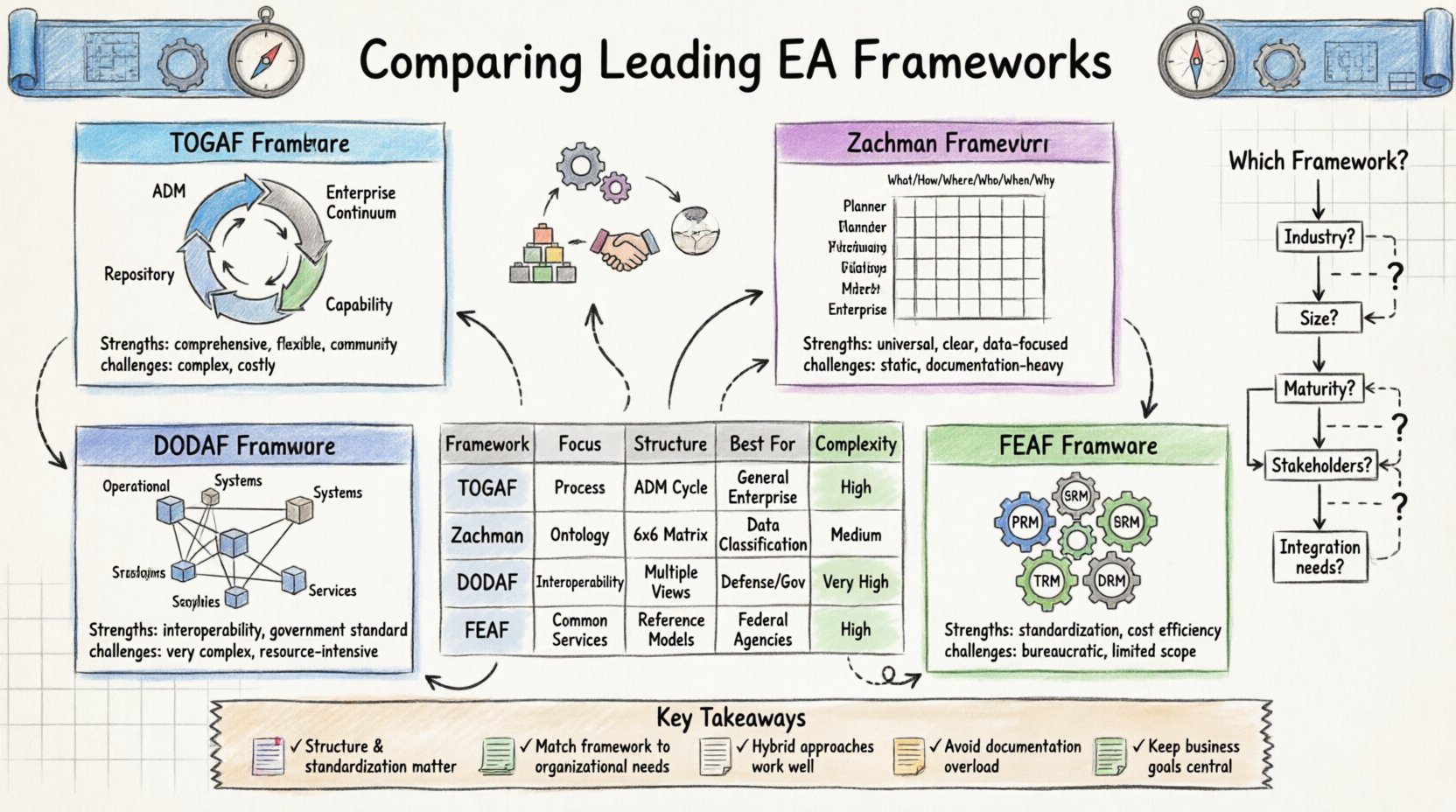
Understanding the differences helps in selection. The table below summarizes the key distinctions between the major frameworks.
| Framework | Primary Focus | Structure | Best For | Complexity |
|---|---|---|---|---|
| TOGAF | Process & Methodology | ADM Cycle | General Enterprise | High |
| Zachman | Ontology & Structure | 6×6 Matrix | Data & Asset Classification | Medium |
| DODAF | Interoperability | Multiple Views | Defense & Government | Very High |
| FEAF | Common Services | Reference Models | Federal Agencies | High |
🔍 Selecting the Right Framework
Selection is a strategic decision. It should align with the organization’s maturity and goals. Consider the following criteria when making a choice.
- Industry Requirements: Certain industries mandate specific frameworks. Defense contractors often need DODAF. Financial institutions may prefer TOGAF for its risk management focus.
- Organizational Size: Large enterprises benefit from the structure of TOGAF or Zachman. Smaller organizations may find the overhead too burdensome and prefer a lightweight approach.
- Current Maturity: If the organization is new to EA, a framework with strong process guidance like TOGAF is helpful. If the focus is purely on data governance, Zachman might be more appropriate.
- Stakeholder Needs: Who is the audience for the architecture? Executives need high-level views. Engineers need detailed technical specifications. The framework must support both.
- Integration Needs: Does the framework integrate with existing standards? TOGAF integrates well with ITIL. Zachman is often used as a supplement to other methods.
Hybrid Approaches:
Many organizations do not use a single framework exclusively. They adopt a hybrid model. For example, an organization might use TOGAF for the process and Zachman for the data classification. This allows for flexibility. It ensures that the strengths of different methodologies are leveraged. The key is to maintain consistency in the output.
🛠️ Implementation Considerations
Implementing a framework is a significant undertaking. It requires commitment from leadership. It requires resources for training. It requires a culture of documentation and governance.
- Governance Structure: Establish an Architecture Board. This group reviews and approves architecture decisions. It ensures alignment with strategy.
- Tooling: Use repository tools to store artifacts. This ensures version control and accessibility. Avoid manual document management.
- Training: Invest in certification for key staff. This builds internal capability. It ensures a common understanding of the terminology.
- Incremental Adoption: Do not attempt to map everything at once. Start with critical business domains. Expand the scope as the framework matures.
- Metrics: Define success metrics. Track the reduction in system redundancy. Measure the speed of deployment for new initiatives.
⚠️ Common Pitfalls to Avoid
Even with a solid framework, projects can fail. Awareness of common mistakes helps mitigate risk.
- Documentation Overload: Creating documentation for the sake of documentation is a waste of time. Focus on value. Only document what is needed for decision-making.
- Lack of Executive Support: Without leadership backing, the EA function becomes isolated. It must be integrated into strategic planning.
- Rigidity: Treating the framework as a rigid set of rules hinders innovation. Adapt the framework to fit the business, not vice versa.
- Ignoring the Business: Focusing too much on technology ignores the business drivers. The architecture must solve business problems.
- Infrequent Updates: Architecture is not a one-time activity. It must be updated as the business environment changes.
🌐 The Future of Enterprise Architecture
The landscape of EA is evolving. New challenges require new approaches. The rise of cloud computing changes the technology layer. Microservices architectures require more granular modeling. Security and compliance are becoming central to the design.
Frameworks must adapt to these changes. TOGAF has updated its versions to address cloud and security. Zachman remains relevant for its ontological clarity. The trend is towards agility. Frameworks that support rapid iteration are becoming more popular. The focus is shifting from documentation to value realization.
Organizations must remain flexible. They should monitor industry trends. They should be willing to modify their EA practices. The framework is a tool, not a constraint. It serves the organization. The organization does not serve the framework.
✅ Summary of Key Takeaways
- Enterprise Architecture frameworks provide structure and standardization.
- TOGAF offers a comprehensive process method suitable for large enterprises.
- Zachman provides a robust ontology for classifying architecture assets.
- DODAF and FEAF are specialized for government and defense contexts.
- Selection depends on industry, size, and strategic goals.
- Implementation requires governance, training, and executive support.
- Avoid documentation overload and maintain flexibility.
By understanding the nuances of each framework, organizations can build a resilient architecture. This leads to better alignment between business and IT. It reduces risk and improves efficiency. The choice of framework is a foundational step in the journey toward digital maturity. Proceed with careful planning and clear objectives.