
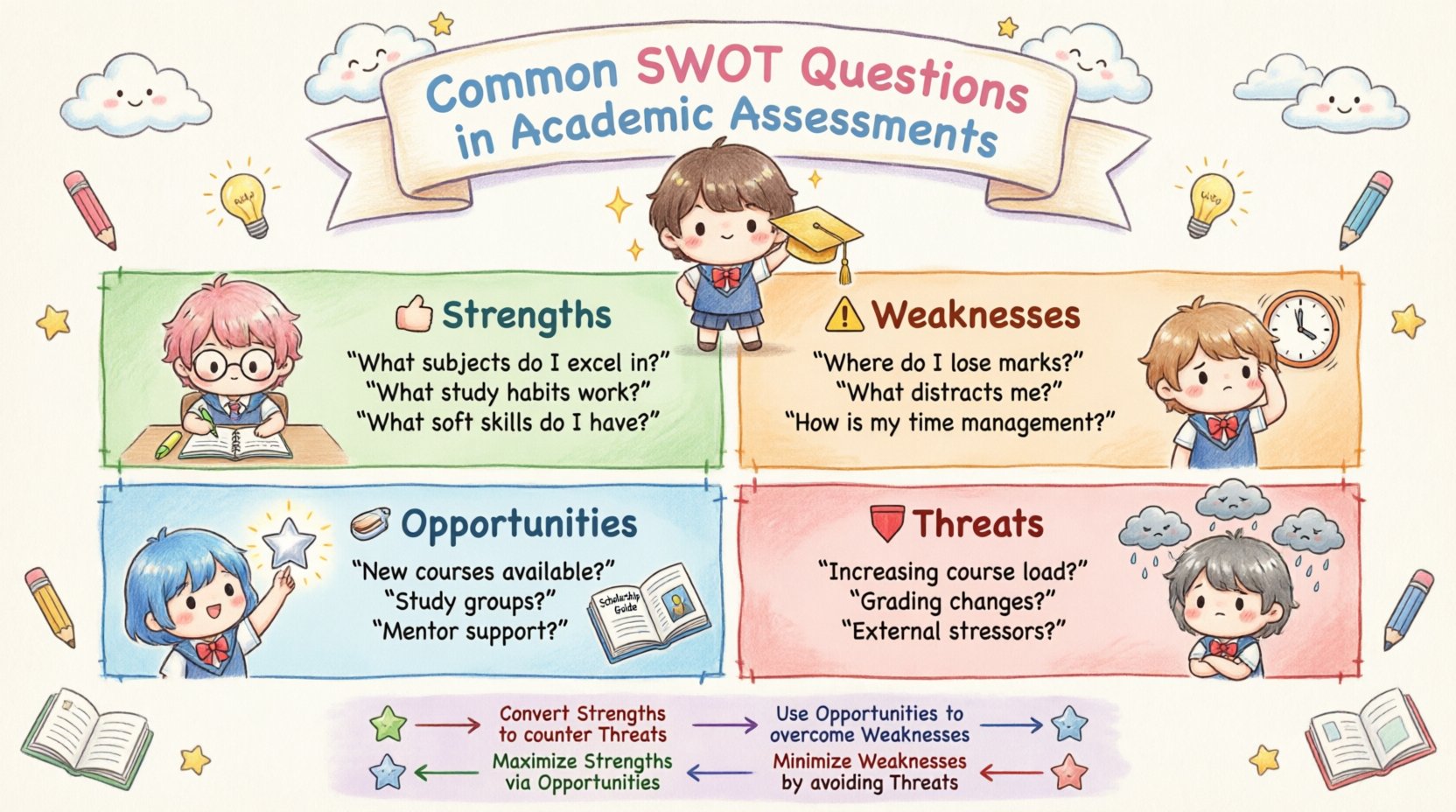
Success in education is rarely accidental. It is the result of deliberate planning, self-awareness, and strategic action. One of the most effective tools for gaining clarity on your academic trajectory is the SWOT analysis. Originally a business framework, this method has become a staple in educational planning for students at all levels. By examining Strengths, Weaknesses, Opportunities, and Threats, you can create a roadmap that aligns your personal goals with your current reality.
When applied to academic assessments, a SWOT analysis moves beyond simple grades. It digs into the habits, resources, external pressures, and personal capabilities that influence learning outcomes. This guide explores the critical questions you should ask yourself during this process. It is designed to help you build a robust understanding of your academic standing without relying on external software or gimmicks.
🧐 Why Use SWOT in Education?
An academic assessment often focuses on past performance. A SWOT analysis shifts the focus to future potential. It forces you to look inward at your capabilities and outward at the environment you study in. This dual perspective prevents tunnel vision. For instance, a student might have excellent grades (Strength) but struggle with time management (Weakness). Without this analysis, they might assume the grades guarantee future success, ignoring the risk of burnout.
Here are the core reasons to integrate this framework into your study routine:
- Clarity: It organizes scattered thoughts into four distinct categories.
- Honesty: It requires you to acknowledge gaps in knowledge or skills.
- Strategy: It helps you connect internal factors with external possibilities.
- Adaptability: It prepares you for changes in curriculum, schedule, or resources.
💪 Strengths: Internal Positive Factors
Strengths are the assets you currently possess. These are internal attributes that give you an advantage over others or make tasks easier to accomplish. In an academic setting, these are often related to your skills, habits, and support systems. Answering questions about strengths requires confidence and accurate self-reflection.
Key Questions to Ask
- What subjects do I excel in naturally? Identifying your high-performing areas helps you allocate less time to them and more time to difficult topics.
- What study habits consistently yield good results? Are you an early riser? Do you use flashcards? Do you prefer group study? Knowing your effective methods allows you to replicate them.
- Do I have access to supportive resources? This includes mentors, family support, quiet study spaces, or library access.
- What soft skills do I possess? Communication, leadership, or critical thinking skills often aid in presentations and group projects.
- How do I handle pressure? If you remain calm during exams, this is a significant strength.
It is important to list these strengths concretely. Instead of writing “I am smart,” write “I have a strong grasp of calculus concepts.” Specificity makes the assessment actionable.
⚠️ Weaknesses: Internal Negative Factors
Weaknesses are internal limitations that hinder your progress. Acknowledging these is often the hardest part of the process because it requires vulnerability. However, you cannot fix what you do not admit. In academia, weaknesses often manifest as procrastination, gaps in foundational knowledge, or poor organizational skills.
Key Questions to Ask
- Where do I consistently lose marks? Is it in essay structure, calculation errors, or lack of preparation?
- What distractions affect my focus? Social media, noisy environments, or personal stress can be major internal blockers.
- Do I have gaps in my foundational knowledge? If you struggled with algebra last year, it will impact your calculus this year. Identifying these holes is crucial.
- How is my time management? Do you miss deadlines? Do you cram the night before?
- What is my attitude toward feedback? Do you ignore corrections, or do you use them to improve?
When listing weaknesses, avoid self-judgment. Treat them as data points. A weakness is simply an area for improvement, not a definition of your intelligence.
🚀 Opportunities: External Positive Factors
Opportunities are external factors that you can leverage to improve your performance. Unlike strengths, these are not inherent to you; they exist in your environment. They are chances to grow, learn, or gain an advantage that you might otherwise miss.
Key Questions to Ask
- Are there new courses or electives available? These might align with your career goals or fill knowledge gaps.
- Is there funding or scholarship support? Financial aid can reduce stress and allow you to focus on studies.
- Can I join a study group or club? Peer learning often deepens understanding and provides accountability.
- Are there workshops or seminars? Institutions often host sessions on research writing or exam preparation.
- Is there a mentor or professor I can approach? Networking with faculty can lead to research opportunities or letters of recommendation.
Identifying opportunities requires you to be aware of the landscape around you. It means looking beyond the syllabus to see what else is available to support your education.
🛑 Threats: External Negative Factors
Threats are external obstacles that could cause trouble for your academic success. These are outside your direct control, but they must be anticipated to mitigate their impact. Threats often relate to the competitive nature of education, economic factors, or institutional policies.
Key Questions to Ask
- Is the course load increasing? A heavier workload can lead to burnout if not managed.
- Are there changes in grading policies? Shifts in how you are assessed can catch you off guard.
- Is there high competition for resources? Limited access to lab equipment, library seats, or tutoring can hinder progress.
- What are the external stressors? Work commitments, family issues, or health concerns can distract from studies.
- Is the curriculum becoming outdated? If skills taught do not match industry needs, the degree value might shift.
📊 Mapping Your Assessment
To visualize how these questions interact, consider the following matrix. This table summarizes how specific academic scenarios map to the four SWOT categories.
| Category | Focus | Example Scenario | Sample Question |
|---|---|---|---|
| Strengths | Internal | High GPA in Math | What topics do I grasp quickly? |
| Weaknesses | Internal | Procrastination | When do I delay starting assignments? |
| Opportunities | External | New Tutoring Center | What support services are available? |
| Threats | External | Part-time Job Hours | What outside commitments conflict with study time? |
🔄 Turning Analysis into Action
Listing answers to these questions is only the first step. The real value comes from connecting these dots. This process is often called a TOWS analysis, where you match Strengths to Opportunities, and Weaknesses to Threats.
Strategic Pairings
- Maxi-Maxi (S-O): Use your Strengths to seize Opportunities. If you are good at writing (Strength), apply for a campus journalism role (Opportunity).
- Mini-Maxi (W-O): Overcome Weaknesses by taking advantage of Opportunities. If you struggle with time management (Weakness), use a campus study schedule workshop (Opportunity).
- Mini-Mini (W-T): Minimize Weaknesses to avoid Threats. If you are prone to anxiety (Weakness), avoid taking too many heavy courses at once (Threat).
- Maxi-Mini (S-T): Use Strengths to block Threats. If you have strong research skills (Strength), use them to secure funding that mitigates financial stress (Threat).
⚠️ Common Pitfalls in Academic SWOT
Even with a solid framework, students often make mistakes that reduce the effectiveness of their analysis. Being aware of these errors ensures your assessment remains accurate.
- Being Too Vague: Writing “I am bad at English” is not helpful. “I struggle with grammar and citation styles” is actionable.
- Confusing Internal and External: A lack of motivation is internal (Weakness). A lack of course availability is external (Threat).
- Ignoring the Context: A Strength in one semester might be a Weakness in another. A quiet library is an asset in some contexts and a constraint in others.
- Static Analysis: A SWOT is not a one-time event. It should be revised at the start of every term or after major assessments.
- Overlooking Emotional Factors: Mental health and confidence levels are critical internal factors that influence performance.
📝 Implementation Steps
To ensure this exercise translates into better grades and reduced stress, follow a structured approach. This ensures consistency and prevents the analysis from becoming just another task.
- Gather Data: Review past transcripts, feedback from teachers, and your own notes on how you felt during exams.
- Allocate Time: Set aside 30 to 60 minutes of uninterrupted time to answer the questions. Do not rush this.
- Categorize: Physically write the answers into the four quadrants. Use different colors for each category to distinguish them visually.
- Prioritize: Select the top three items from each category. You cannot fix everything at once.
- Create a Plan: For every Weakness, define a specific counter-measure. For every Opportunity, define a step to take.
- Review Monthly: Check your progress. Have you addressed the Weaknesses? Did the Threats materialize?
🎓 The Role of Self-Reflection
At its core, a SWOT analysis is an exercise in self-reflection. It asks you to look at your academic life with a critical but constructive eye. It moves the narrative from “I failed this test” to “What specific factors led to this outcome, and how can I adjust?”
Students who engage in this process report higher levels of control over their education. They feel less overwhelmed because they have a plan. They understand that a poor grade is not a permanent state but a signal to adjust their strategy. This mindset is essential for long-term academic sustainability.
Remember that the goal is not perfection. The goal is progress. You will always have weaknesses, and there will always be threats. The difference lies in whether you are aware of them and prepared to respond.
🌟 Final Thoughts on Academic Planning
Integrating SWOT questions into your academic routine provides a structured way to navigate the complexities of higher education. It transforms vague feelings of stress into concrete data points that can be managed. By understanding your strengths, you build confidence. By acknowledging weaknesses, you build resilience. By spotting opportunities, you build momentum. By anticipating threats, you build safety.
Use this framework as a living document. It should evolve as you grow. As you move from freshman year to senior year, your strengths will change, your opportunities will shift, and the threats you face will differ. Keeping your SWOT analysis updated ensures that your educational journey remains aligned with your personal and professional goals.
Start today. Take a sheet of paper, divide it into four sections, and begin answering the questions. The clarity you gain might just be the key to the next level of your academic success.