
In the fast-paced environment of software development, the tension between delivering new value and maintaining code quality is constant. Teams often find themselves in a dilemma: do we build the next big feature, or do we fix the crumbling foundation? This is the eternal struggle of balancing technical debt and new features. Within the Scrum framework, this balance is not just a technical decision; it is a strategic imperative that determines long-term sustainability and velocity.
Technical debt is not inherently evil. It is often a conscious trade-off made to speed up delivery. However, like financial debt, it accumulates interest. If ignored, the interest payments slow down progress until the work becomes impossible. This guide provides a comprehensive roadmap for Product Owners, Scrum Masters, and Developers to navigate this landscape with clarity and authority.
🧐 Understanding the Nature of Technical Debt
Before managing debt, we must define it clearly. Technical debt refers to the implied cost of additional rework caused by choosing an easy, limited, or incomplete solution now instead of a better approach that would take longer.
Types of Technical Debt
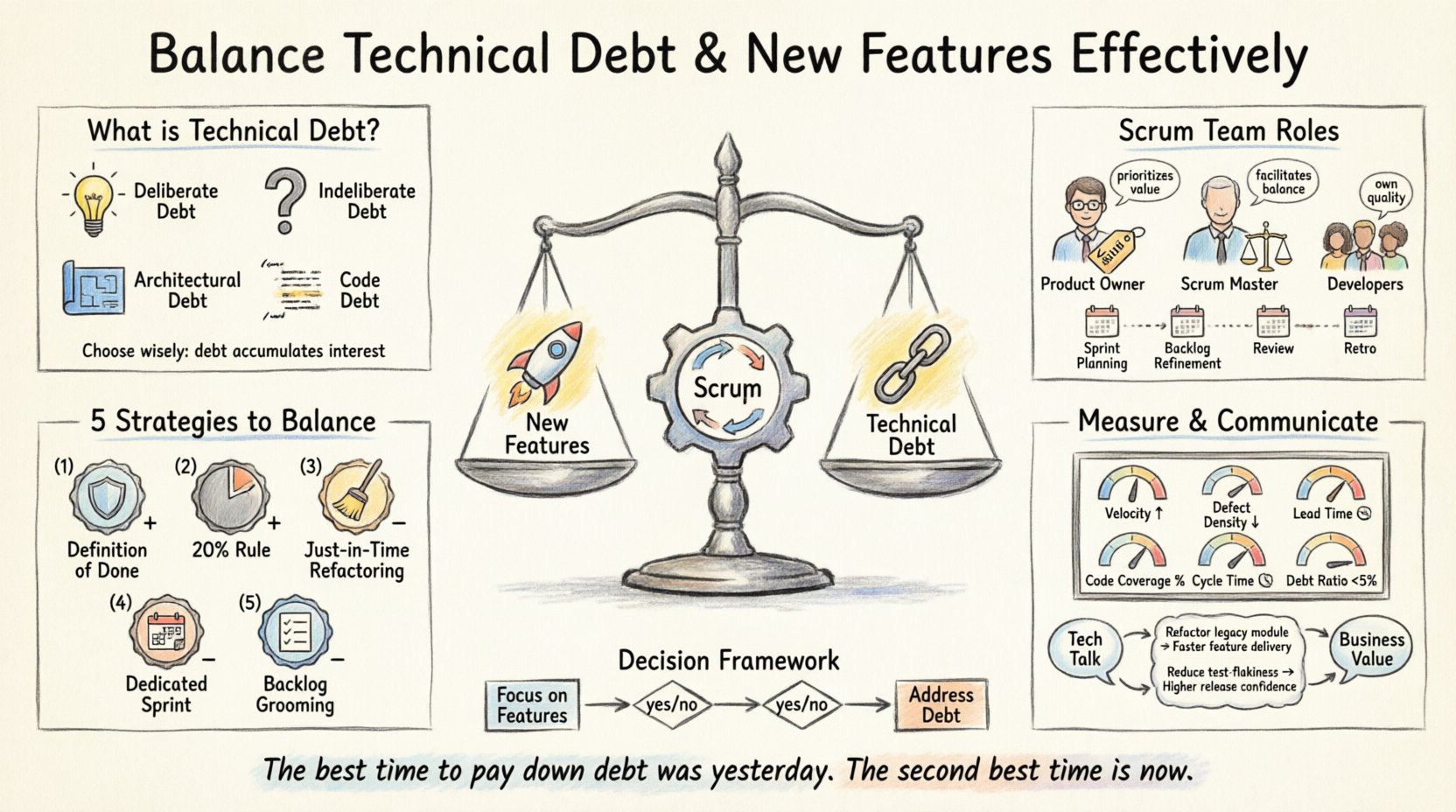
- Deliberate Debt: Decisions made knowingly to ship faster, with a plan to refactor later.
- Indeliberate Debt: Mistakes, lack of knowledge, or poor planning that results in suboptimal code.
- Architectural Debt: Issues stemming from high-level design choices that restrict future flexibility.
- Code Debt: Specific instances of messy code, lack of tests, or duplication within the codebase.
Recognizing the type of debt helps determine the appropriate strategy. Deliberate debt requires a repayment plan, while indeliberate debt requires training and better processes.
The Cost of Interest
Every time you add a new feature on top of unrefactored code, the difficulty increases. This is the “interest” on the debt. Over time, the time required to implement a feature grows exponentially. Velocity, the rate at which a team delivers value, begins to decay. This is not just about code quality; it is about business continuity.
🏗️ The Scrum Context for Debt Management
Scrum provides a framework, but it does not dictate how to handle code quality. The responsibility lies with the Scrum Team. The Product Owner prioritizes value, while the Developers are responsible for the implementation quality.
Roles and Responsibilities
- Product Owner: Must understand the value of reducing debt. Debt reduction often increases future velocity, which is a form of value.
- Scrum Master: Facilitates the conversation between business value and technical sustainability. They help remove impediments that prevent quality work.
- Developers: Own the quality of the product. They must advocate for the time needed to maintain the codebase.
Events and Artifacts
Scrum events can be leveraged to address debt without stopping feature delivery.
- Sprint Planning: Capacity planning must account for non-functional requirements, including debt reduction.
- Backlog Refinement: This is the primary venue for identifying debt items and creating tasks to address them.
- Sprint Review: Stakeholders see the working software. They can understand why certain technical improvements were made if communicated well.
- Retrospective: A dedicated space to discuss process issues that lead to debt and agree on improvements.
⚖️ Strategies for Balancing the Equation
There is no single silver bullet. Different teams require different mixes of strategies. The goal is sustainability, not perfection.
1. The Definition of Done (DoD)
The most effective way to prevent debt from accumulating is to ensure it is not created in the first place. The Definition of Done acts as a quality gate.
- Code Review: Require peer reviews for every pull request.
- Automated Testing: Ensure unit, integration, and acceptance tests cover new code.
- Documentation: Update documentation as part of the task completion.
- Performance Standards: Code must meet specific performance benchmarks.
If a task does not meet the DoD, it is not done. It cannot be released. This forces the team to address quality issues immediately, rather than pushing them to a future date.
2. The 20% Rule (Heuristic Approach)
Some teams adopt a heuristic where 20% of the capacity in every sprint is dedicated to technical work. This ensures steady repayment of debt without halting feature development.
- Pros: Consistent progress on debt; predictable velocity.
- Cons: May not address critical spikes in debt; can feel arbitrary.
3. Just-in-Time Refactoring
Instead of setting aside time for refactoring, developers refactor the code while working on a new feature. If you touch a file to add a feature, clean it up while you are there.
- Boy Scout Rule: Leave the code cleaner than you found it.
- Context Switching: Reduces the cognitive load of switching between “build mode” and “fix mode”.
4. Dedicated Refactoring Sprints
Some teams prefer a dedicated sprint solely for technical work. While controversial, this can be effective if the debt is blocking all progress.
- When to use: When the system is critically unstable or security is at risk.
- Risk: Stakeholders may feel value is not being delivered. Communication is key.
5. Backlog Grooming for Debt
Technical debt must be treated like product features. It needs to be in the backlog, prioritized, and estimated.
- Tagging: Use labels to identify debt items clearly.
- Estimation: Estimate the effort to fix the debt so it can be compared to feature value.
- Prioritization: Rank debt items based on risk and impact on velocity.
📊 Measuring Success
You cannot manage what you do not measure. However, be careful not to measure vanity metrics. Focus on indicators that reflect stability and speed.
Key Metrics
| Metric | What it Measures | Goal |
|---|---|---|
| Velocity | Points completed per sprint | Stable or increasing over time |
| Defect Density | Bugs per line of code | Decreasing |
| Lead Time | Time from commit to production | Shorter is better |
| Cycle Time | Time from start to finish of a task | Shorter is better |
| Code Coverage | Percentage of code tested | Increasing (e.g., 80%+) |
| Technical Debt Ratio | Cost to fix vs. cost to build | Below 5% (industry benchmark) |
Visualizing Debt
Use charts to show the trend of technical debt over time. A “Debt Radar” or a simple line graph can help stakeholders visualize the cost of inaction.
🗣️ Communicating with Stakeholders
One of the biggest challenges is explaining technical debt to non-technical stakeholders. They see features as revenue and debt as a cost center.
Translating Tech to Business
Do not talk about “refactoring” or “spaghetti code.” Talk about business outcomes.
- Instead of: “We need to refactor the authentication module.”
- Try: “We need to update the login system to reduce security risks and speed up future account features by 50%.”
- Instead of: “The database is slow.”
- Try: “Performance issues are causing user drop-off during checkout. Fixing this will improve conversion rates.”
Building Trust
Trust is built when the team delivers on promises. If you commit to a sprint goal and fail because of technical debt, trust erodes. If you communicate early about risks and propose solutions, trust grows.
- Transparency: Be honest about the state of the codebase.
- Proactivity: Warn stakeholders before a crisis occurs.
- Evidence: Use data (metrics) to support your requests for time.
🛡️ Risk Management
Not all debt is created equal. Some debt is safe; some is dangerous. Use a risk matrix to prioritize.
Risk Categories
- High Risk: Security vulnerabilities, critical path failures, compliance issues. These must be addressed immediately.
- Medium Risk: Performance degradation, difficult to maintain code. These should be scheduled.
- Low Risk: Naming conventions, minor refactoring. These can be done as part of normal work.
🧠 Cultivating a Quality Culture
Tools and processes are useless without the right mindset. The team culture must value quality as much as speed.
Psychological Safety
Developers must feel safe to admit when code is messy without fear of blame. A blameless culture encourages early detection of debt.
- No Hero Culture: Avoid relying on individuals to fix problems at the last minute.
- Shared Ownership: The whole team owns the codebase, not just the author.
Continuous Learning
Technical debt often stems from outdated knowledge. Encourage learning.
- Knowledge Sharing: Regular tech talks and brown bag sessions.
- Training: Invest in upskilling the team on new tools and best practices.
- Mentorship: Pair junior developers with seniors to transfer quality standards.
🔄 The Feedback Loop
Balance is dynamic. What works today may not work tomorrow. You must constantly adjust your approach based on feedback.
Retrospectives
Make “Technical Health” a standing item in your retrospectives. Ask:
- Did we create any new debt this sprint?
- Did we pay down any debt?
- How did the code quality impact our velocity?
- What can we change to prevent debt in the future?
Monitoring
Implement automated monitoring tools to catch regressions early. CI/CD pipelines should include quality gates.
- Linters: Enforce code style automatically.
- Static Analysis: Scan for security vulnerabilities and complexity.
- Integration Tests: Run automatically on every commit.
🎯 Decision Framework
When faced with a choice between a feature and debt reduction, use this decision framework.
| Question | If Yes | If No |
|---|---|---|
| Is the system stable? | Focus on Features | Focus on Debt |
| Is the feature critical for revenue? | Feature with minimal debt | Re-evaluate Priority |
| Is the debt blocking work? | Address Debt | Proceed with Feature |
| Is the risk acceptable? | Proceed | Address Debt |
🏁 Moving Forward
There is no finish line. Technical debt management is a continuous journey. The goal is not zero debt, but a debt level that allows the team to move at a sustainable pace. By integrating quality into the Definition of Done, communicating value to stakeholders, and measuring the right metrics, you can ensure that your Scrum team remains productive and stable for the long haul.
Remember, the best time to pay down debt was yesterday. The second best time is now. Start small, measure often, and keep the conversation open. Your future self will thank you.