
In modern organizations, the gap between technology capabilities and business objectives often leads to inefficiency, wasted investment, and missed opportunities. Enterprise Architecture (EA) serves as the strategic bridge connecting these two domains. It provides a structured framework for designing, planning, and governing IT systems in a way that directly supports organizational mission and vision. This guide explores the mechanics of alignment, the essential components of architecture, and the practical steps required to synchronize technology with business needs.
The Strategic Imperative for Alignment 🎯
Technology is no longer a back-office function; it is a core driver of value creation. When IT initiatives are not anchored to business strategy, resources are often consumed by maintaining legacy systems that offer little competitive advantage. Conversely, business units may procure tools without considering integration, leading to data silos and operational friction.
Aligning IT with business goals ensures that:
- Investment Efficiency: Capital is directed toward projects that deliver measurable value.
- Agility: The organization can pivot quickly in response to market changes.
- Risk Management: Compliance and security standards are embedded into the design of systems.
- Clarity: Stakeholders understand how technology enables specific business outcomes.
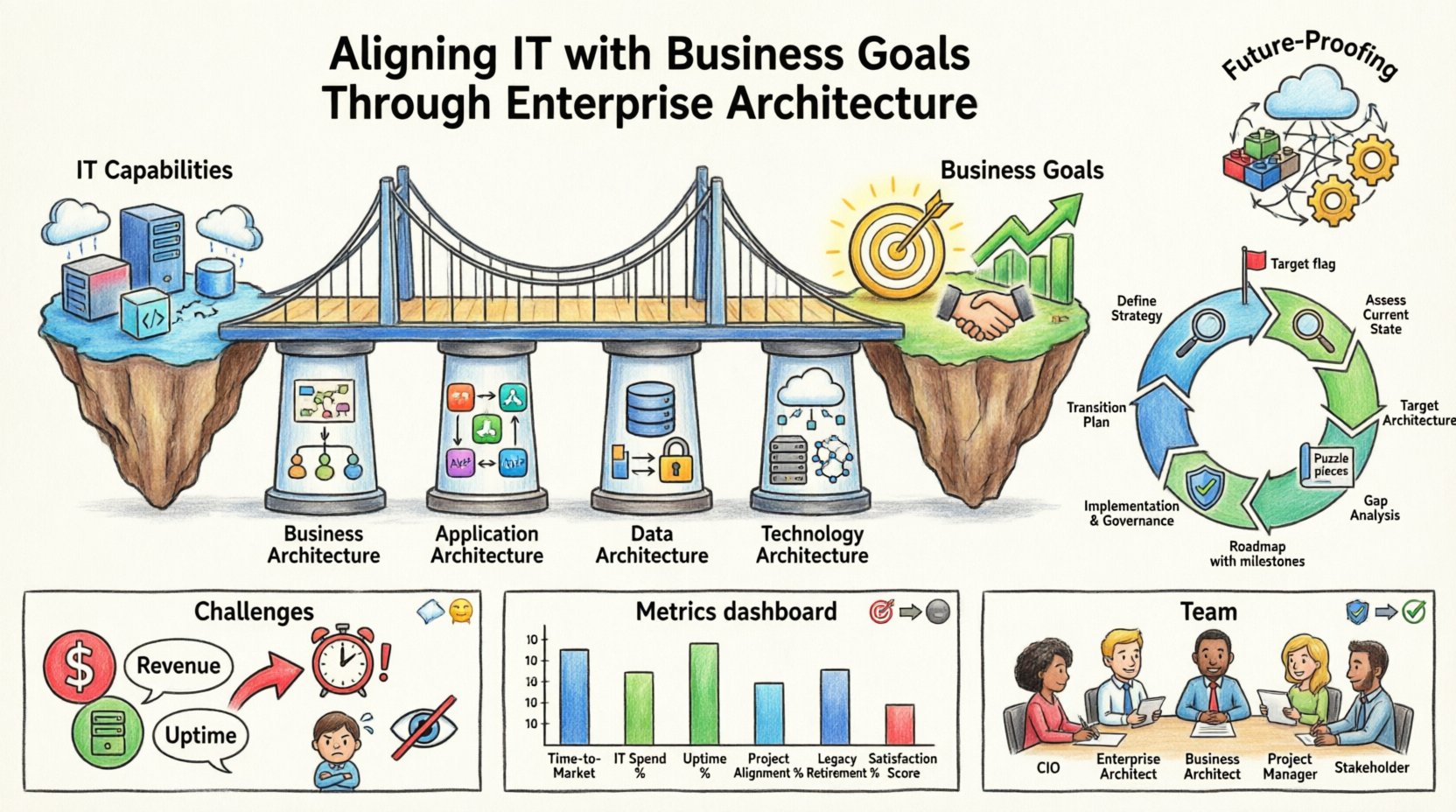
Enterprise Architecture acts as the blueprint for this alignment. It does not merely document systems; it defines the relationships between business capabilities, information flows, applications, and infrastructure.
Core Components of Enterprise Architecture 🧱
To achieve meaningful alignment, an organization must understand the foundational layers of its architecture. These layers work together to translate high-level strategy into technical reality.
1. Business Architecture
This layer defines the business strategy, governance, organization, and key business processes. It answers questions such as:
- What are the core capabilities of the organization?
- How does value flow through the business?
- What are the organizational structures supporting the strategy?
2. Application Architecture
This describes the individual software applications, their interactions, and their relationships to core business processes. It focuses on:
- Application portfolios and their lifecycle status.
- Service orientation and modularity.
- Integration patterns between disparate systems.
3. Data Architecture
Information is the lifeblood of modern decision-making. This component manages:
- Data models and data flow.
- Information governance and security.
- Data standards and master data management.
4. Technology Architecture
This layer covers the hardware, software, and network infrastructure required to support the applications and data. Key considerations include:
- Infrastructure scalability and reliability.
- Security protocols and compliance requirements.
- Cloud vs. on-premise resource allocation.
The Alignment Process: A Step-by-Step Approach 🔄
Integrating IT strategy with business goals is not a one-time event but a continuous cycle. The following steps outline a robust methodology for achieving and maintaining alignment.
Step 1: Define Business Strategy and Objectives
Before discussing technology, leadership must articulate clear business goals. This involves identifying key performance indicators (KPIs), market positioning, and growth targets. Without a clear destination, IT cannot build the right vehicle.
Step 2: Assess Current State Capabilities
An honest assessment of the existing IT landscape is crucial. This includes inventorying hardware, software licenses, and personnel skills. Identifying technical debt and legacy constraints helps determine what can be reused and what must be replaced.
Step 3: Define the Target Architecture
Based on the business strategy, architects design a target state. This vision outlines how the future organization should operate. It specifies the desired applications, data flows, and infrastructure models needed to support the business goals.
Step 4: Gap Analysis
Compare the current state with the target state. Identify the specific gaps in functionality, skills, or technology. This analysis forms the basis for the transition plan.
Step 5: Develop a Transition Roadmap
Creating a phased plan is essential for managing change. Projects are prioritized based on business value and risk. This roadmap ensures that the organization moves toward the target state in manageable increments.
Step 6: Implementation and Governance
As projects are executed, governance mechanisms ensure adherence to the architecture. Architecture review boards evaluate new initiatives to prevent divergence from the strategic plan.
Common Challenges in IT-Business Alignment 🛑
Even with a solid framework, organizations face hurdles. Recognizing these challenges allows leaders to proactively mitigate risks.
- Language Barriers: Business leaders speak in terms of revenue and market share, while IT speaks in terms of uptime and latency. Bridging this communication gap requires translation and shared vocabulary.
- Short-Term Focus: Business units often prioritize immediate needs over long-term stability. This can lead to shadow IT and fragmented systems.
- Resistance to Change: Established processes and legacy mindsets can resist the adoption of new architectural standards.
- Lack of Visibility: Without clear metrics, the value of architectural work remains invisible to senior stakeholders.
Measuring Success: Key Metrics 📊
To validate that alignment is working, organizations must track specific metrics. The table below outlines critical indicators across different dimensions.
| Dimension | Key Metric | Why It Matters |
|---|---|---|
| Business Value | Time-to-Market for New Features | Indicates how quickly IT supports business innovation. |
| Financial | IT Spend as % of Revenue | Ensures technology costs remain proportionate to business size. |
| Operational | System Availability and Uptime | Directly impacts customer experience and revenue generation. |
| Strategic | Percentage of Projects Aligned to Strategy | Measures the effectiveness of governance and planning. |
| Technical | Legacy System Retirement Rate | Tracks progress in modernizing the technology stack. |
| Customer | User Satisfaction Scores | Reflects the usability and effectiveness of internal and external tools. |
The Human Element: Roles and Responsibilities 👥
Architecture is not just about diagrams; it is about people. Successful alignment requires clear roles and a collaborative culture.
- Chief Information Officer (CIO): Responsible for the overall IT strategy and ensuring it matches business priorities.
- Enterprise Architects: Design the frameworks and standards that guide technical decisions.
- Business Architects: Translate business processes into architectural requirements.
- Project Managers: Execute the roadmap while adhering to architectural standards.
- Business Stakeholders: Provide input on requirements and validate that solutions meet their needs.
Regular collaboration forums, such as architecture review boards and business-IT sync meetings, foster this partnership. They ensure that decisions are made with a holistic view of the organization.
Adapting to Change in a Dynamic Environment 🌐
The technology landscape evolves rapidly. New methodologies, security threats, and market trends emerge constantly. An architecture that is too rigid becomes a bottleneck. Therefore, alignment must be dynamic.
Agile Architecture
Traditional waterfall planning often fails to keep pace with business needs. Adopting agile principles within architecture allows for iterative design. This means creating high-level standards that guide teams while allowing flexibility in implementation details.
Continuous Feedback Loops
Feedback from operations and users should inform architectural decisions. If a system is causing friction in business processes, the architecture must be adjusted. This creates a living document rather than a static plan.
Innovation Scouting
Organizations must monitor emerging technologies. However, adoption should be driven by business need, not technology hype. Pilot programs and proof-of-concepts help validate whether a new technology truly supports strategic goals before full-scale investment.
Governance and Compliance 🛡️
Alignment also involves adhering to regulatory requirements and internal policies. Governance ensures that the architecture remains compliant while supporting business agility.
- Data Privacy: Ensuring personal information is handled according to laws like GDPR or CCPA.
- Security Standards: Implementing controls to protect against threats without hindering workflow.
- Vendor Management: Evaluating third-party solutions for fit and risk.
- Financial Controls: Tracking budget usage against allocated funds for architectural initiatives.
Effective governance is not about saying “no” to business requests; it is about ensuring that the “yes” is sustainable and secure.
Future-Proofing the Organization 🚀
Looking ahead, organizations must consider scalability and adaptability. The architecture should be designed to handle growth without requiring a complete rebuild. This involves:
- Modularity: Building systems as independent components that can be updated or replaced without disrupting the whole.
- Interoperability: Ensuring different systems can exchange data seamlessly.
- Cloud Readiness: Designing with cloud principles in mind to leverage elasticity and cost-efficiency.
- Automation: Using infrastructure as code to reduce manual errors and speed up deployment.
By prioritizing these characteristics, the organization builds a foundation that can withstand future disruptions and support long-term growth.
Summary of Benefits ✅
When IT and business goals are aligned through Enterprise Architecture, the organization realizes significant advantages. The synergy between strategy and execution reduces waste and accelerates delivery. Leaders gain confidence that technology investments are driving tangible results. Teams operate with a clear understanding of their role in the broader mission.
The journey toward alignment requires commitment, transparency, and continuous improvement. It is not a destination but a discipline. By adhering to structured frameworks and maintaining open communication, organizations can ensure their technology serves as a powerful engine for success.
Start by assessing your current state. Engage stakeholders early. Define clear objectives. Then, build the architecture that connects your people, processes, and technology to your strategic vision. This disciplined approach is the key to sustainable growth in a complex digital landscape.