Connecting high-level business objectives with the granular work of development teams is often the most challenging aspect of scaling Agile. Many organizations struggle with the disconnect between what executives decide and what teams build. This gap leads to wasted effort, misaligned priorities, and frustration across the board. Achieving alignment requires a deliberate approach that respects the Scrum framework while integrating strategic intent into every layer of the organization.
This guide explores how to bridge the divide between corporate strategy and Scrum team deliverables. We will examine the mechanics of translation, the roles involved, and the processes that sustain long-term coherence. The goal is not to force teams into a rigid plan, but to create a fluid environment where value flows naturally from vision to execution.
Why Alignment Matters 🏗️
When strategy and execution drift apart, resources are consumed without generating proportional value. Teams may become efficient at building features that no longer serve the business purpose. Conversely, leadership may set ambitious goals that lack the technical context to be realized. Bridging this gap ensures that every Sprint contributes to the broader organizational mission.
Alignment provides several critical benefits:
- Resource Optimization: Effort is directed toward high-value outcomes rather than low-priority tasks.
- Risk Reduction: Strategic pivots are communicated early, allowing teams to adjust course before significant investment occurs.
- Morale Boost: Teams understand the “why” behind their work, fostering a sense of purpose and ownership.
- Faster Time to Market: Decisions are made faster when stakeholders and teams share a common understanding of priorities.
Without this connection, Scrum risks becoming a local optimization exercise where teams deliver high-quality increments that do not advance the business. The following sections detail how to maintain the connection.
The Scrum Artifacts That Bridge the Gap 📋
Scrum contains specific artifacts designed to provide transparency. These are not just documentation tools; they are the primary mechanism for conveying strategic intent to the team.
The Product Vision
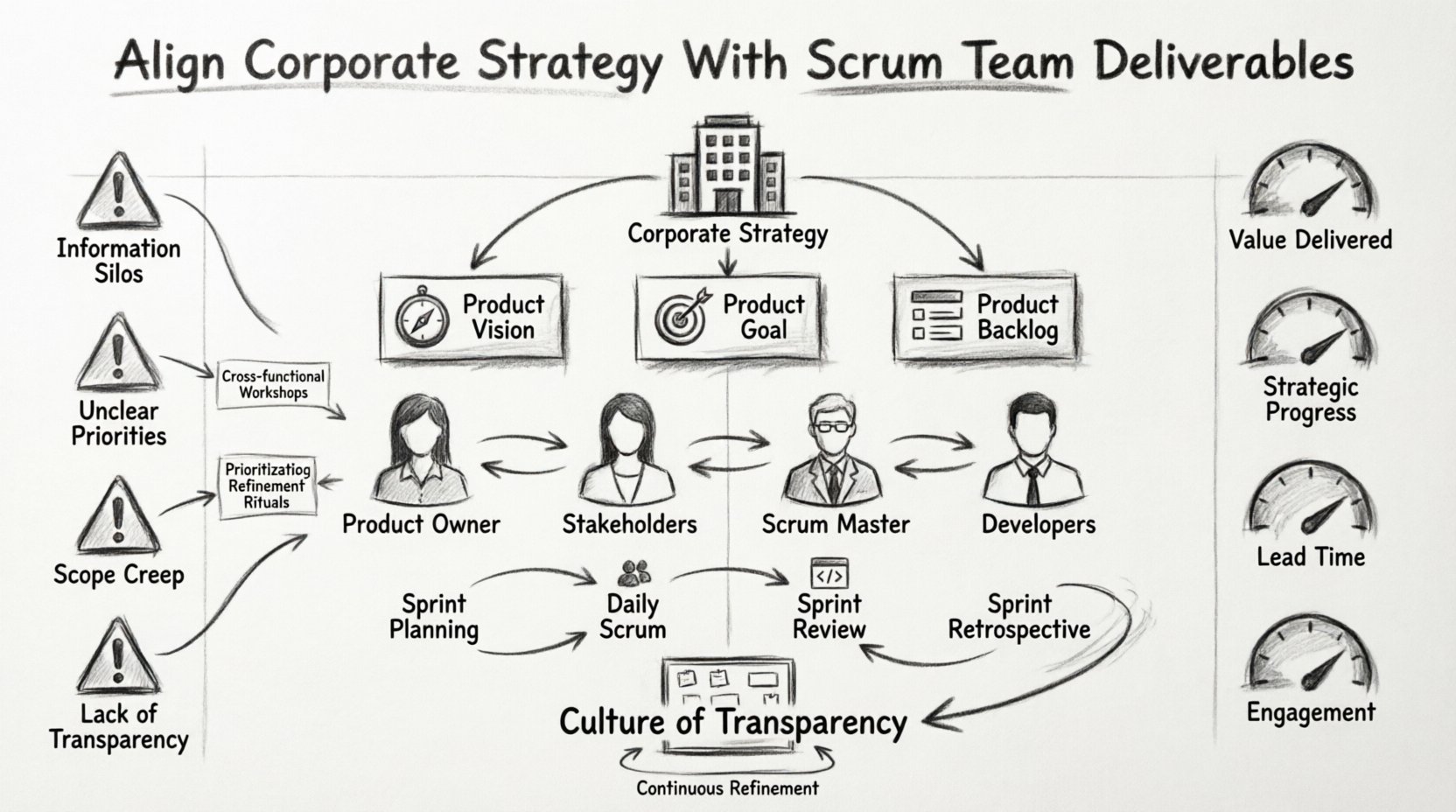
The Product Vision is the foundational element. It describes the future state of the product and why it exists. For alignment to work, this vision must be directly traceable to corporate goals. If the company strategy is to expand into a new market, the Product Vision must reflect how the product enables that expansion.
The Product Goal
While the Vision is long-term, the Product Goal is the target for the current product iteration. It provides a concrete objective for the Scrum Team to work toward over the next quarter or year. This goal acts as the bridge between the abstract strategy and the tactical backlog.
The Product Backlog
The Backlog is the living list of everything needed to achieve the Product Goal. Items here are not random tasks; they are potential value delivery mechanisms. Each item should ideally link back to a strategic objective, ensuring that the work being done is relevant.
Roles and Responsibilities 👥
Alignment is not a passive state; it requires active participation from specific roles. Each role has a distinct function in ensuring that strategy informs delivery.
- Product Owner: Acts as the primary translator. They interpret corporate strategy into actionable requirements for the team. They must be accessible to stakeholders and capable of making trade-off decisions based on strategic value.
- Stakeholders: Provide the context of the market and the business. They define the “what” and the “why” but rely on the team for the “how.” Regular engagement is necessary to keep their understanding of progress accurate.
- Scrum Master: Facilitates the removal of impediments that prevent alignment. They help teams understand how their work fits into the bigger picture and coach stakeholders on effective collaboration.
- Developers: Provide technical reality checks. They ensure that strategic ambitions are feasible within the constraints of technology and capacity.
Conflicts often arise when these roles do not understand each other’s constraints. The Product Owner needs to understand technical debt, and Stakeholders need to understand delivery velocity. Clear communication channels are essential.
Operationalizing Strategy in Sprints 🔄
Strategy must not sit in a slide deck; it must appear in the daily work of the team. This happens through specific Scrum events.
Sprint Planning
This event is the critical moment where strategy becomes commitment. The team selects items from the backlog that best serve the Product Goal. If the strategic objective shifts, the Product Owner must update the backlog immediately so that the next Sprint reflects the new direction.
Daily Scrum
While this is a planning event for the Developers, it is also a check on progress toward the Sprint Goal. If the team realizes they are drifting from the intended value, they can adapt their plan within the Sprint.
Sprint Review
This is the feedback loop with stakeholders. It is not just a demo; it is a discussion on whether the increment meets the strategic needs. Stakeholders provide input that may change the Product Goal for the next cycle. This ensures the product evolves in response to real-world conditions.
Sprint Retrospective
The team reflects on their process. If strategic alignment is failing, it is often due to a process issue. The Retrospective is the place to identify bottlenecks, communication gaps, or misunderstandings that hinder the flow of value.
Metrics and Measurement 📊
You cannot improve what you do not measure. However, measuring the wrong things can destroy alignment. Focusing solely on velocity or story points can lead to teams optimizing for quantity over value.
Effective measurement focuses on outcomes rather than outputs.
- Value Delivered: How much business value has been realized? This might be measured in revenue, user adoption, or cost savings.
- Strategic Progress: Are we moving closer to the Product Goal? This tracks the completion of major milestones.
- Lead Time: How long does it take to get an idea from conception to production? Faster lead times allow for more frequent strategic pivots.
- Employee Engagement: Are teams feeling connected to the mission? High engagement correlates with better quality and innovation.
Common Barriers to Alignment 🚧
Even with the right framework, obstacles can arise. Understanding these barriers helps organizations mitigate them before they cause significant damage.
| Barrier | Impact | Mitigation Strategy |
|---|---|---|
| Information Silos | Teams work in isolation without context. | Create regular cross-functional syncs and share dashboards. |
| Unclear Priorities | Teams pull work that isn’t the highest value. | Implement clear prioritization frameworks (e.g., WSJF). |
| Scope Creep | Strategic goals shift constantly without stability. | Define fixed timeboxes for strategic planning and review. |
| Lack of Transparency | Progress is hidden or exaggerated. | Use visible boards and honest reporting of impediments. |
Building a Culture of Transparency 🌍
Alignment is impossible without trust. If stakeholders do not trust the team’s estimates, they will micromanage. If the team does not trust the strategy, they will not commit to it. Transparency is the glue that holds this relationship together.
To foster transparency:
- Visual Management: Make work visible to everyone. Use physical or digital boards that show the flow of work from idea to delivery.
- Open Communication: Encourage questions. If a strategy doesn’t make sense to the team, they should ask why. If stakeholders are unsure of the progress, they should ask for data.
- Shared Accountability: Success and failure belong to the organization, not just the team. Celebrate wins together and analyze losses together.
Continuous Refinement 🛠️
Alignment is not a one-time setup. It requires constant maintenance. Markets change, technologies evolve, and business models shift. The Scrum framework supports this through its iterative nature.
Organizations should schedule periodic strategic reviews separate from the Sprint cadence. This allows leadership to set long-term direction without interrupting the team’s flow. These reviews inform the Product Goal, which in turn guides the Backlog.
Additionally, feedback loops must be short. The longer it takes to get feedback on a strategic decision, the more expensive it is to correct. Embedding feedback mechanisms into the delivery process ensures that the strategy remains relevant.
The Role of OKRs in Scrum ⚙️
Objectives and Key Results (OKRs) are a popular method for setting goals. When used correctly, they complement Scrum well.
- Objectives: Align with the Product Vision. They describe the qualitative goal.
- Key Results: Align with the Product Goal. They describe the measurable outcome.
Teams can use OKRs to prioritize their backlog. If a Key Result is not moving, the team knows to re-evaluate their Sprint work. This creates a direct line of sight between daily tasks and organizational success.
Final Thoughts 🌟
Aligning corporate strategy with Scrum team deliverables is a journey of continuous communication and adaptation. It requires moving away from command-and-control structures toward a model of shared understanding. When done correctly, the organization becomes more agile, responsive, and valuable.
The key is to remember that strategy is not a static document. It is a living hypothesis that must be tested against reality. Scrum teams provide the reality check. By treating the backlog as a strategic tool and the Sprint as a learning cycle, organizations can ensure that their work always moves the needle.