

Enterprise Architecture (EA) is undergoing a fundamental transformation. For decades, the discipline focused on static blueprints, documenting relationships between business processes, data, applications, and technology infrastructure. Today, the integration of artificial intelligence demands a dynamic approach. AI is not merely a tool added to the stack; it is a structural force that reshapes how organizations operate, make decisions, and deliver value.
This guide explores the critical shifts occurring within Enterprise Architecture as AI capabilities mature. We examine how architects must adapt frameworks, governance models, and skills to support intelligent systems. The goal is to build resilient, adaptable, and ethical architectures that leverage machine learning without compromising stability or compliance.
1. The Paradigm Shift: From Static to Dynamic 📈
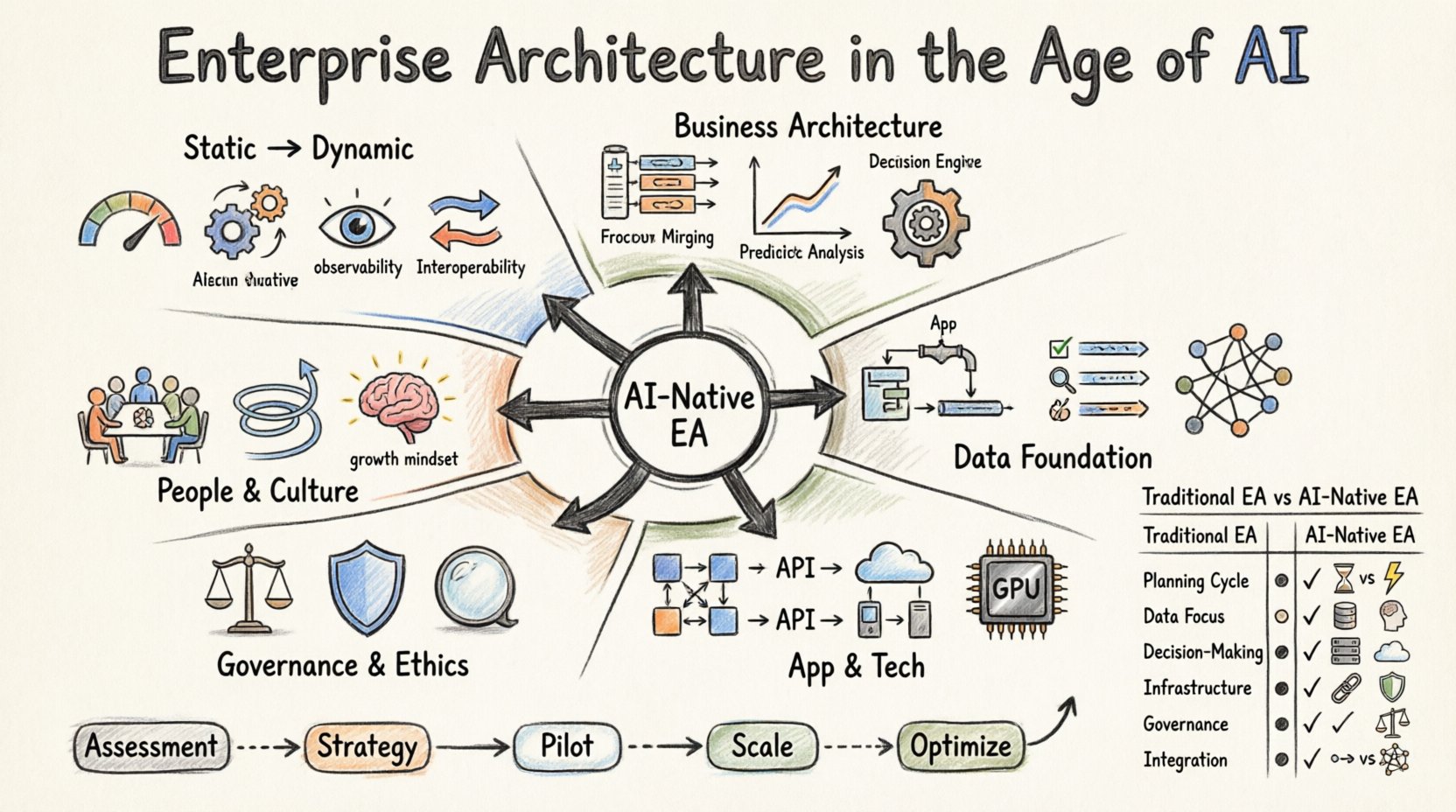
Traditional EA models often relied on annual planning cycles and static diagrams. In an AI-driven environment, data flows continuously, and models evolve rapidly. The architecture must support real-time adaptation rather than rigid adherence to long-term plans.
- Velocity: Systems need to ingest and process data at machine speed.
- Adaptability: Models require continuous retraining and versioning.
- Observability: Architectures must provide deep visibility into model behavior and drift.
- Interoperability: AI components must integrate seamlessly with legacy systems.
The shift requires moving away from viewing architecture as a set of documents. Instead, it becomes a living system of principles and patterns that guide autonomous decision-making.
2. Business Architecture and AI Strategy 🏢
Business architecture defines how an organization creates, delivers, and captures value. AI impacts this layer by automating complex tasks and enabling predictive insights. Architects must align business goals with technical capabilities.
Process Automation and Optimization
Intelligent automation goes beyond simple rule-based scripts. Machine learning models can analyze process logs to identify bottlenecks and suggest improvements.
- Process Mining: Using event logs to understand actual workflow execution.
- Predictive Analytics: Forecasting demand or resource needs before they occur.
- Decision Engines: Embedding logic that adapts based on real-time context.
Strategic Alignment
Business leaders must understand the limitations and potential of AI. EA acts as the bridge, translating strategic intent into technical requirements.
- Value Realization: Defining clear metrics for AI initiatives.
- Use Case Prioritization: Focusing on high-impact areas rather than technology for technology’s sake.
- Change Management: Preparing the workforce for AI-assisted roles.
3. Data Architecture: The Foundation of Intelligence 💾
Data is the fuel for AI. Without high-quality, accessible, and governed data, models will fail. Data architecture in the AI age focuses on lineage, quality, and accessibility.
Data Quality and Governance
Garbage in, garbage out remains true. Architectures must enforce strict quality standards at the point of ingestion.
- Validation Rules: Automated checks for completeness and accuracy.
- Master Data Management: Ensuring a single source of truth for key entities.
- Data Lineage: Tracking the origin and transformation of data used in models.
Data Fabric and Mesh
Monolithic data warehouses are often too slow for modern AI needs. Distributed architectures offer better scalability and ownership.
- Data Mesh: Decentralized domain-oriented data ownership.
- Data Fabric: An integrated layer that connects disparate data sources.
- Real-Time Pipelines: Streaming architectures for immediate model inference.
4. Application and Technology Architecture 🛠️
Application architecture must accommodate the lifecycle of AI models. This includes training environments, inference endpoints, and feedback loops.
Microservices and API-First Design
AI capabilities should be exposed as services. This allows multiple business units to consume intelligence without building their own infrastructure.
- Model-as-a-Service: Standardized interfaces for prediction and generation.
- Orchestration: Coordinating multiple AI services within a workflow.
- Scalability: Auto-scaling resources based on inference demand.
Infrastructure and Compute
AI workloads require significant compute power. Architectures must balance cost, performance, and location.
- Cloud vs. Edge: Deciding where processing happens based on latency needs.
- Hardware Acceleration: Utilizing GPUs or TPUs for training and inference.
- Containerization: Packaging models for consistent deployment across environments.
5. Governance, Ethics, and Risk ⚖️
As AI becomes embedded in critical systems, governance must evolve. This involves managing bias, ensuring explainability, and maintaining compliance.
Ethical Considerations
Architects must design systems that respect privacy and fairness.
- Bias Detection: Regular auditing of training data and model outputs.
- Privacy by Design: Minimizing data collection and anonymizing sensitive information.
- Transparency: Ensuring stakeholders understand how decisions are made.
Risk Management
New risks emerge with AI integration, including model drift and security vulnerabilities.
- Model Drift: Monitoring performance degradation over time.
- Security: Protecting models from adversarial attacks and data poisoning.
- Compliance: Adhering to regulations like GDPR or industry-specific standards.
6. Skills and Organizational Culture 🧠
Technology is only half the equation. The people building and managing these systems need new skills and mindsets.
The Modern Architect
Traditional architects need to expand their toolkit to include data science concepts.
- Data Literacy: Understanding statistical methods and model limitations.
- Code Fluency: Ability to review code and understand deployment pipelines.
- Systems Thinking: Viewing AI as part of a larger socio-technical system.
Cultural Adaptation
Organizations must foster a culture of experimentation and learning.
- Collaboration: Breaking down silos between IT, data science, and business.
- Continuous Learning: Encouraging upskilling in emerging technologies.
- Failure Tolerance: Treating failed experiments as learning opportunities.
7. A Practical Roadmap for Integration 🗺️
Implementing AI into Enterprise Architecture requires a phased approach. Rushing leads to technical debt and security gaps.
- Assessment: Evaluate current data readiness and infrastructure capabilities.
- Strategy: Define clear objectives and identify high-value use cases.
- Pilot: Run small-scale experiments to validate assumptions.
- Scale: Expand successful pilots across the organization with robust governance.
- Optimize: Continuously monitor performance and refine models.
8. Comparison: Traditional vs. AI-Native Architecture
Understanding the differences helps in planning the transition.
| Feature | Traditional EA | AI-Native EA |
|---|---|---|
| Planning Cycle | Annual or multi-year | Continuous, iterative |
| Data Focus | Storage and retrieval | Quality, lineage, and ingestion |
| Decision Making | Human-centric, rule-based | Hybrid, data-driven |
| Infrastructure | Static servers, on-prem | Dynamic, cloud-native, edge |
| Governance | Compliance and access | Compliance, ethics, and explainability |
| Integration | Point-to-point | API-first, event-driven |
9. Challenges and Mitigations
Adopting AI in EA is not without hurdles. Identifying these early allows for proactive mitigation.
| Challenge | Mitigation Strategy |
|---|---|
| Legacy Systems | Use abstraction layers and APIs to expose data. |
| Talent Gap | Invest in training and hire cross-functional teams. |
| Cost Management | Implement FinOps practices for cloud and compute. |
| Regulatory Uncertainty | Adopt flexible governance frameworks that can adapt. |
| Model Complexity | Use explainable AI techniques and simplified models where possible. |
10. Future Outlook and Emerging Trends 🔮
The landscape continues to evolve. Architects must stay informed about trends that could reshape the discipline further.
- Generative AI: Moving from predictive to generative capabilities for content and code.
- Autonomous Agents: Systems that can execute tasks without human intervention.
- Sustainability: Optimizing energy consumption of large-scale AI models.
- Human-in-the-Loop: Maintaining human oversight for critical decisions.
11. Key Takeaways for Architects 📝
Success in this new era requires a shift in mindset and methodology.
- Start with Data: Ensure data quality before building models.
- Embrace Agility: Move away from rigid planning cycles.
- Prioritize Ethics: Make fairness and transparency core design principles.
- Collaborate: Work closely with data scientists and business leaders.
- Monitor Continuously: Treat deployment as the start of the lifecycle, not the end.
12. Final Thoughts on Strategic Alignment 🤝
Enterprise Architecture in the age of AI is about balancing innovation with stability. It is not about replacing human judgment but augmenting it with powerful tools. The architects who succeed will be those who understand the technical possibilities while remaining grounded in business value and ethical responsibility.
The path forward is clear. By building robust data foundations, adopting flexible governance, and fostering a culture of learning, organizations can navigate the complexities of AI integration. The result is an architecture that is not just resilient, but intelligent.
13. Frequently Asked Questions ❓
How does AI change the role of an Enterprise Architect?
The role expands to include data strategy, model governance, and ethical oversight. Architects must understand the lifecycle of machine learning models and how they fit into the broader IT landscape.
What is the biggest risk in AI-driven architecture?
Model drift and data bias are significant risks. Without monitoring, models can degrade in performance or make unfair decisions over time.
How do we handle legacy systems with AI?
Use APIs and middleware to create abstraction layers. This allows new AI services to consume data from legacy systems without requiring immediate modernization.
Is cloud computing necessary for AI?
While not strictly necessary, cloud platforms offer the scalability and specialized hardware often required for training and running large models. Edge computing is also an option for low-latency needs.
How do we measure the success of AI initiatives?
Define clear KPIs aligned with business outcomes. Metrics should include model accuracy, cost savings, efficiency gains, and user adoption rates.