


Enterprise Architecture (EA) has long been viewed as a strategic function, often operating in a space of theoretical models and high-level diagrams. However, the modern business landscape demands precision. Relying solely on intuition or static documentation is no longer sufficient for organizations aiming for agility and resilience. The shift toward evidence-based decision-making places data at the center of architectural governance.
This guide explores how integrating robust data practices into your Enterprise Architecture framework can lead to more accurate planning, reduced risk, and better alignment between IT capabilities and business objectives. We will examine the mechanics of data-driven EA without relying on specific vendor tools, focusing instead on principles, processes, and structural logic.
🧩 The Intersection of Data and Enterprise Architecture
Enterprise Architecture serves as the blueprint for an organization’s structure. It defines how business processes, information flows, technology systems, and organizational units interact. Historically, this blueprint was drawn based on best practices and expert opinion. Today, the volume of information available within an organization allows architects to validate assumptions with actual usage patterns.
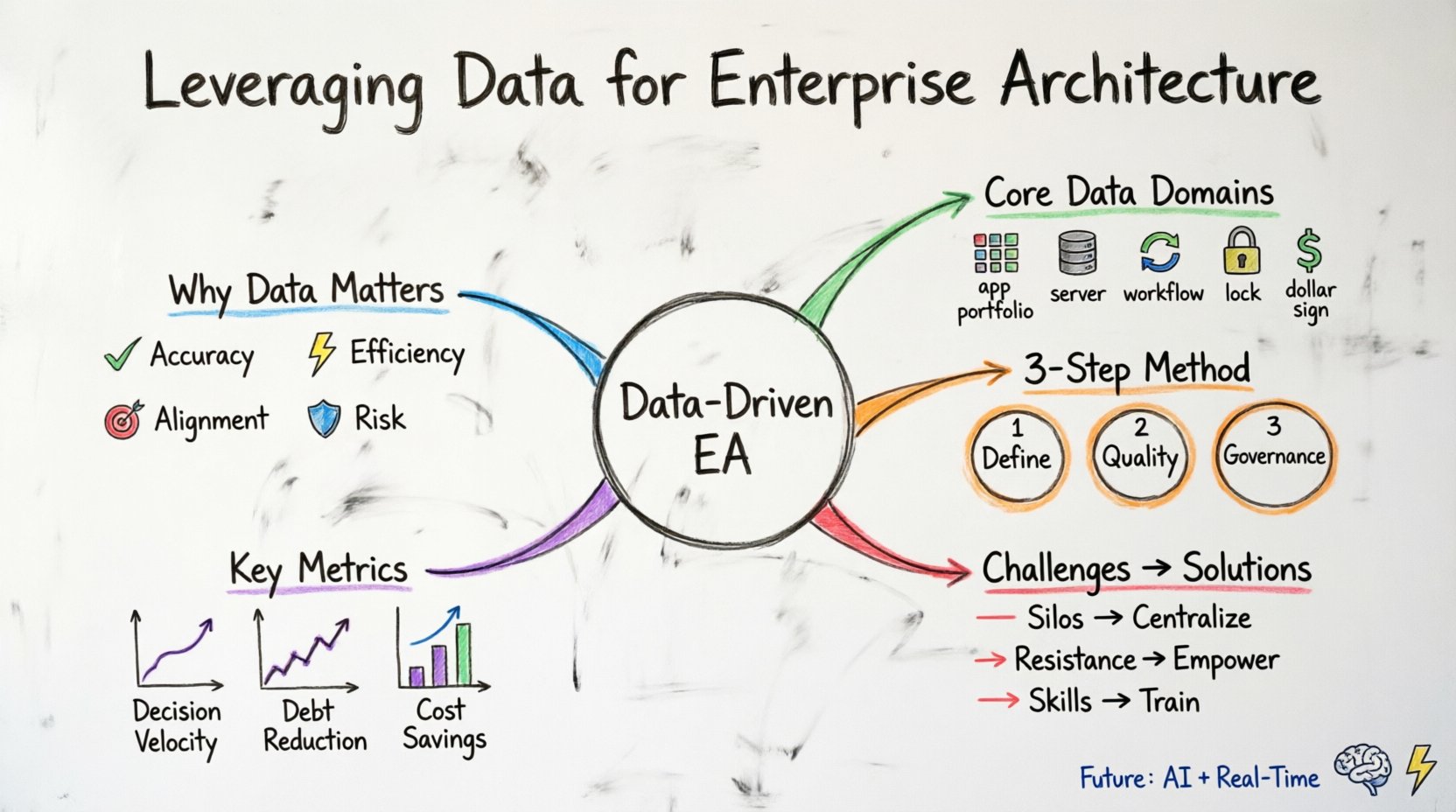
Why Data Matters in EA
- Accuracy: Data provides a factual basis for understanding current states rather than relying on memory or outdated documentation.
- Efficiency: Identifying redundant systems or underutilized resources becomes possible when analyzing usage logs and performance metrics.
- Alignment: Correlating business KPIs with IT assets ensures that technology investments directly support revenue-generating activities.
- Risk Management: Data reveals vulnerabilities in legacy systems or dependencies that might not be apparent in standard topology maps.
When architects treat data as a first-class citizen, the architecture evolves from a static document into a living system that reflects the dynamic nature of the enterprise.
🗂️ Core Data Domains for Architects
To effectively leverage data, Enterprise Architects must identify which datasets provide the highest value. Not all data is relevant to architectural decisions. Focusing on the right domains ensures that effort is directed toward insights that drive change.
Key Data Categories
| Data Domain | Architectural Relevance | Example Metrics |
|---|---|---|
| Application Portfolio | Identifies redundancy, maintenance costs, and technical debt. | License costs, uptime, user adoption rates |
| Infrastructure | Reveals capacity constraints and scalability limits. | CPU utilization, storage growth, network latency |
| Business Processes | Maps IT support to actual workflow execution. | Process cycle time, error rates, handoff points |
| Security & Compliance | Highlights gaps in governance and access control. | Failed login attempts, patch compliance, audit findings |
| Financial | Connects IT spend to business outcomes. | Cost per transaction, ROI per project, OPEX vs CAPEX |
By categorizing data in this manner, architects can create targeted queries and dashboards that speak directly to specific architectural concerns.
🛠️ Methodology for Data-Driven EA
Implementing a data-centric approach requires a structured methodology. It is not enough to simply collect data; the organization must define how that data is curated, analyzed, and applied to architectural decisions.
Step 1: Define Data Requirements
Before collecting information, architects must specify what they need to know. This involves mapping architectural questions to data points.
- Question: Are we maintaining too many applications?
- Data Point: Application usage frequency, support ticket volume, license renewal dates.
- Question: Is our infrastructure scalable?
- Data Point: Peak load times, growth trends over the last 24 months, resource bottlenecks.
Step 2: Establish Data Quality Standards
Garbage in, garbage out. Architectural decisions based on poor data lead to strategic failures. Organizations must enforce standards for data integrity.
- Completeness: Ensure all assets are cataloged.
- Accuracy: Validate that system names and versions match reality.
- Timeliness: Ensure data is updated regularly, not just during annual audits.
- Consistency: Ensure naming conventions and categorizations are uniform across departments.
Step 3: Integrate with Governance Frameworks
Data governance and Enterprise Architecture should not operate in silos. They require a unified approach to ensure that data policies support architectural goals.
- Define who owns the data within the architecture repository.
- Establish review cycles for architectural models to ensure they reflect current data states.
- Link data stewardship responsibilities to specific architecture domains.
📈 Metrics and Measurement
How do you know if leveraging data has improved your architecture? You need measurable outcomes. These metrics should track both the health of the architecture and the efficiency of the decision-making process.
Performance Indicators
- Decision Velocity: The time taken to approve or reject a new system based on data evidence.
- Debt Reduction Rate: The percentage of identified technical debt resolved over a specific period.
- Alignment Score: A calculated metric showing how well IT initiatives match business priorities.
- Cost Avoidance: Savings realized by identifying redundant systems or optimizing resource usage.
Reporting Cadence
Data should not be a one-time report. It requires a rhythm.
- Weekly: Operational metrics (system health, incident trends).
- Monthly: Portfolio health (adoption rates, license utilization).
- Quarterly: Strategic alignment (project ROI, architectural compliance).
- Annually: Roadmap review and long-term trend analysis.
🚧 Common Challenges and Mitigation
Transitioning to a data-driven approach is not without obstacles. Organizations often face resistance, technical debt in their data collection, or cultural barriers.
Challenge 1: Data Silos
Different departments often store data in disparate systems, making aggregation difficult.
- Mitigation: Implement a centralized data lake or warehouse specifically for architecture metadata. Use APIs to pull data where possible.
Challenge 2: Resistance to Transparency
Teams may feel threatened by data that exposes inefficiencies in their systems.
- Mitigation: Frame data usage as a tool for empowerment rather than policing. Focus on how it helps teams reduce their workload.
Challenge 3: Lack of Skills
Architects may not have the analytical skills required to interpret complex datasets.
- Mitigation: Invest in training for architects on data literacy. Collaborate with data analysts to bridge the gap.
🔮 Future Trends in Data and EA
The landscape of data and architecture is evolving. Staying ahead requires awareness of emerging technologies and methodologies.
Artificial Intelligence Integration
AI and machine learning can automate the analysis of architectural data. Algorithms can predict system failures or suggest optimal configurations based on historical patterns.
- Predictive Maintenance: Identifying infrastructure issues before they cause downtime.
- Automated Compliance: Real-time checking of configurations against policy.
Real-Time Architecture
The move from batch processing to real-time data streams allows for dynamic architecture adjustments. This is crucial for organizations operating in high-speed markets.
- Event-Driven Design: Architecture that reacts instantly to data inputs.
- Live Dashboards: Stakeholders can view architectural health in real-time.
🤝 Stakeholder Engagement
Data is only valuable if it is understood and acted upon by stakeholders. Communication is key to ensuring that architectural data influences business strategy.
Tailoring the Message
- For Executives: Focus on cost, risk, and strategic alignment. Use high-level dashboards.
- For IT Teams: Focus on technical debt, system stability, and integration complexity. Use detailed logs and metrics.
- For Business Units: Focus on how IT supports their specific goals. Use process efficiency data.
Visualizing Data
Complex data sets are difficult to digest. Visualization tools should be employed to make the data accessible.
- Heat maps for resource utilization.
- Flow charts for data movement and dependencies.
- Graphs for trend analysis over time.
🏁 Building a Sustainable Framework
Creating a sustainable framework for data-driven Enterprise Architecture requires commitment from the top down. It is a continuous improvement process, not a project with a finish line.
- Leadership Support: Ensure executive sponsorship to enforce data standards.
- Iterative Process: Start small. Pilot the approach with one department or system domain before scaling.
- Feedback Loops: Regularly review the effectiveness of the data sources and adjust as needed.
- Documentation: Maintain clear records of how data influenced specific architectural decisions.
By embedding data into the DNA of your Enterprise Architecture, you create a resilient structure capable of adapting to change. The goal is not just to build systems, but to build systems that are informed, efficient, and aligned with the true needs of the business.
Remember, the value lies not in the volume of data collected, but in the quality of insights derived and the actions taken based on those insights. With a disciplined approach, data becomes the foundation for architectural excellence.