


In the modern business landscape, organizations face a constant pressure to adapt, innovate, and scale. Digital transformation is often cited as the primary vehicle for this adaptation, yet many initiatives stall or fail to deliver expected value. The missing link in many of these efforts is a robust Enterprise Architecture (EA) framework. Without a clear architectural blueprint, digital initiatives can become fragmented, costly, and misaligned with long-term business goals. This guide explores the critical function of Enterprise Architecture in driving successful digital transformation.
Defining Enterprise Architecture 🧩
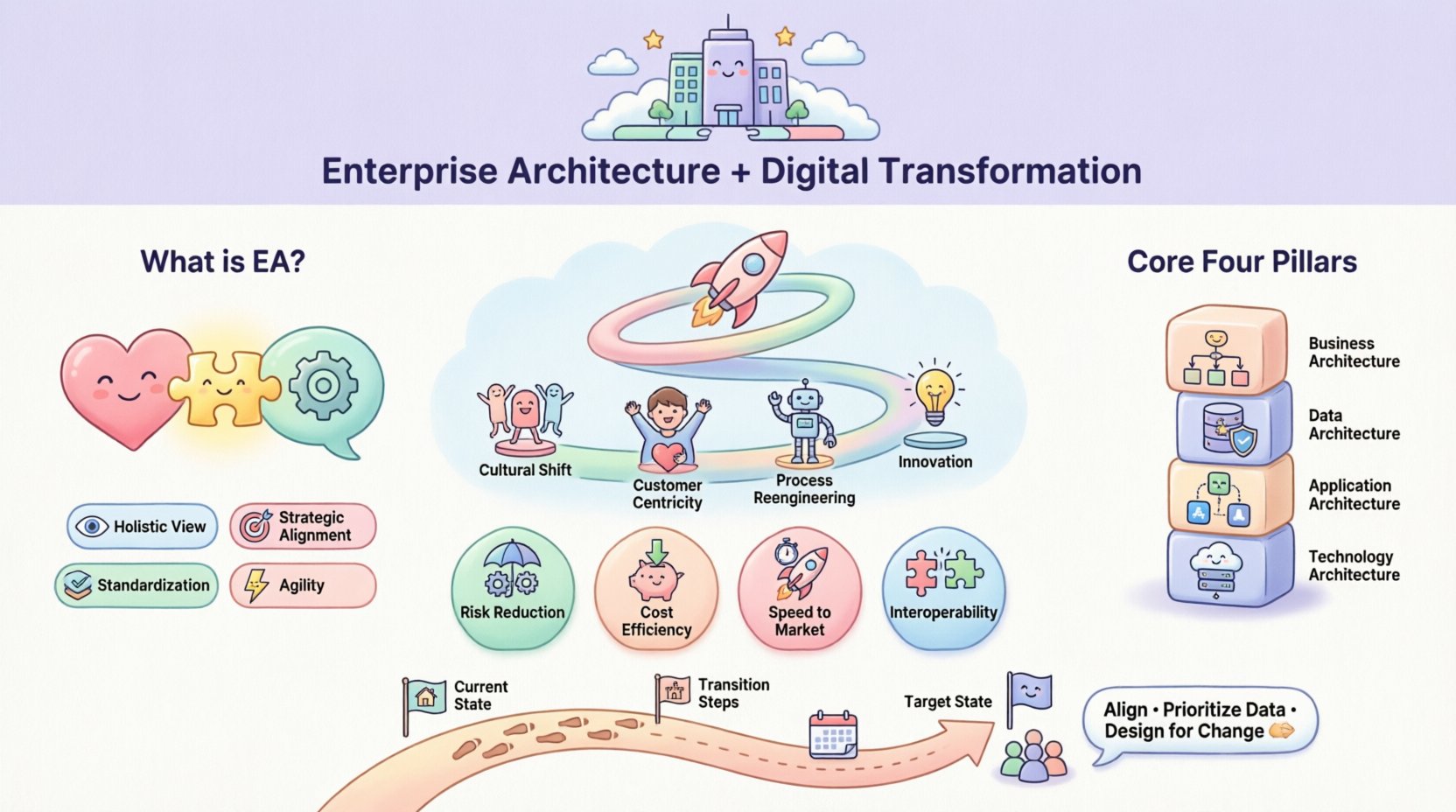
Enterprise Architecture is not merely a set of diagrams or a IT department function. It is a strategic discipline that aligns an organization’s business strategy with its technology infrastructure. Think of it as the city planning for a growing metropolis. Just as a city needs zoning laws, transportation networks, and utility grids to function coherently, an enterprise needs defined processes, data flows, applications, and technology standards.
Key characteristics of a mature Enterprise Architecture include:
- Holistic View: It looks at the entire organization, not just siloed departments.
- Strategic Alignment: IT capabilities directly support business objectives.
- Standardization: Common platforms and processes reduce redundancy.
- Agility: The structure allows for rapid change without breaking core systems.
Understanding Digital Transformation 🚀
Digital transformation is often misunderstood as simply adopting new software or moving to the cloud. While technology is the enabler, true transformation is about changing how value is delivered to customers and how operations are conducted. It involves:
- Cultural Shift: Moving towards data-driven decision-making.
- Customer Centricity: Using technology to improve user experiences.
- Process Reengineering: Automating manual workflows to increase efficiency.
- Innovation: Creating new revenue streams through digital products.
When digital transformation occurs without architectural guidance, it often leads to “shadow IT”. Departments acquire their own tools that do not integrate with the core ecosystem, creating data silos and security vulnerabilities.
Why EA Matters for Transformation 🎯
Enterprise Architecture acts as the stabilizer during the turbulence of change. It provides the structure necessary to navigate complex transitions. Here is how EA directly impacts digital initiatives:
- Risk Reduction: By mapping dependencies, architects can identify potential failures before implementation.
- Cost Efficiency: Eliminating redundant systems and optimizing infrastructure reduces spend.
- Speed to Market: Standardized components allow for faster development and deployment.
- Interoperability: Ensures new digital tools communicate effectively with legacy systems.
Without EA, organizations often find themselves in a “spaghetti architecture” state. This makes maintenance difficult and innovation slow. EA provides the clarity needed to invest in the right technologies at the right time.
Core Pillars of Architectural Alignment 🏛️
A comprehensive architectural framework consists of several domains. For digital transformation to succeed, each domain must evolve in tandem. The following table outlines these domains and their specific role in transformation:
| Domain | Focus Area | Role in Digital Transformation |
|---|---|---|
| Business Architecture | Processes, Organization, Strategy | Defines how the business operates and where value is created. |
| Data Architecture | Information Flows, Governance | Ensures data is accessible, accurate, and secure for analytics. |
| Application Architecture | Software, Integrations, Services | Enables modularity and scalability of digital services. |
| Technology Architecture | Hardware, Networks, Cloud | Provides the infrastructure to run modern applications efficiently. |
When these pillars are aligned, the organization can pivot quickly. For example, if the business decides to launch a mobile-first strategy, the Application and Technology architectures must support mobile access, while the Data architecture must ensure real-time data availability.
Managing Complexity and Legacy Systems ⚙️
One of the biggest challenges in digital transformation is the presence of legacy systems. These are older applications and infrastructure that have been built up over decades. They often hold critical business data but lack modern integration capabilities.
Enterprise Architecture provides a strategy for dealing with these systems without halting progress. Common approaches include:
- Encapsulation: Wrapping legacy functions in APIs so modern apps can use them.
- Migration: Gradually moving functionality to new platforms.
- Replacement: Phasing out old systems entirely when viable.
- Maintenance: Keeping systems running if they are stable and non-critical.
Architects assess the technical debt associated with legacy systems. Technical debt refers to the implied cost of additional rework caused by choosing an easy solution now instead of a better approach that would take longer. EA helps quantify this debt and plan its repayment through incremental upgrades.
Governance and Decision Making ⚖️
Transformation requires making thousands of decisions. Who approves the technology stack? Who manages the data standards? Who ensures security compliance? Enterprise Governance provides the framework for these decisions. It ensures that changes align with the overall strategy and do not introduce unintended consequences.
Effective governance involves:
- Standards Bodies: Groups that define acceptable technologies and practices.
- Review Boards: Committees that evaluate major projects against architectural principles.
- Compliance Checks: Ensuring regulations and internal policies are met.
- Feedback Loops: Gathering insights from implementation teams to refine architecture.
Without governance, teams may choose tools that look good on paper but create long-term maintenance issues. Governance ensures consistency and quality across the enterprise.
Future-Proofing Your Architecture 🛡️
Technology trends change rapidly. What is cutting edge today may be obsolete in five years. A good Enterprise Architecture anticipates these shifts. It builds flexibility into the system design so that components can be swapped out as needed.
Key strategies for future-proofing include:
- Modularity: Designing systems as independent modules that can be updated separately.
- Open Standards: Using protocols that are widely supported and not vendor-locked.
- Scalability: Ensuring the system can handle increased load without redesign.
- Security by Design: Embedding security controls from the start rather than adding them later.
By planning for change, the organization reduces the shock of technological shifts. This allows leadership to focus on business outcomes rather than firefighting technical issues.
Measuring Architectural Value 📊
How do you know if Enterprise Architecture is delivering value? It is important to measure outcomes rather than just activities. Metrics should reflect alignment, efficiency, and risk.
Key performance indicators for EA include:
- System Integration Rate: Percentage of systems that communicate seamlessly.
- Time to Deploy: Speed at which new capabilities reach the market.
- Cost of Change: Effort required to modify existing systems.
- Incident Frequency: Number of outages or errors related to architecture.
- Business Satisfaction: Feedback from business units on IT support.
Tracking these metrics helps leadership understand the return on investment for architectural initiatives. It justifies the budget required to maintain the EA function.
Common Pitfalls to Avoid ⚠️
Even with a good plan, organizations can stumble. Recognizing common pitfalls helps steer the transformation in the right direction.
- Over-Engineering: Creating too many rules that slow down development. Architecture should enable, not hinder.
- Ignoring Culture: Technology changes are easy; people changes are hard. Address resistance early.
- Lack of Visibility: If stakeholders cannot see the architecture, they cannot trust it. Communicate clearly.
- Static Planning: Architecture is not a one-time project. It requires continuous evolution.
- Siloed Teams: Business and IT must work together. Separate goals lead to misalignment.
Building the Roadmap for Success 🗺️
Creating a roadmap is the final step in leveraging Enterprise Architecture for transformation. This document outlines the journey from the current state to the target state. It includes milestones, resource requirements, and timelines.
A successful roadmap includes:
- Current State Assessment: A clear picture of where the organization stands today.
- Target State Definition: A vision of what the organization looks like after transformation.
- Transition Plans: Step-by-step guidance on how to get from here to there.
- Resource Allocation: Identifying the people and budget needed.
This roadmap serves as a contract between business leaders and technology teams. It ensures everyone is working toward the same goal with a shared understanding of the path ahead.
Final Thoughts on Strategic Alignment 🤝
The intersection of Enterprise Architecture and Digital Transformation is where long-term success is secured. It is not about controlling every decision, but about providing the guardrails that allow innovation to flourish safely. By understanding the core pillars, managing legacy complexity, and establishing strong governance, organizations can navigate the digital landscape with confidence.
Focus on alignment. Prioritize data. Design for change. These principles will guide your architecture through the inevitable shifts of the modern economy. The goal is not just to survive the transformation, but to thrive within it.