

Enterprise Architecture (EA) serves as the strategic blueprint for an organization, aligning its business goals with its IT infrastructure and processes. However, transforming an existing architecture is rarely a simple task. It involves navigating complex legacy systems, managing organizational culture, and ensuring continuous alignment with shifting market demands. This guide examines real-world scenarios where organizations have successfully executed enterprise architecture transformations. By analyzing these examples, we can understand the patterns, challenges, and methodologies that lead to tangible results without relying on specific vendor solutions.
The journey from a fragmented IT landscape to a cohesive, agile enterprise architecture requires more than just new tools; it demands a fundamental shift in mindset. Success is measured by improved decision-making speed, reduced technical debt, and enhanced business agility. The following sections detail the critical factors involved, supported by detailed case studies from various sectors.
🧩 The Strategic Imperative for Transformation
Organizations often begin the EA transformation journey because they have reached a tipping point. Legacy systems become difficult to maintain, data silos prevent a unified view of the business, and the pace of innovation slows down due to rigid infrastructure. The goal is to create an architecture that supports change rather than resisting it.
Key drivers for these transformations include:
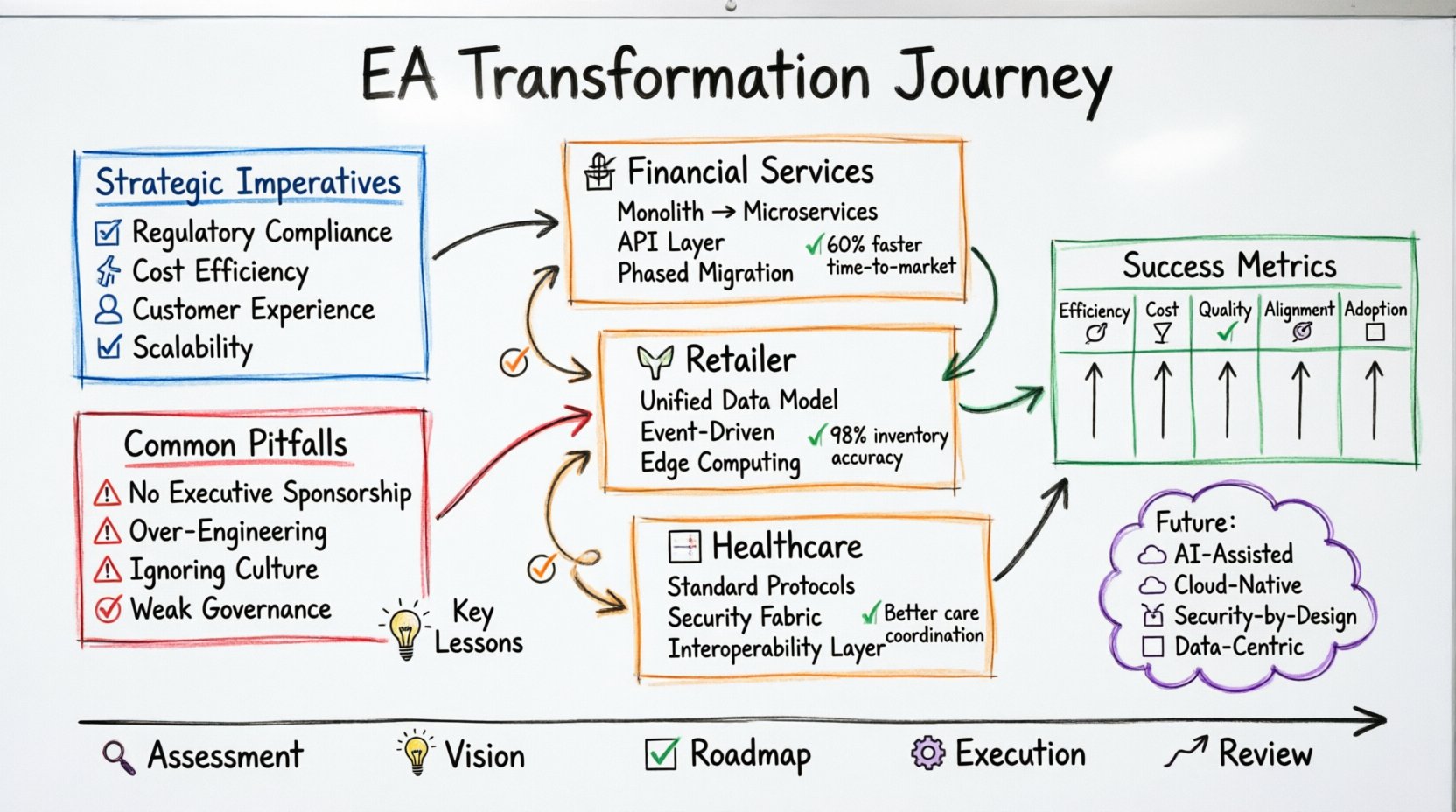
- Regulatory Compliance: Ensuring data governance meets evolving legal standards.
- Cost Efficiency: Reducing redundancy in applications and infrastructure.
- Customer Experience: Enabling seamless interactions across digital and physical channels.
- Scalability: Preparing the foundation for future growth and market expansion.
Without a clear architectural strategy, technology investments often result in temporary fixes rather than long-term solutions. A robust transformation plan ensures that every investment contributes to the broader organizational vision.
⚠️ Common Pitfalls in Enterprise Architecture
Before diving into success stories, it is essential to understand why many initiatives fail. The challenges are often less technical and more organizational. Recognizing these pitfalls early allows leaders to mitigate risks.
1. Lack of Executive Sponsorship
When leadership views EA as a documentation exercise rather than a strategic enabler, resources are scarce. Successful transformations require C-level commitment to enforce standards and prioritize architectural decisions over immediate tactical requests.
2. Over-Engineering
Architects sometimes create models that are too theoretical. If the architecture cannot be implemented within reasonable timeframes, it loses credibility. The focus must remain on practical implementation and value delivery.
3. Ignoring Cultural Change
Technology changes are easy; people changes are hard. Developers, business analysts, and operations teams must understand the new standards. Without training and communication, adoption rates remain low, leading to shadow IT and fragmented systems.
4. Neglecting Governance
Without a clear governance model, exceptions pile up. A defined process for reviewing architecture changes ensures that the system remains consistent. Governance should be lightweight and agile, not a bureaucratic bottleneck.
🏦 Case Study 1: Global Financial Services Institution
Context: A major financial services firm with a 50-year history struggled with a monolithic core banking system. The legacy architecture could not support real-time transactions or rapid product launches. Competitors were launching digital banking features in weeks, while this organization took months.
Challenge: The core challenge was to modernize the core banking platform without disrupting daily operations or compromising security. The organization needed to move towards a distributed architecture that supported microservices and API-first development.
Approach:
- Domain-Driven Design: The team mapped business capabilities to technical domains. This allowed them to decompose the monolith into manageable services.
- API Strategy: An internal API layer was created to expose functionality to new digital channels without touching the core directly.
- Phased Migration: Rather than a “big bang” replacement, they migrated functions incrementally. Customer data, account management, and transaction processing were moved in distinct waves.
Outcome: Within two years, the organization reduced the time-to-market for new products by 60%. Technical debt was reduced by 40% as legacy code was retired. The new architecture allowed for better scalability during peak transaction times, such as tax season.
Key Lesson: Incremental migration reduces risk. Breaking the monolith into domains allows teams to own specific areas of responsibility, fostering accountability and faster development cycles.
🛍️ Case Study 2: Omnichannel Retailer
Context: A large retail chain operated both physical stores and an e-commerce platform. However, inventory data was siloed. A customer might see an item as “in stock” online, but it was actually reserved for a store nearby. This led to frustration and lost sales.
Challenge: The organization needed a unified view of inventory and customer data across all touchpoints. The legacy systems could not communicate in real-time, causing discrepancies in order fulfillment.
Approach:
- Unified Data Model: A master data management (MDM) layer was implemented to standardize product and customer information.
- Event-Driven Architecture: Changes in inventory were published as events. All systems subscribed to these events to update their local views immediately.
- Edge Computing: Store-level systems were equipped to handle local transactions and sync with the central cloud when connectivity allowed.
Outcome: Inventory accuracy improved to 98%. The retailer introduced a “buy online, pick up in-store” feature that drove foot traffic. Customer satisfaction scores increased significantly due to reliable stock information.
Key Lesson: Data consistency is the backbone of modern retail. Real-time data synchronization enables features that enhance the customer experience and operational efficiency.
🏥 Case Study 3: Healthcare Provider Network
Context: A healthcare network consisted of multiple hospitals and clinics. Each facility used different electronic health record (EHR) systems. Patient data was not portable, making referrals and care coordination difficult.
Challenge: The primary concern was patient privacy and data interoperability. They needed to share information securely while adhering to strict regulatory requirements regarding health data.
Approach:
- Standardized Protocols: The organization adopted industry-standard data exchange protocols to ensure compatibility between different systems.
- Security Fabric: A centralized security layer managed authentication and encryption across all endpoints. Identity management was unified to prevent unauthorized access.
- Interoperability Layer: A middleware solution acted as a translator between disparate systems, allowing them to speak a common language without replacing the underlying EHRs.
Outcome: Care coordination improved, reducing duplicate testing and administrative errors. Patient wait times decreased as providers had immediate access to complete medical histories. Compliance audits became smoother due to centralized logging and access controls.
Key Lesson: Interoperability does not always require replacing existing systems. A well-designed integration layer can bridge gaps while respecting the constraints of legacy environments.
📊 Measuring Success: Metrics and KPIs
How do you know if the transformation is working? Relying on intuition is insufficient. Quantitative and qualitative metrics must be tracked to validate the return on investment.
The table below outlines key performance indicators commonly used to measure EA transformation success.
| Category | Metric | Target Outcome |
|---|---|---|
| Efficiency | Time-to-Market | Reduce by 30-50% |
| Cost | Technology Debt Ratio | Decrease by 20% |
| Quality | System Uptime | 99.9% Availability |
| Alignment | Project Success Rate | 85% of projects meet goals |
| Adoption | Architecture Compliance | 90% adherence to standards |
Tracking these metrics requires a centralized dashboard. This ensures transparency and allows leadership to make data-driven decisions regarding resource allocation.
🔄 Sustaining Momentum: Governance and Culture
Transformations often stall after the initial implementation phase. To sustain momentum, governance must evolve from a policing mechanism to a service function.
1. Agile Governance
Traditional governance processes were often slow and document-heavy. Modern approaches integrate governance into the development lifecycle. Automated checks ensure that code and infrastructure comply with standards before deployment.
2. Continuous Learning
The technology landscape changes rapidly. Architects and developers need continuous training. Establishing communities of practice allows teams to share knowledge and solve problems collaboratively.
3. Feedback Loops
Regular retrospectives help identify what is working and what is not. This feedback informs the next iteration of the architecture, ensuring it remains relevant to business needs.
🚀 Future Trends in Enterprise Architecture
The field of EA is evolving. Several trends are shaping the future of how organizations design and manage their technology landscapes.
- Data-Centric Design: Moving away from application-centric models to focus on data as the primary asset. This ensures that insights can be derived regardless of the application layer.
- AI-Assisted Architecture: Using machine learning to analyze architecture models and suggest optimizations. AI can predict bottlenecks and recommend refactoring strategies.
- Cloud-Native Strategies: Designing systems specifically for cloud environments, leveraging elasticity and managed services to reduce operational overhead.
- Security by Design: Integrating security controls at the architectural level rather than as an add-on. This reduces vulnerabilities and simplifies compliance.
🤝 The Human Element: Stakeholder Engagement
Technology is only one part of the equation. The success of an architecture transformation depends heavily on the people using it.
Engaging Business Stakeholders: Architects must translate technical capabilities into business value. Regular workshops ensure that business leaders understand the implications of architectural decisions.
Empowering Technical Teams: Developers should be involved in architectural decisions. This fosters ownership and ensures that the design is practical. Providing them with the right tools and documentation reduces friction.
Change Management: Communicating the “why” behind the transformation is crucial. Employees need to see how the changes benefit their daily work, not just the organization’s bottom line.
🛠️ Practical Steps for Implementation
For organizations considering a similar path, here is a structured approach to initiating an enterprise architecture transformation.
- Assessment: Conduct a thorough audit of the current state. Identify redundancies, bottlenecks, and risks.
- Vision: Define the target state. What does success look like in three to five years?
- Roadmap: Create a phased plan. Prioritize high-impact, low-risk initiatives to build momentum.
- Execution: Implement the plan with clear milestones. Assign ownership for each workstream.
- Review: Monitor progress against the roadmap. Adjust as necessary based on feedback and changing conditions.
🌟 Conclusion
Successful enterprise architecture transformations are complex endeavors that require patience, discipline, and strategic vision. The case studies presented here demonstrate that there is no single path to success. Each organization must tailor its approach to its specific context, industry, and maturity level.
By focusing on business alignment, adopting agile governance, and prioritizing the human element, organizations can build architectures that drive innovation and resilience. The journey is ongoing. As markets change and new technologies emerge, the architecture must adapt. Continuous improvement is the only constant in the world of enterprise architecture.
Ultimately, the goal is to create an environment where technology enables the business, rather than hindering it. When executed correctly, the transformation yields not just better systems, but a more capable and responsive organization ready for the future.