

In the dynamic world of Agile development, the quality of the work input directly dictates the quality of the output. When teams adopt the Scrum framework, the Product Backlog becomes the single source of truth for what is to be built. However, a backlog filled with vague tasks or massive epics leads to confusion, estimation errors, and delayed delivery. To navigate this, Scrum teams rely on a specific heuristic known as INVEST to ensure user stories are fit for purpose.
This guide details how to apply INVEST criteria for high quality user stories. It breaks down each component of the acronym, explains the practical application within a Scrum environment, and provides actionable strategies to refine your backlog. By adhering to these standards, teams can maintain a steady pace of delivery and ensure that every sprint contributes meaningful value to the product.
🧩 What is the INVEST Model?
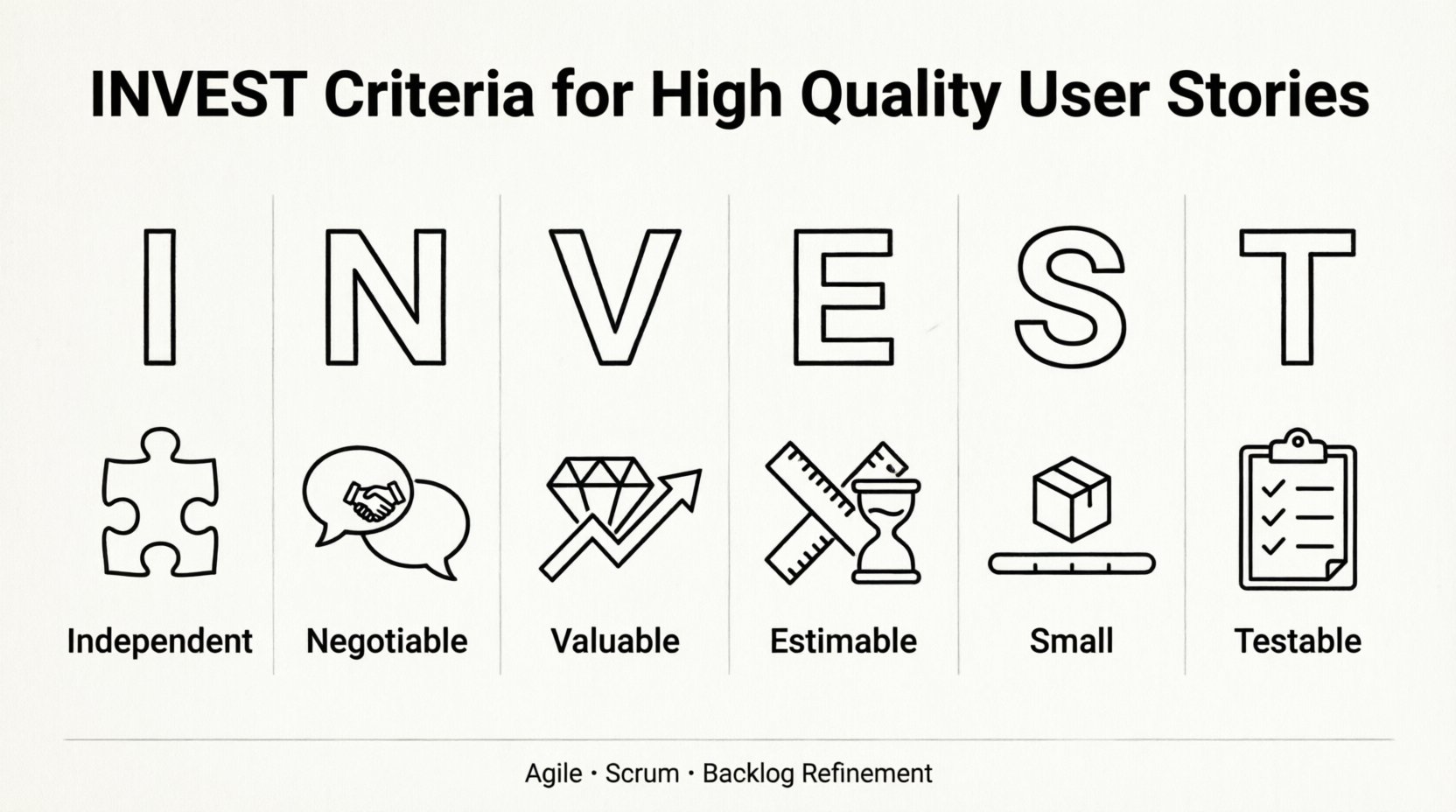
The INVEST model was introduced by Bill Wake in 2003 as a mnemonic to help teams write better user stories. It stands for Independent, Negotiable, Valuable, Estimable, Small, and Testable. While often associated with Agile software development, these principles apply to any product development context where iterative work is required.
Using INVEST helps teams avoid common pitfalls such as:
- Stories that are too large to complete in a single iteration.
- Requirements that are ambiguous and open to interpretation.
- Features that do not deliver immediate value to the user or business.
- Tasks that cannot be verified or tested effectively.
When a user story meets all six criteria, it is considered a viable candidate for the Sprint Backlog. If it fails any of these checks, it requires refinement before commitment.
🔍 Deep Dive into the INVEST Criteria
1. Independent (I)
Independence means that a user story should be self-contained and not rely on the completion of other stories to be delivered. While dependencies often exist in complex systems, the ideal state is for a story to be actionable on its own.
Why Independence Matters:
- Scheduling Flexibility: If a story depends on another, you cannot prioritize it independently. This limits the team’s ability to reorder work based on value.
- Parallel Work: Independent stories allow multiple developers to work simultaneously without blocking each other.
- Refinement Efficiency: Smaller, independent items are easier to discuss and clarify during backlog refinement sessions.
How to Achieve Independence:
- Split Technical Dependencies: If a database change is needed before a UI feature, split the database work into its own story.
- Remove External Blocks: If a story waits for an API from another team, document this as a dependency but try to mock or simulate the API to allow development to proceed.
- Sequence Carefully: If order matters, ensure the preceding story is small enough to be completed first, minimizing the risk of the second story being blocked.
2. Negotiable (N)
A user story is not a contract; it is a placeholder for a conversation. The “Negotiable” criterion emphasizes that the details of the story are open for discussion between the Product Owner and the Development Team.
The Role of Conversation:
- Focus on Value: Instead of documenting every technical detail upfront, focus on the problem to be solved. The solution can evolve.
- Flexibility: Requirements change. A negotiable story allows the team to adapt the implementation details as they learn more about the user needs.
- Avoid Over-Documentation: Writing pages of specifications creates a false sense of certainty. Keep the written record brief and rely on face-to-face (or virtual) communication.
When to Stop Negotiating:
- Once the story enters the Sprint, the scope should be stable. Negotiation happens during refinement, not during execution.
3. Valuable (V)
This is the most critical criterion. A user story must deliver value to the customer, the user, or the business. If a task does not add value, it should not be in the backlog.
Defining Value:
- User Value: Does this feature make the user’s life easier, faster, or more secure?
- Business Value: Does this increase revenue, reduce costs, or improve compliance?
- Strategic Value: Does this align with the long-term vision of the product?
Technical Debt:
Some work is valuable but not user-facing. Refactoring code or updating infrastructure is valuable because it prevents future degradation. However, even these tasks should be framed in terms of the benefit they provide (e.g., “Improve system stability” rather than “Update library version”).
4. Estimable (E)
The team must be able to estimate the effort required to complete the story. If the team cannot estimate it, the story is likely too vague or contains unknown risks.
Factors Influencing Estimation:
- Clarity: Do we understand what “done” looks like?
- Knowledge: Do we have the technical skills to solve the problem?
- Scope: Is the scope defined enough to gauge size?
Handling Unknowns:
If a story is not estimable, it should be broken down further or turned into a Spike. A Spike is a research task designed to reduce uncertainty so that the actual work becomes estimable later.
5. Small (S)
A story must be small enough to be completed within a single Sprint. If a story spans multiple iterations, it introduces unnecessary complexity and risk.
Why Size Matters:
- Predictability: Smaller stories have fewer hidden risks. It is easier to predict the outcome of a small task than a large one.
- Feedback Loop: Delivering small increments allows for faster feedback from stakeholders.
- Momentum: Completing small stories frequently creates a sense of progress and keeps the team motivated.
Rule of Thumb:
A good rule of thumb is that a story should not take more than a few days of work for the whole team combined. If it exceeds this, split it further.
6. Testable (T)
A story is not done until it can be verified. Testability ensures that there is a clear definition of “Done” and that the quality can be objectively measured.
Acceptance Criteria:
- Specific Conditions: Use clear conditions that can be checked (e.g., “Password must be 8 characters” vs “Password should be secure”).
- Automation: Whenever possible, acceptance criteria should be automatable for regression testing.
- QA Alignment: The Development and QA teams should agree on the criteria before work begins.
Non-Functional Requirements:
Performance and security requirements must also be testable. Instead of “Fast loading,” use “Page loads in under 2 seconds on a 3G connection.”
📊 Comparing Good vs. Bad User Stories
To illustrate the impact of the INVEST criteria, consider the following table comparing poorly written stories against refined versions.
| Criterion | Bad Example | Good Example |
|---|---|---|
| Independent | Update the user profile page AND integrate the new payment gateway. | Update the user profile page to allow photo uploads. |
| Negotiable | The login button must be red, 12px, and located at the top right. | Users need a way to log in securely using their email. |
| Valuable | Refactor the legacy database code. | Improve database query speed to reduce page load time. |
| Estimable | Make the system smarter. | Implement a recommendation engine based on purchase history. |
| Small | Build the entire e-commerce checkout flow. | Allow users to enter shipping address during checkout. |
| Testable | The search should work well. | Search returns results within 1 second for queries under 20 characters. |
⚠️ Common Pitfalls in Backlog Management
Even with the INVEST framework, teams often struggle to maintain high-quality stories. Here are common challenges and how to address them.
1. The Big Ball of Mud
When stories are too large, they become “Big Balls of Mud.” These are monolithic tasks that absorb all the time in a sprint and often result in unfinished work. To fix this, enforce strict size limits during refinement.
2. The Specification Trap
Teams sometimes treat the user story as a legal contract, writing thousands of words of specifications. This kills negotiation. Instead, keep the description concise and use comments or documentation links for deeper details.
3. Ignoring Technical Debt
Teams often prioritize new features over maintenance. This leads to a slow-down over time. Ensure that a portion of the backlog is dedicated to technical health, framed as valuable stories.
4. Lack of Acceptance Criteria
Developers finish the work, but QA cannot verify it. Always define acceptance criteria before the Sprint begins. Use the Given-When-Then format for clarity.
🛠️ Practical Steps for Backlog Refinement
Applying INVEST is an ongoing process. Here is a workflow to integrate it into your Scrum routine.
- 1. Initial Triage: When a new idea comes in, check if it is Valuable. If not, archive or discard it.
- 2. Story Mapping: Break down large themes into smaller stories. Check for Independence and Size.
- 3. Refinement Session: Gather the team. Discuss the details to ensure Negotiability and Estimation are possible.
- 4. Definition of Done: Review the story against the Testable criterion. Are there clear criteria for completion?
- 5. Prioritization: Order the refined stories by value. Ensure the top stories are the most INVEST-compliant.
📝 Checklist for Story Quality
Before adding a story to a Sprint, run it through this checklist. If the answer is “No” to any of these, return the story for refinement.
- ✅ Is the story independent of other stories?
- ✅ Can the team negotiate the implementation details?
- ✅ Does this story deliver clear value to the user?
- ✅ Can the team estimate the effort required?
- ✅ Is the story small enough to fit in a Sprint?
- ✅ Are there clear acceptance criteria for testing?
🔄 Continuous Improvement
Quality is not a one-time state. It requires constant attention. As the team learns more about the product, user stories may need to be updated. This is not a failure; it is part of the adaptive nature of Agile.
Teams should review their story quality regularly. Ask questions like:
- Did we finish all committed stories?
- Were there unexpected dependencies?
- Did we spend too much time on estimation?
- Did the testing phase reveal vague criteria?
Use these insights to adjust your refinement process. Over time, the backlog becomes cleaner, and the team becomes faster.
🚀 Wrapping Up the Process
Implementing the INVEST criteria is a foundational step toward Agile success. It transforms the Product Backlog from a simple to-do list into a strategic asset. By ensuring stories are Independent, Negotiable, Valuable, Estimable, Small, and Testable, teams reduce risk and increase predictability.
Remember that this is a framework, not a rigid rulebook. Adapt the criteria to fit your specific context. The goal is high-quality communication and delivery. When the team focuses on quality input, the output naturally follows. Consistent application of these principles leads to a sustainable pace of work and a product that truly serves its users.
Start reviewing your backlog today. Identify the stories that do not meet the INVEST standards and work on refining them. The difference in your team’s velocity and morale will be noticeable.