


Agile frameworks like Scrum prioritize flexibility and customer collaboration. However, the complexity of modern software development often demands a dedicated focus on requirements and value definition that goes beyond the standard Scrum roles. The Business Analyst (BA) plays a critical part in bridging the gap between stakeholder needs and technical implementation. Integrating a BA into a Scrum team requires a deliberate shift in mindset, clear role definition, and robust communication channels.
This guide explores the practical steps to embed Business Analysts effectively within Scrum teams. It focuses on collaboration, clarity, and process rather than tools. By following these strategies, teams can enhance their delivery speed and ensure that the product being built aligns with actual business value.
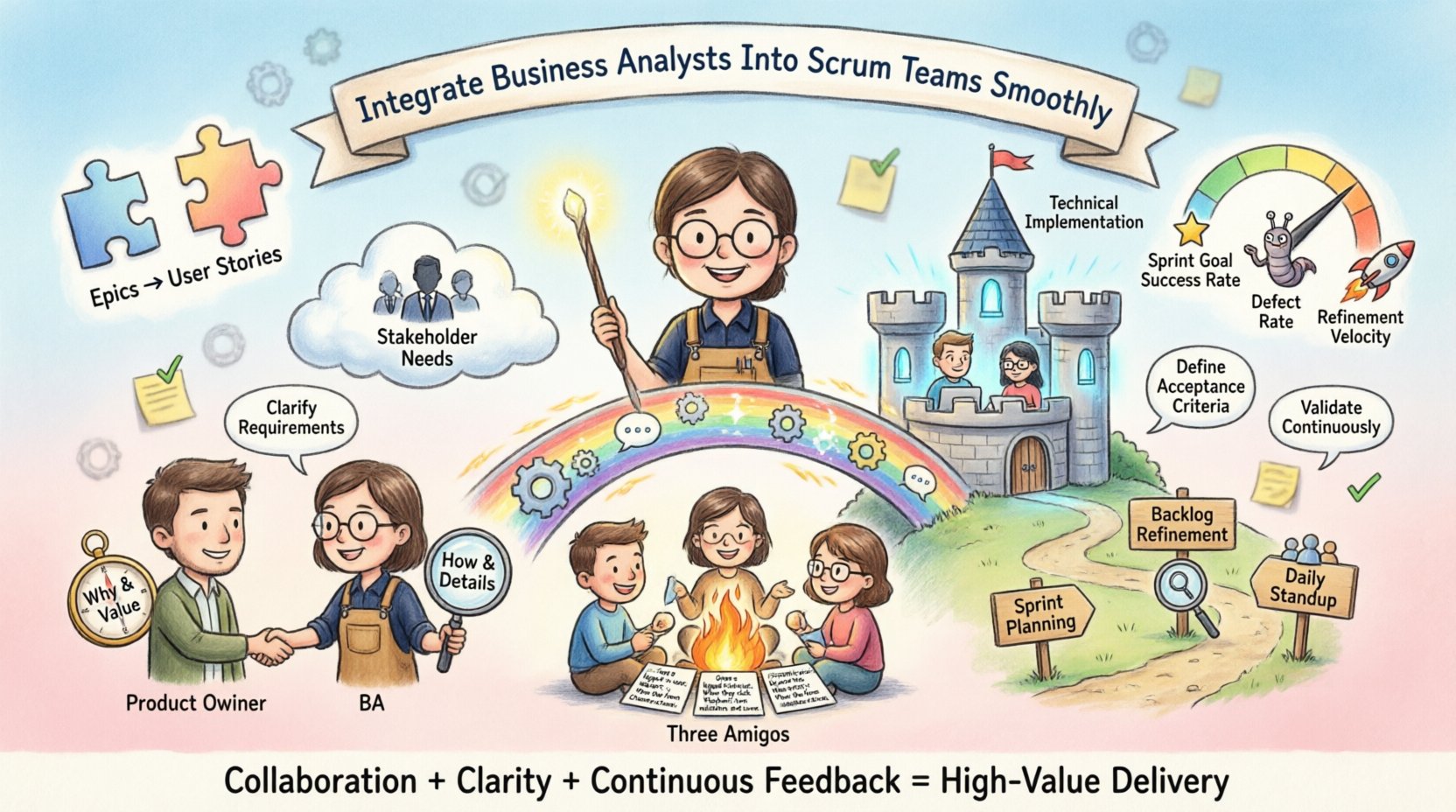
Understanding the BA Role in Scrum 🧩
In traditional waterfall methodologies, the Business Analyst often operates as a distinct phase of the project lifecycle. They gather requirements, document them, and hand them off to developers. In Scrum, this siloed approach creates friction. The goal is to integrate the BA as a member of the cross-functional team, working alongside the Product Owner (PO) and the Developers.
The BA in Scrum is not just a scribe. They are a facilitator of understanding. Their primary focus is ensuring that the team understands the “why” behind a feature and the “what” in sufficient detail to build it correctly the first time.
- Clarifying Requirements: They break down large epics into manageable user stories.
- Defining Acceptance Criteria: They work with the team to ensure testability.
- Stakeholder Liaison: They translate business language into technical constraints and vice versa.
- Continuous Discovery: They validate assumptions throughout the sprint, not just at the beginning.
When a BA is integrated smoothly, they become the glue that holds the product vision and the technical execution together. This reduces rework and increases team velocity over time.
Bridging the Gap Between Product Owner and BA 🤝
The relationship between the Product Owner and the Business Analyst is the most critical dynamic in this integration. While the PO owns the “What” and the “Why” (value and priority), the BA often dives deep into the “How” and “Details” (implementation specifics and constraints).
It is common for confusion to arise if these roles are not distinguished clearly. The PO represents the voice of the customer and the business. The BA supports the PO by ensuring that the backlog items are ready for development.
Key Responsibilities Split
To avoid overlap and conflict, teams should map out specific responsibilities. This table outlines a healthy division of labor:
| Area | Product Owner Focus | Business Analyst Focus |
|---|---|---|
| Backlog Management | Prioritization and ordering | Refinement and clarity |
| Stakeholder Interaction | Strategic alignment and negotiation | Requirement gathering and validation |
| Story Details | Business value and success metrics | Acceptance criteria and edge cases |
| Team Support | Answering “Why is this important?” | Answering “How does this work?” |
This separation allows the PO to focus on strategy while the BA ensures the tactical execution is sound. When they work in tandem, the team receives high-quality input during planning sessions.
Practical Integration Strategies 🛠️
Integrating a BA is not just about adding a title to a roster. It involves changing how meetings are run and how work flows through the system. Below are actionable steps to achieve smooth integration.
1. Participate in Sprint Planning
The BA should be present during Sprint Planning. Their role here is to ensure that the selected stories are understood by the developers. They help the team estimate effort by clarifying technical constraints that might not be obvious in a high-level story.
- Pre-Planning: The BA reviews the top items in the backlog to ensure they meet the “Definition of Ready”.
- During Planning: They explain the business context and answer immediate questions.
- Post-Planning: They assist in finalizing the acceptance criteria before the sprint begins.
2. Engage in Backlog Refinement
Backlog refinement (or grooming) is where the magic happens. This is the dedicated time where the team breaks down large items into smaller, actionable stories. The BA leads this activity with the PO.
Without a BA, refinement can stall due to a lack of detail. With a BA, the team can move faster because the stories are already fleshed out. The BA ensures that edge cases are considered, reducing the likelihood of blockers during development.
3. Collaborate on Acceptance Criteria
Acceptance criteria are the contract between the business and the developers. The BA should draft these alongside the developers. This collaboration ensures that the criteria are testable and realistic.
Using techniques like Gherkin syntax (Given/When/Then) can help standardize these criteria. This makes them readable for both business stakeholders and technical team members.
Common Challenges and Solutions 🛑
Even with a clear plan, friction can occur. Recognizing common pitfalls allows teams to address them proactively. The following table identifies frequent issues and provides constructive solutions.
| Challenge | Impact on Team | Proposed Solution |
|---|---|---|
| Role Overlap | Confusion over who owns the backlog | Define clear boundaries between PO (Value) and BA (Details) |
| Information Silos | Developers waiting on BA for answers | Encourage “Three Amigos” meetings (PO, BA, Dev) |
| Over-Documentation | Slows down delivery speed | Focus on lightweight documentation and live conversation |
| Dependency Bottlenecks | BA becomes a single point of failure | Cross-train other team members on requirements |
| Scope Creep | Sprint goals become unclear | BA reinforces the “Definition of Done” and scope limits |
Addressing these challenges requires open communication. If a developer feels blocked by a lack of information, they should speak up immediately. The BA should respond by facilitating a quick clarification session rather than waiting for the next formal meeting.
Communication Frameworks 🗣️
Effective integration relies on consistent communication patterns. The BA should not operate in isolation. They need to be embedded in the daily rhythm of the team.
The Three Amigos
One of the most effective patterns is the “Three Amigos” session. This involves the Product Owner, the Business Analyst, and a Developer (or QA engineer) meeting before a story is pulled into a sprint.
Why it works:
- Shared Understanding: All perspectives are aligned on the goal.
- Early Detection: Technical feasibility is checked against business value early.
- Reduced Rework: Ambiguities are resolved before coding starts.
Daily Standups
The BA should participate in the Daily Standup. While their updates might differ from developers, their presence signals availability.
Typical BA Update:
- What requirements did I clarify yesterday?
- Are there any pending questions from the business side?
- What support do I need from the team today?
This keeps the team aware of the BA’s focus and allows developers to know when the BA is available for quick questions.
Metrics for Success 📊
How do you know if the integration is working? You need to measure the health of the collaboration, not just the output. Traditional metrics like lines of code or story points alone do not capture the BA’s value.
Consider tracking the following indicators:
- Sprint Goal Success Rate: Are teams completing what they planned? A smooth BA integration often leads to higher completion rates because risks are identified earlier.
- Defect Rate: Are bugs related to misunderstood requirements decreasing? This indicates better clarity in the requirements phase.
- Refinement Velocity: How long does it take to refine a story? If the BA is effective, stories should move from “To Do” to “Ready” faster.
- Stakeholder Satisfaction: Do business stakeholders feel their needs are being met accurately? This is the ultimate measure of the BA’s contribution.
- Team Flow: Are developers waiting on requirements less often? Reduced wait time indicates a healthy handoff.
Reviewing these metrics in the Retrospective allows the team to adjust their working agreements. If the defect rate is high, perhaps the BA and PO need to spend more time on acceptance criteria. If flow is low, perhaps the BA needs to be more available during the sprint.
Navigating Ambiguity and Change 🌪️
Change is inevitable in software development. The Business Analyst is often the first to sense a shift in market conditions or stakeholder priorities. In a Scrum environment, this change must be managed without disrupting the team’s focus.
The BA helps the team navigate ambiguity by breaking it down into manageable chunks. Instead of presenting a vague directive, the BA presents options. For example, rather than saying “Make the checkout faster,” the BA might say “We can reduce the checkout steps by two, or we can optimize the payment gateway API. Which do you prefer?”
This empowers the team to make informed decisions. It also protects the team from constant context switching. The BA acts as a filter, ensuring that only validated and necessary changes enter the sprint.
Building a Shared Culture 🤝
Integration is as much about culture as it is about process. The BA must be viewed as a peer, not a vendor. This means inviting them to social events, celebrating wins together, and involving them in decision-making.
When the BA feels like part of the team, they contribute more than just documents. They contribute ideas, risk assessments, and user empathy. This cultural shift is essential for long-term success.
Encourage the developers to learn about the business domain. Encourage the BA to learn about the technical architecture. Cross-pollination of knowledge creates a resilient team capable of adapting to challenges.
Final Thoughts on Integration 💡
Integrating Business Analysts into Scrum teams is a journey of continuous improvement. It requires patience, clear communication, and a willingness to adapt roles. When done correctly, the result is a high-performing unit that delivers value consistently.
The goal is not to create a hierarchy of requirements, but to create a shared understanding of the product. By focusing on collaboration, clarity, and continuous feedback, teams can leverage the unique strengths of the Business Analyst role to drive better outcomes.
Start by defining the roles clearly. Establish the communication rhythms. Monitor the metrics. Adjust as needed. With these steps, your team will be well-equipped to handle the complexities of modern product development.