


Effective Agile delivery relies heavily on preparation. When teams jump straight into Sprint Planning without adequate preparation, the result is often ambiguity, stalled momentum, and a lack of commitment. The process of refining backlog items before Sprint Planning starts is the backbone of a predictable and high-performing Scrum team. This guide explores the mechanics, philosophy, and practical steps required to ensure your Product Backlog is in a state of readiness.
🤔 Why Backlog Refinement Matters
Many organizations treat the Product Backlog as a static list that grows indefinitely. In reality, it is a dynamic artifact that requires constant maintenance. Refinement is not a one-time event; it is an ongoing activity. Without it, the cost of change increases, and the team’s ability to forecast delivery diminishes.
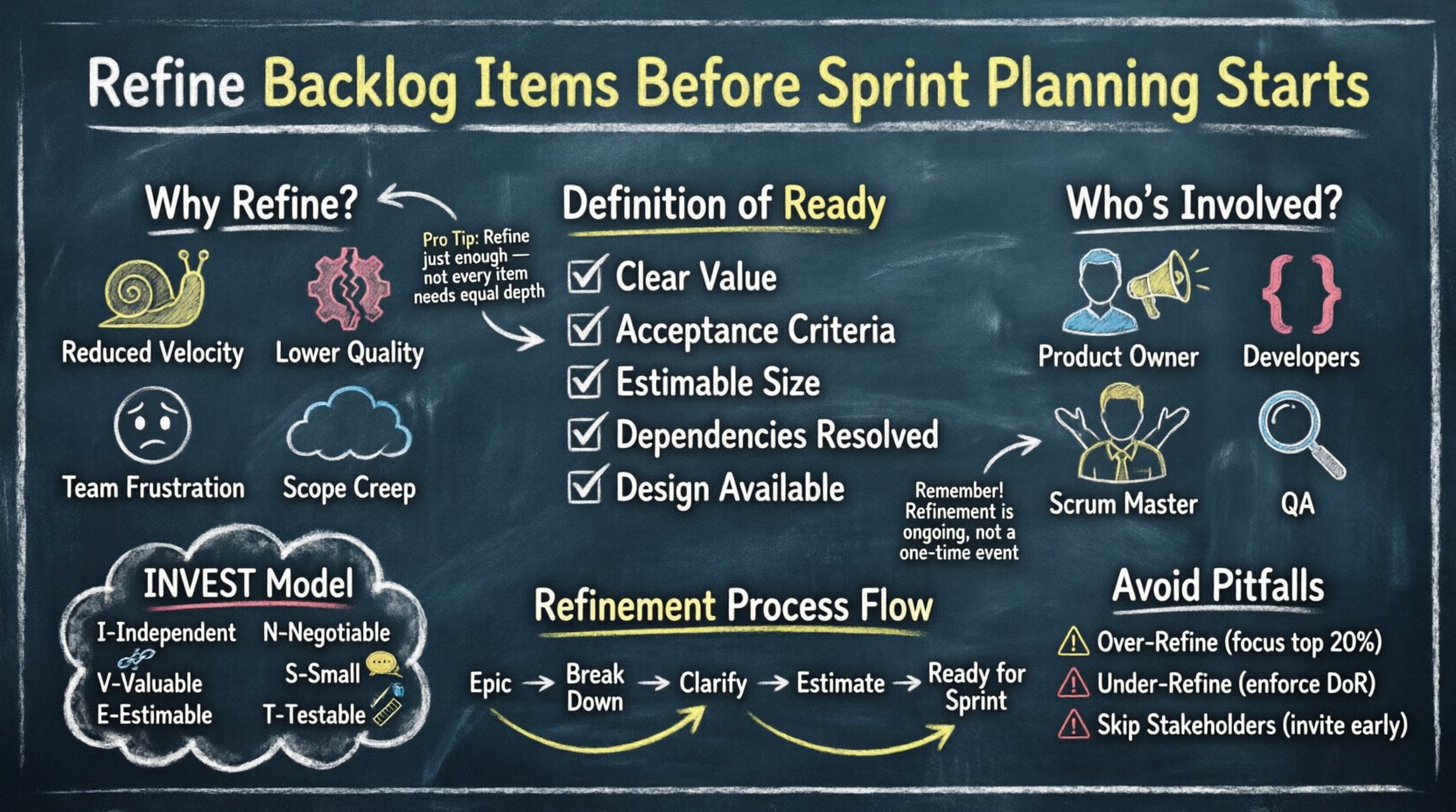
Consider the alternative: entering a Sprint Planning session with vague requirements. The team spends the first half of the meeting asking questions instead of committing to work. This leads to:
- Reduced Velocity: Time spent clarifying requirements during planning is time not spent developing.
- Lower Quality: Unclear acceptance criteria often lead to rework after the sprint is complete.
- Team Frustration: Developers feel unprepared and forced to guess requirements.
- Scope Creep: Without clear boundaries, new ideas are added mid-sprint.
Refinement mitigates these risks. It shifts the cognitive load away from the Sprint Planning meeting, allowing the team to focus on how to build the solution rather than what needs to be built.
🛠 What is Backlog Refinement?
Backlog refinement, sometimes referred to as backlog grooming, is the process of reviewing, updating, and organizing Product Backlog items. It involves breaking down large epics into smaller stories, clarifying requirements, and estimating effort.
This activity is distinct from Sprint Planning. Planning is the decision-making event where the team commits to a specific set of items for the upcoming sprint. Refinement is the preparatory work that makes those decisions possible.
Key Characteristics of Refinement
- Collaborative: It requires the Product Owner, Development Team, and sometimes stakeholders.
- Ongoing: It happens continuously, not just right before planning.
- Time-Boxed: It should not consume the entire sprint. A common rule of thumb is to dedicate 5-10% of the team’s capacity.
- Iterative: Items may be refined multiple times before they are selected for a sprint.
👥 Who Should Be Involved?
Refinement is a team sport. While the Product Owner owns the backlog, the development team owns the implementation. Both perspectives are necessary.
- Product Owner: Provides context, clarifies the “why” and “what,” and prioritizes items based on business value.
- Developers: Identify technical risks, clarify implementation details, and provide estimates.
- Scrum Master: Facilitates the session, ensures the team stays focused, and removes impediments to the process.
- QA/Testers: Define acceptance criteria and identify edge cases early.
Excluding stakeholders too early can lead to missed requirements. Including too many can slow down the discussion. The core team should drive the conversation, with stakeholders available for specific deep-dives if needed.
📝 The Definition of Ready
Before an item can be pulled into a Sprint Planning session, it must meet a specific threshold of clarity. This is often formalized as a Definition of Ready (DoR). An item that does not meet the DoR should not be discussed for selection in the upcoming sprint.
Core Elements of a Ready Item
- Clear Value: The user story clearly states who needs the feature and why it matters.
- Acceptance Criteria: Specific conditions that must be met for the story to be considered complete.
- Estimable Size: The story is small enough to be sized (e.g., story points) and fits within a sprint.
- Dependencies Resolved: Technical or external dependencies are identified and managed.
- Design Available: UI/UX designs or technical specifications are available if required.
🔍 Deep Dive: User Story Mapping
One of the most effective techniques for refinement is User Story Mapping. This visual method helps the team understand the flow of the user experience and identify gaps in functionality.
Instead of a flat list, stories are arranged horizontally to represent the user journey. This allows the team to see the big picture and decide what constitutes a Minimum Viable Product (MVP) for the next sprint.
Steps for Story Mapping:
- Identify Activities: What are the major steps a user takes to achieve their goal?
- Break into Tasks: What specific actions are required within each activity?
- Identify Stories: Convert tasks into actionable user stories.
- Sequence: Arrange stories in priority order to create a walkable path.
🧮 Estimation During Refinement
Estimation is a critical part of preparation. It does not predict the exact time required but rather the relative complexity and effort involved. Teams often use Story Points or T-Shirt Sizing.
Factors Influencing Estimation
- Complexity: How difficult is the technical implementation?
- Uncertainty: How much do we know about the requirements?
- Effort: How many hours of work are anticipated?
- Risk: Are there potential pitfalls that could delay progress?
During refinement, the team discusses these factors. If an item is too large, it is split into smaller stories. If it is too vague, it is sent back to the Product Owner for clarification. This ensures that the items selected during Sprint Planning are realistic.
⚠️ Common Pitfalls in Refinement
Even experienced teams can fall into traps during the refinement process. Awareness of these pitfalls helps maintain the integrity of the workflow.
| Pitfall | Impact | Mitigation Strategy |
|---|---|---|
| Over-Refinement | Wasting time on work not yet selected for a sprint. | Focus only on the top 20% of the backlog. |
| Under-Refinement | Items arrive at planning with too many unknowns. | Enforce the Definition of Ready strictly. |
| Ignoring Technical Debt | Future velocity slows down due to accumulated issues. | Allocate specific capacity for refactoring. |
| Skipping Stakeholder Input | Missing business context leads to wrong solutions. | Invite stakeholders for high-priority discussions. |
| Estimation as Commitment | Pressure to hit numbers rather than deliver value. | Treat estimates as forecasts, not promises. |
🛡 Managing Dependencies
Dependencies can derail a sprint before it begins. During refinement, the team must identify if a story relies on another story, an external API, or a third-party service.
Types of Dependencies:
- Internal: Story A must be completed before Story B can begin.
- External: Reliance on a vendor or a different team.
- Resource: Need for a specific skill set not currently available.
When dependencies are found, the team must plan accordingly. This might mean scheduling the dependent stories in the same sprint or coordinating with other teams ahead of time.
📏 Acceptance Criteria Deep Dive
Acceptance Criteria are the conditions that a software product must satisfy to be accepted by a user, customer, or other stakeholder. They are written from the perspective of the user.
Writing Effective Criteria
- Be Specific: Avoid vague terms like “fast” or “easy.” Use measurable terms like “loads in under 2 seconds.”
- Be Testable: QA should be able to write a test case based on the criteria.
- Cover Edge Cases: What happens if the user enters invalid data? What if the network fails?
- Use Gherkin Syntax: Some teams prefer “Given/When/Then” format for clarity.
Example:
- Bad: “User can login.”
- Good: “Given a valid username and password, when the user clicks login, then the system redirects to the dashboard.”
🔄 Continuous Improvement
Refinement is not static. As the team gains more experience with the domain, the way they refine items changes. Retrospectives should include a discussion on the refinement process itself.
Questions to ask during a retrospective:
- Did we have enough items ready for the next sprint?
- Were there any surprises during the sprint that could have been caught earlier?
- Did the team feel confident in their estimates?
- Was the Definition of Ready met for all selected items?
📅 Timing and Cadence
There is no single rule for when refinement should happen, but consistency is key. Some teams hold a dedicated refinement session mid-sprint. Others integrate it into daily standups or pair programming.
Recommended Cadence:
- Weekly Sessions: A 1-hour meeting once a week for the whole team.
- Ad-hoc: Product Owner and lead developer discuss items daily.
- Just-in-Time: Refining items 1-2 sprints before they are needed.
The goal is to ensure that the top of the backlog is always polished. If you wait until the last minute, you risk rushing the process and compromising quality.
🧩 The INVEST Model
When breaking down items, the INVEST model is a standard framework to ensure quality.
- I – Independent: Stories should be able to be developed independently of others.
- N – Negotiable: Details are open for discussion, not fixed contracts.
- V – Valuable: Each story must deliver value to the user.
- E – Estimable: The team must be able to size the effort.
- S – Small: Stories should fit within a sprint.
- T – Testable: There must be a way to verify the story is done.
🌱 Fostering a Refinement Culture
Process is important, but culture is vital. A culture of refinement values preparation over speed. It encourages asking questions early. It creates an environment where it is safe to say “I don’t understand this requirement” without fear of judgment.
Leadership must support this. If management pushes for more speed without allowing time for preparation, the refinement process will suffer. Conversely, if leadership values predictability and quality, they will allocate time for this critical activity.
📊 Measuring Success
How do you know if your refinement process is working? Look at these metrics over time.
- Sprint Goal Success Rate: Are you completing what you planned?
- Carry Over Rate: How many stories are moved to the next sprint due to lack of clarity?
- Velocity Stability: Is your team’s output consistent?
- Bug Count: Are you finding fewer bugs in production?
🏁 Summary of Best Practices
To summarize, refining backlog items before Sprint Planning starts is not optional; it is essential for Agile maturity. By adhering to the following best practices, teams can ensure a smooth planning session and a productive sprint.
- Define Readiness: Establish clear criteria for what a story needs to be ready.
- Involve the Team: Ensure developers and testers participate in the conversation.
- Focus on Value: Prioritize items that deliver the most business value.
- Estimate Early: Size stories before the sprint begins to set expectations.
- Manage Dependencies: Identify risks and external blockers early.
- Keep it Time-Boxed: Respect the team’s capacity and avoid over-refinement.
By investing time in this preparatory phase, you build a foundation for sustainable development. The result is a team that delivers value consistently, with high confidence and low stress.