

Strategic planning relies heavily on understanding your current position. The SWOT analysis is a standard tool for this purpose, yet many organizations treat it as a checkbox exercise. A superficial list of strengths and weaknesses rarely drives meaningful change. To truly leverage this framework, you must dig deeper into the internal factors that define your organization.
When evaluating strengths and weaknesses, the goal is not just to identify what you have, but to understand why you have it and how it functions under pressure. This article explores how to transform a basic list into a robust strategic asset.
🔍 The Core Components of Internal Analysis
Strengths and weaknesses are internal to the organization. Unlike opportunities and threats, which exist in the external environment, these elements are under your direct control. A deep evaluation requires looking past obvious attributes.
Defining Strengths Accurately
A strength is not merely a positive attribute; it is a capability that provides a competitive advantage. Consider the following dimensions:
- Resource Availability: Do you have the capital, technology, or personnel to execute plans?
- Process Efficiency: Are your workflows faster or cheaper than the competition?
- Brand Reputation: Does customer trust translate into higher retention or lower acquisition costs?
- Talent Density: Is your team skilled in areas critical to your future growth?
For example, stating “we have good software” is a surface observation. A deep evaluation would be “our proprietary data analytics platform reduces client reporting time by 40%, allowing our team to focus on strategy rather than manual entry.”
Identifying Weaknesses Without Bias
Weaknesses are internal limitations that hinder performance. Acknowledging them requires honesty. Common pitfalls include:
- Denial: Ignoring a deficit because it feels uncomfortable.
- Confusion: Mistaking a lack of resources for a lack of skill.
- Externalization: Blaming a weakness on market conditions rather than internal processes.
True weaknesses might include outdated legacy systems, high employee turnover in key departments, or a lack of documented standard operating procedures.
📝 Moving Beyond the Checklist
Many teams stop at a brainstorming session. They write items on a whiteboard and move on. This approach lacks the rigor needed for strategic decision-making. To add depth, you must interrogate every item on your list.
Asking the Right Questions
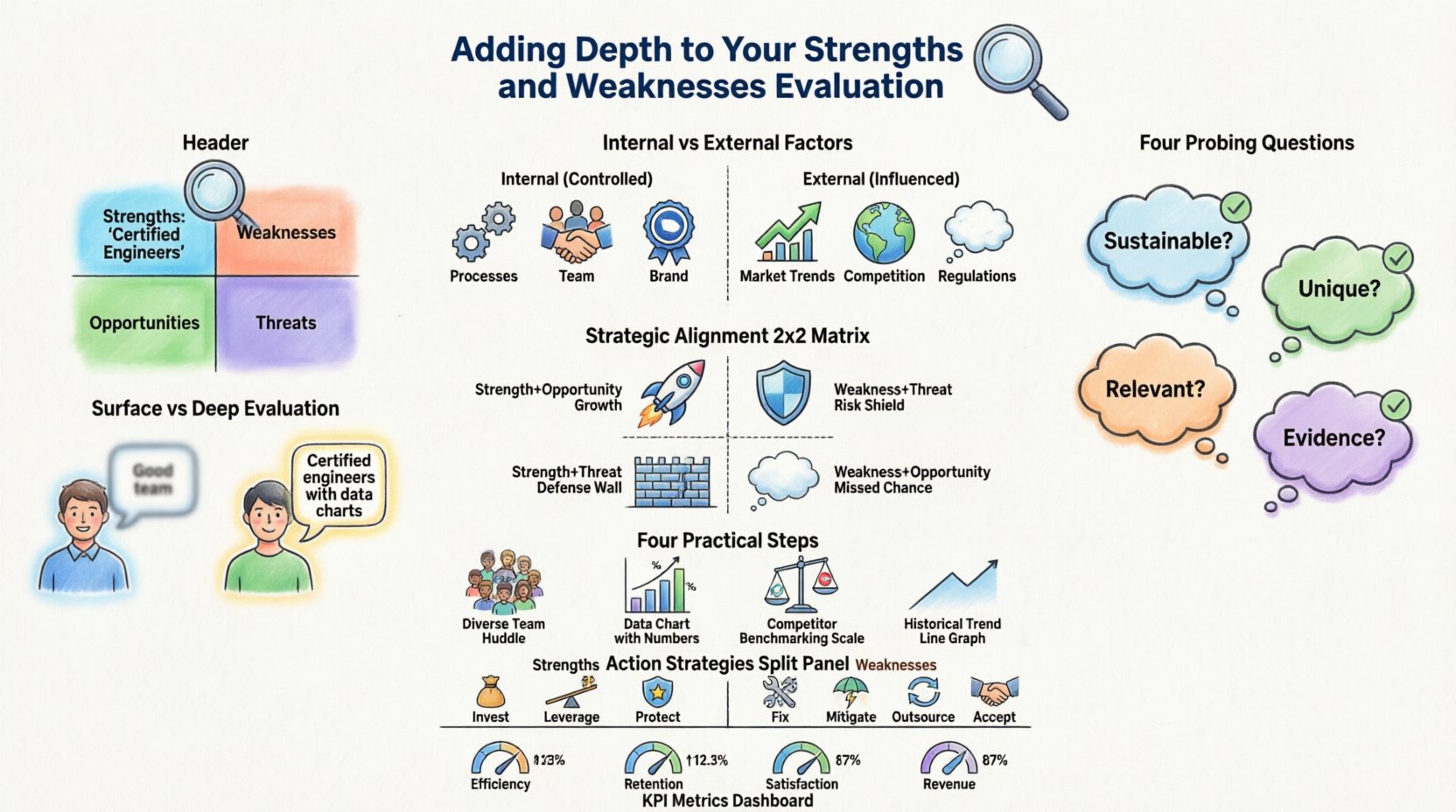
For every strength and weakness identified, ask these probing questions:
- Is it sustainable? Can we maintain this advantage over the next 3 to 5 years?
- Is it unique? Can competitors easily replicate this trait?
- Is it relevant? Does this trait align with our current strategic goals?
- What is the evidence? Do we have metrics to support this claim?
Without these answers, an item remains an opinion rather than a strategic fact.
📊 Surface vs. Deep Evaluation
Visualizing the difference between a standard analysis and a deep dive helps clarify the value of this effort. The table below outlines the contrast.
| Feature | Surface-Level Analysis | Deep Evaluation |
|---|---|---|
| Clarity | Vague terms (e.g., “good team”) | Specific capabilities (e.g., “certified engineers”) |
| Validation | Based on feelings or anecdotes | Backed by data and metrics |
| Context | Isolated facts | Connected to market position |
| Utility | Informational only | Actionable for decision-making |
| Origin | Group brainstorming | Cross-functional data review |
🔗 Connecting Strengths and Weaknesses to External Factors
Strengths and weaknesses do not exist in a vacuum. They gain meaning only when compared against opportunities and threats in the external market. A deep evaluation integrates these internal findings with the broader landscape.
Strategic Alignment
Consider how your internal capabilities interact with external realities:
- Strength + Opportunity: This is a growth vector. Use your strength to capture the opportunity.
- Weakness + Threat: This is a risk zone. You must mitigate the weakness to avoid the threat.
- Strength + Threat: This is a defense position. Use your strength to withstand the threat.
- Weakness + Opportunity: This is a missed chance. You lack the capacity to seize the opportunity.
By mapping these interactions, you move from static lists to dynamic strategy.
🛠️ Practical Steps for Deepening the Review
Implementing a deeper evaluation process requires structure. Follow these steps to ensure thoroughness.
1. Gather Diverse Perspectives
A single department cannot see the whole picture. Include input from:
- Frontline employees who deal with daily operational issues.
- Senior leadership who understand long-term financial goals.
- Customer-facing staff who hear direct feedback.
- Finance teams who possess the hard data on performance.
2. Quantify Qualitative Traits
Where possible, turn subjective traits into numbers. Instead of “high morale,” look at engagement survey scores or retention rates. Instead of “strong brand,” look at Net Promoter Score (NPS) or market share trends.
3. Benchmark Against Competitors
Internal data is insufficient without comparison. If you claim a strength, how does it compare to the market leader? If you claim a weakness, is it an industry-wide issue or specific to you? Competitive benchmarking provides necessary context.
4. Review Historical Performance
Look at past data to see trends. Has a strength been declining? Has a weakness persisted despite attempts to fix it? Historical trends reveal the trajectory of your internal capabilities.
⚠️ Common Pitfalls to Avoid
Even with a good framework, errors can occur. Be mindful of these common mistakes.
- Mixing Internal and External: Do not list “market growth” as a strength. That is an external opportunity. Strengths must be internal.
- Being Too Generic: “Good management” is not specific enough. “Lean management structure” is better.
- Ignoring the Negative: Focusing only on strengths leads to overconfidence. Weaknesses require just as much attention.
- One-Time Exercise: Treat this as a living document. Revisit it quarterly or annually.
🚀 Turning Insights into Action
The ultimate goal of a deep evaluation is action. Once you have identified your true strengths and weaknesses, you must decide how to use them.
Strategies for Strengths
- Invest: Allocate more resources to strengthen your strongest areas further.
- Leverage: Use them to enter new markets or launch new products.
- Protect: Ensure competitors cannot easily copy your unique advantages.
Strategies for Weaknesses
- Fix: If a weakness is critical, allocate resources to resolve it immediately.
- Mitigate: If you cannot fix it, build safeguards to reduce its impact.
- Outsource: If a weakness is outside your core competency, consider partnering with experts.
- Accept: Some weaknesses are acceptable if they do not hinder your strategic goals.
📈 Measuring the Impact
After implementing changes based on your evaluation, you need to measure success. Define key performance indicators (KPIs) that reflect the health of your internal capabilities.
- Operational Efficiency: Measure cycle times and error rates.
- Employee Retention: Track turnover in critical roles.
- Customer Satisfaction: Monitor feedback scores over time.
- Revenue Growth: Ensure internal improvements translate to financial results.
Regularly reviewing these metrics ensures that your strengths remain strengths and your weaknesses do not become critical failures.
🌟 Final Thoughts on Strategic Clarity
Adding depth to your strengths and weaknesses evaluation transforms a basic tool into a powerful engine for growth. It moves the conversation from “what we are” to “how we function.” By demanding evidence, context, and specificity, you ensure that your strategic plans are built on reality rather than assumption.
Remember, a strategy is only as good as the data that supports it. Invest the time to understand your internal landscape thoroughly. The clarity you gain will guide your decisions, allocate your resources, and secure your position in the market. Commit to this level of rigor, and your planning process will yield significantly better results.