

Business environments rarely operate in straight lines. Decisions are made amidst shifting market dynamics, unpredictable regulatory changes, and internal organizational friction. When facing these intricate challenges, a simple list of pros and cons often falls short. This is where the structured application of SWOT logic becomes indispensable. By dissecting internal capabilities against external pressures, leaders can navigate ambiguity with clarity.
This guide explores how to move beyond basic checklists. We will examine how to apply rigorous logic to Strengths, Weaknesses, Opportunities, and Threats to solve complex strategic problems. The focus remains on the analytical framework itself, ensuring a robust understanding of how to utilize these elements for sustainable planning.
Understanding the Core Components of SWOT 🔍
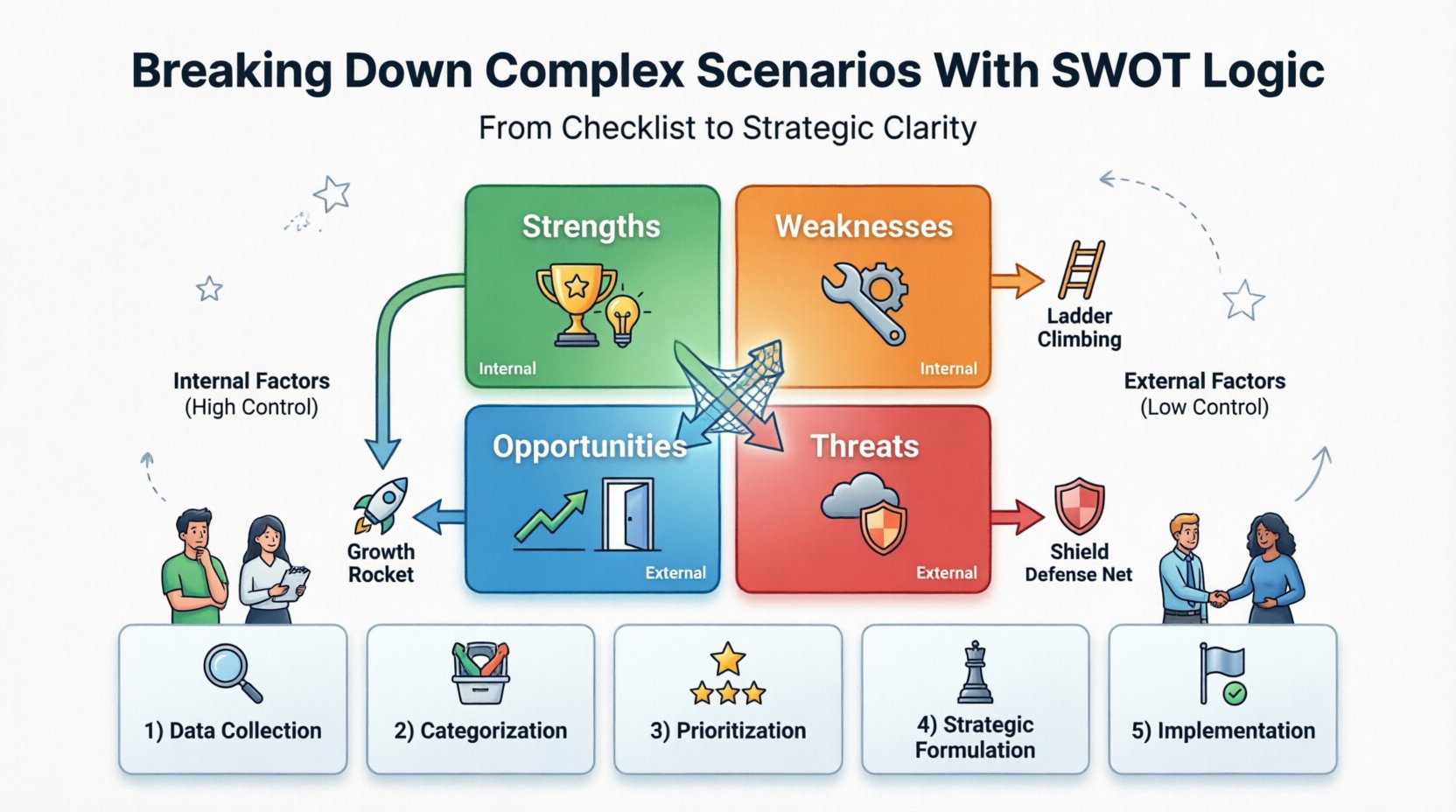
Before deconstructing complexity, one must understand the fundamental pillars. SWOT stands for Strengths, Weaknesses, Opportunities, and Threats. Each category represents a specific dimension of the strategic landscape.
- Strengths (S): Internal attributes that give an organization an advantage over others. These are resources, capabilities, or processes that are currently under your control.
- Weaknesses (W): Internal limitations that place the organization at a disadvantage relative to others. These are areas requiring improvement or investment.
- Opportunities (O): External elements in the environment that could help the organization achieve its objectives. These are trends or gaps in the market.
- Threats (T): External elements that could cause trouble for the business. These include competitors, changing laws, or economic downturns.
While these definitions are standard, their application in complex scenarios requires nuance. A strength is not merely a “good thing”; it is a sustainable asset. A threat is not just a risk; it is a probability-weighted impact.
Why Simple SWOT Fails in Complex Environments 🚫
Many organizations treat SWOT analysis as a brainstorming session followed by a meeting adjournment. In volatile markets, this approach is insufficient. Complexity arises when factors interact. A weakness in one area might amplify a threat in another. A strength might blind an organization to an emerging opportunity.
Common pitfalls include:
- Lack of Specificity: Labeling a factor as “good” without defining the metric.
- Static View: Treating the analysis as a single point in time rather than a dynamic state.
- Isolation of Factors: Analyzing Strengths without considering how they mitigate Threats.
- Internal Bias: Overestimating strengths while underestimating external threats.
To handle complexity, the logic must shift from categorization to correlation. We must understand how these four quadrants influence one another.
Mapping Internal and External Factors 🗺️
Effective analysis requires distinguishing between what is controllable and what is observable. The table below outlines the distinction between internal and external dimensions.
| Dimension | Category | Examples | Control Level |
|---|---|---|---|
| Internal | Strengths | Proprietary technology, skilled workforce, brand reputation | High |
| Internal | Weaknesses | Outdated infrastructure, high turnover, debt levels | High |
| External | Opportunities | New regulations favoring the sector, competitor exit, emerging markets | Low |
| External | Threats | New entrants, trade tariffs, shifting consumer preferences | Low |
Recognizing the control level is vital. Strategies built on external factors require agility, while those built on internal factors require resource allocation.
The Logic of Interaction: Connecting the Dots 🔗
In complex scenarios, the value lies in the intersections. This logic moves the analysis from a grid to a matrix. It asks “How does X affect Y?” rather than just “What is X?”.
1. S-O Strategies (Maxi-Maxi)
These strategies leverage internal strengths to maximize external opportunities. For example, using a strong R&D team (Strength) to capitalize on a new technology trend (Opportunity). This is the ideal scenario for growth.
2. W-O Strategies (Mini-Maxi)
These strategies focus on overcoming internal weaknesses by taking advantage of external opportunities. This often requires investment or restructuring. For instance, upgrading legacy systems (addressing Weakness) to enter a digital-first market (Opportunity).
3. S-T Strategies (Maxi-Mini)
Here, internal strengths are used to minimize external threats. This is a defensive posture. A strong cash reserve (Strength) might be used to weather an economic recession (Threat) that would bankrupt a competitor.
4. W-T Strategies (Mini-Mini)
These strategies aim to minimize weaknesses and avoid threats. This is often a survival mode. Reducing debt (addressing Weakness) to avoid bankruptcy risks during a credit crunch (Threat).
Step-by-Step Framework for Complex Analysis 📝
Executing this logic requires a disciplined process. There is no software shortcut that replaces human judgment. The following steps ensure rigor.
Step 1: Data Collection and Validation
Gather data from multiple sources. Internal reports, customer feedback, market research, and financial statements provide the raw material. Do not rely on anecdotes. Validate every claim.
- Is the data current?
- Is the source unbiased?
- Does the data support the claim?
Step 2: Categorization and Verification
Place items into the four quadrants. However, verify the classification. A “new regulation” might be an Opportunity for some and a Threat for others. Ensure the classification aligns with the specific business context.
Step 3: Prioritization
Not all factors are equal. Use a scoring system to rank them. Consider impact and likelihood. High impact, high likelihood factors move to the top of the list. This helps focus resources where they matter most.
Step 4: Strategic Formulation
Develop specific actions based on the interactions defined earlier. Avoid vague goals. Instead of “improve quality,” use “reduce defect rates by 15% within six months.”
Step 5: Implementation and Monitoring
Analysis is useless without action. Assign ownership for each strategy. Set milestones. Regularly review the SWOT to ensure the factors have not changed.
Case Example: Market Expansion 🌍
Consider a company planning to expand into a foreign market. The scenario is complex due to cultural differences, regulatory hurdles, and competitive intensity.
- Strength: Established supply chain logistics.
- Weakness: Lack of local language capabilities.
- Opportunity: Local competitors are struggling with labor shortages.
- Threat: Strict import tariffs on raw materials.
Applying the logic:
- S-O: Use the supply chain strength to offer faster delivery than local competitors who have labor shortages.
- W-T: Address the language gap to avoid compliance errors with import tariffs.
- S-T: Use the supply chain efficiency to absorb tariff costs better than competitors.
This demonstrates how the factors interact. The weakness is not just a gap; it is a vulnerability regarding the threat. The strength is not just an asset; it is a shield against the threat.
Common Pitfalls and How to Avoid Them ⚠️
Even with a framework, errors occur. Awareness of these pitfalls helps maintain accuracy.
- Confusing Symptoms with Causes: Low sales are a symptom, not necessarily a SWOT factor. The cause might be a Weakness (poor distribution) or a Threat (price undercutting).
- Overlooking Intangibles: Culture and morale are real assets. They often appear as Strengths but are hard to quantify.
- Ignoring the Competition: A Strength is relative. If a competitor has a better version of your strength, it is not a sustainable advantage.
- Static Analysis: A SWOT created today may be obsolete next quarter. The external environment changes rapidly.
Integrating with Risk Management 🛡️
SWOT logic pairs well with formal risk management. Threats map directly to risk registers. Opportunities map to potential upside scenarios. Strengths and Weaknesses map to risk appetite and capacity.
When analyzing a complex scenario, cross-reference the SWOT findings with risk assessments. If a Threat is identified, does the organization have the internal capacity to handle it? If a Weakness exists, does it increase the probability of that Threat occurring? This integration creates a holistic view of organizational health.
The Role of Stakeholder Input 🗣️
A single perspective rarely captures the full complexity. Diverse viewpoints reveal blind spots. Employees might see operational Weaknesses that management overlooks. Sales teams might spot Market Opportunities before they appear in financial data.
Conducting workshops with cross-functional teams ensures that the analysis is comprehensive. However, facilitation is key. Without structure, these sessions can devolve into complaints or arguments. The framework keeps the discussion focused on facts and logic.
Measuring Success Post-Analysis 📏
How do you know the analysis was useful? The metric is not the document itself, but the decisions made. Did the strategy change? Did resources shift? Did the organization avoid a potential threat that others missed?
Track the outcomes of the strategies derived from the SWOT. If an S-O strategy fails, revisit the initial analysis. Was the Opportunity overestimated? Was the Strength misidentified? This feedback loop refines the logic for future scenarios.
Final Strategic Implications 💡
Complexity is the new normal. Organizations that rely on intuition alone will struggle. Structured logic provides a scaffold for decision-making. SWOT analysis, when applied with depth and attention to interaction, offers a powerful lens for viewing the business landscape.
The goal is not to predict the future perfectly, but to prepare for multiple possibilities. By understanding the interplay between internal capabilities and external realities, leaders can build resilience. This approach moves strategy from a static document to a dynamic tool for navigation.
Focus on the connections. Prioritize the critical factors. Validate the data. And ensure that every insight leads to a concrete action. This is how complex scenarios are broken down and managed effectively.