

Strategic analysis requires more than just identifying factors; it demands a structured approach to understanding how those factors interact. SWOT analysis serves as a foundational tool for this process, breaking down internal and external elements into four distinct categories. However, simply listing points does not guarantee actionable insight. To truly leverage this methodology, practitioners must engage with specific practice frameworks designed for case studies. These frameworks transform static lists into dynamic strategic models.
This article outlines comprehensive methods for practicing SWOT analysis through case studies. We will explore how to structure your analysis, avoid common cognitive biases, and integrate complementary tools like the TOWS matrix. By adhering to these structured approaches, you can build a robust analytical skillset applicable across industries, non-profits, and personal development contexts.
🔍 Understanding the Core Components
Before diving into practice frameworks, it is essential to define the boundaries of the analysis. A SWOT analysis consists of four quadrants. Each quadrant requires a specific type of inquiry to ensure accuracy.
- Strengths (Internal): What capabilities, resources, or advantages does the entity possess? Think about brand reputation, proprietary technology, or skilled personnel.
- Weaknesses (Internal): Where are the gaps in performance or resources? Consider outdated infrastructure, high turnover, or lack of market presence.
- Opportunities (External): What trends or market shifts can be capitalized upon? Examples include emerging technologies, regulatory changes, or competitor failures.
- Threats (External): What external obstacles could hinder success? This includes economic downturns, new regulations, or aggressive competitor moves.
When practicing with case studies, the goal is to distinguish clearly between internal and external factors. A common error is misclassifying an external opportunity as an internal strength. For instance, a growing market is an opportunity, not a strength, unless the entity has specific control over that growth.
🛠 Framework 1: The Vertical Deep Dive
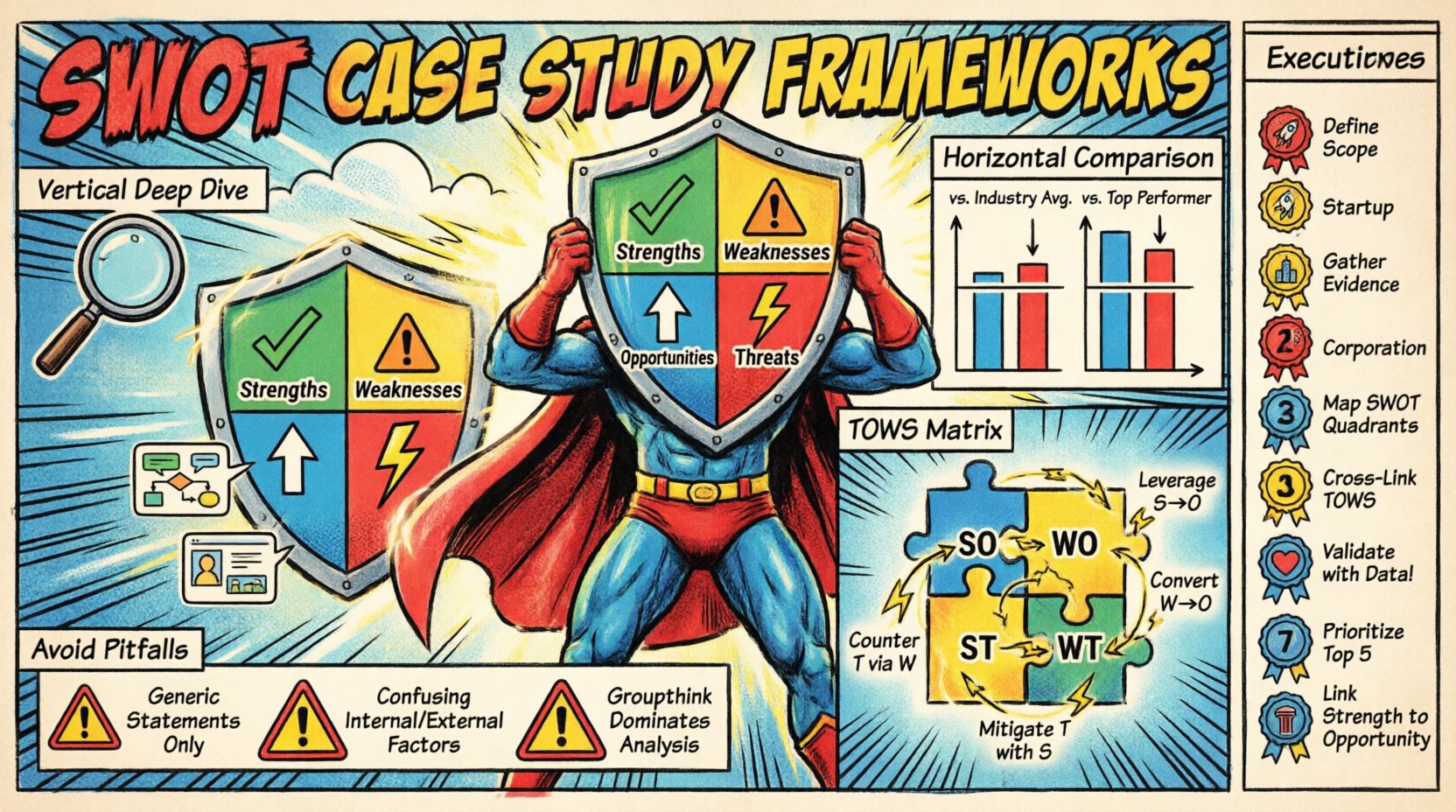
The Vertical Deep Dive framework focuses on expanding each quadrant before moving to the next. This method prevents premature synthesis and ensures a comprehensive data collection phase.
Step 1: Define the Scope
- Identify the specific business unit or project being analyzed.
- Set a clear time horizon (e.g., next 12 months, next 5 years).
- Define the primary objective (e.g., market entry, product launch, restructuring).
Step 2: Isolate Each Quadrant
Do not mix factors. Dedicate a specific session to brainstorming only Strengths. Then move to Weaknesses. Then Opportunities. Then Threats. This isolation reduces cognitive load and prevents the “halo effect,” where positive feelings about the subject bleed into negative assessments.
Step 3: Validate with Evidence
- For every point listed, ask: “What data supports this?”
- Reject subjective opinions unless backed by qualitative feedback.
- Use metrics where available (e.g., customer satisfaction scores, revenue growth rates).
🔄 Framework 2: The Horizontal Comparison
While the Vertical Deep Dive focuses on depth, the Horizontal Comparison focuses on breadth. This framework involves comparing the subject against peers or historical data to contextualize the findings.
Competitor Benchmarking
Analyze the SWOT of key competitors. This helps identify blind spots. If a competitor has a strength in distribution that you do not list as a threat, you may have overlooked a critical weakness.
Historical Trend Analysis
Review past SWOT analyses for the same entity. Have Strengths become Weaknesses over time? Have Opportunities been missed repeatedly? This longitudinal view adds a layer of temporal context.
⚖️ Framework 3: The TOWS Matrix Integration
Once the SWOT is complete, the analysis often stalls at the “so what?” stage. The TOWS matrix moves the practice from descriptive to prescriptive. It pairs factors to generate strategies.
| Strategy Type | Focus | Example Action |
|---|---|---|
| SO Strategies | Maximize Strengths, Exploit Opportunities | Leverage strong brand to enter new market. |
| WO Strategies | Overcome Weaknesses, Seize Opportunities | Invest in technology to capture market trend. |
| ST Strategies | Use Strengths, Mitigate Threats | Use cash reserves to weather competitor price war. |
| WT Strategies | Minimize Weaknesses, Avoid Threats | Divest unprofitable units to reduce debt risk. |
Practicing this integration requires forcing connections. You must explicitly link a specific Strength to a specific Opportunity. This forces the analyst to think about application rather than just identification.
🚧 Common Pitfalls and Mitigation
Even experienced analysts fall into traps. Recognizing these common errors is a vital part of the practice process. The table below outlines frequent mistakes and how to avoid them.
| Pitfall | Consequence | Mitigation Strategy |
|---|---|---|
| Generic Statements | Findings lack actionable value. | Require specific metrics or named entities for every point. |
| Internal/External Confusion | Strategies target the wrong levers. | Apply the “Control Test”: Can we control this factor directly? |
| Groupthink | Analysis reflects consensus rather than reality. | Use anonymous brainstorming tools before group discussion. |
| Static Snapshot | Strategies become obsolete quickly. | Include a review date and update frequency in the plan. |
| Overloading | Too many factors dilute focus. | Limit each quadrant to the top 5 most critical factors. |
📝 Execution Guide for Case Studies
When working through a specific case study, follow this step-by-step execution guide. This ensures consistency and rigor in your analysis.
- Gather Background Data: Collect financial reports, market research, and organizational charts. Do not rely on memory.
- Conduct Stakeholder Interviews: Speak with employees at different levels. Frontline staff often see weaknesses that management overlooks.
- Brainstorm Independently: Have team members write down their SWOT factors individually before sharing.
- Collaborate and Consolidate: Bring the team together to merge lists. Remove duplicates and merge similar points.
- Prioritize: Vote or rank the top 3 factors in each quadrant. Not all factors are equally important.
- Develop TOWS Strategies: Create specific initiatives based on the prioritized matrix.
- Assign Ownership: Every strategy must have an owner and a deadline.
🧠 Advanced Techniques for Nuanced Analysis
For more complex scenarios, basic SWOT may lack the granularity required. Consider integrating these advanced techniques.
1. PESTLE Integration
PESTLE (Political, Economic, Social, Technological, Legal, Environmental) provides a broader lens for the “Opportunities” and “Threats” quadrants. Use PESTLE to ensure external factors are not missed.
- Political: Trade tariffs, tax policies.
- Economic: Inflation rates, exchange rates.
- Social: Demographic shifts, lifestyle changes.
- Technological: Automation, AI advancements.
- Legal: Employment laws, compliance requirements.
- Environmental: Sustainability mandates, climate risks.
2. The Likert Scale Scoring
To add quantitative rigor, assign a score from 1 to 5 to each factor based on its impact and probability.
- Impact: How much will this affect the outcome?
- Probability: How likely is this factor to materialize?
This scoring system helps prioritize resources. High Impact/High Probability factors demand immediate attention.
🌍 Applying Frameworks Across Sectors
The application of SWOT varies depending on the context. The following table illustrates how the focus shifts between sectors.
| Sector | Key Focus Area | Unique Consideration |
|---|---|---|
| Startups | Resource Scarcity | Focus heavily on Weaknesses and Threats due to limited runway. |
| Large Corporations | Innovation vs. Stability | Balancing internal inertia (Weakness) with market opportunities. |
| Non-Profits | Funding & Mission | Opportunities often tied to grants, not sales revenue. |
| Public Sector | Compliance & Public Trust | Threats often stem from regulatory changes or public opinion. |
📈 Measuring Progress and Refinement
Analysis is not a one-time event. To maintain effectiveness, you must measure the quality of your analysis over time.
Review Cycles
- Quarterly Review: Check if Opportunities have materialized or Threats have occurred.
- Annual Strategic Reset: Re-evaluate the entire framework against long-term goals.
Feedback Loops
Did the strategies derived from the SWOT lead to the desired outcomes? If not, revisit the analysis. Was a Weakness underestimated? Was an Opportunity overestimated? This feedback loop is crucial for skill development.
🎓 Developing Personal Analytical Discipline
Whether for a team or personal growth, discipline in the practice of SWOT is key. Here are habits to cultivate.
- Critical Thinking: Question assumptions. Just because a factor is listed does not mean it is true.
- Data-Driven Mindset: Rely on evidence rather than intuition.
- Honesty: Be willing to acknowledge weaknesses without defensiveness.
- Contextual Awareness: Understand the macro environment affecting your specific situation.
📚 Resources for Further Development
Continuous learning enhances the quality of your case studies. Consider the following resources to deepen your understanding.
- Academic Journals: Review case studies published in management and business strategy journals.
- Industry Reports: Read annual reports from top firms in your target sector.
- Historical Case Studies: Study famous business turnarounds or failures to see SWOT in action.
- Workshops: Participate in strategic planning workshops to practice facilitation.
🔗 Next Steps for Practitioners
Implementing these frameworks requires commitment. Start with a small pilot case study. Apply the Vertical Deep Dive framework first to build confidence. Once comfortable, introduce the TOWS matrix for strategic alignment. Regularly review your past analyses to refine your judgment.
By treating SWOT analysis as a disciplined practice rather than a checklist, you develop a strategic mindset capable of navigating complex environments. The goal is not just to list factors, but to understand the dynamic relationships between them. This depth of understanding leads to more resilient strategies and better decision-making outcomes.
Remember, the value lies in the rigor of the process. Consistency in application builds the intuition needed to spot patterns quickly. Use the tables and guides provided here as a reference. Adapt them to fit your specific context. With practice, the distinction between a superficial list and a strategic asset becomes clear.