

When faced with a Business Strategy or Management exam, the SWOT analysis is a common requirement. However, simply listing points is rarely enough to secure high marks. Examiners look for depth, critical thinking, and a structured approach that connects internal capabilities with external market forces. This guide details how to structure your SWOT answers effectively to maximize your score.
Understanding the Core Components 🧩
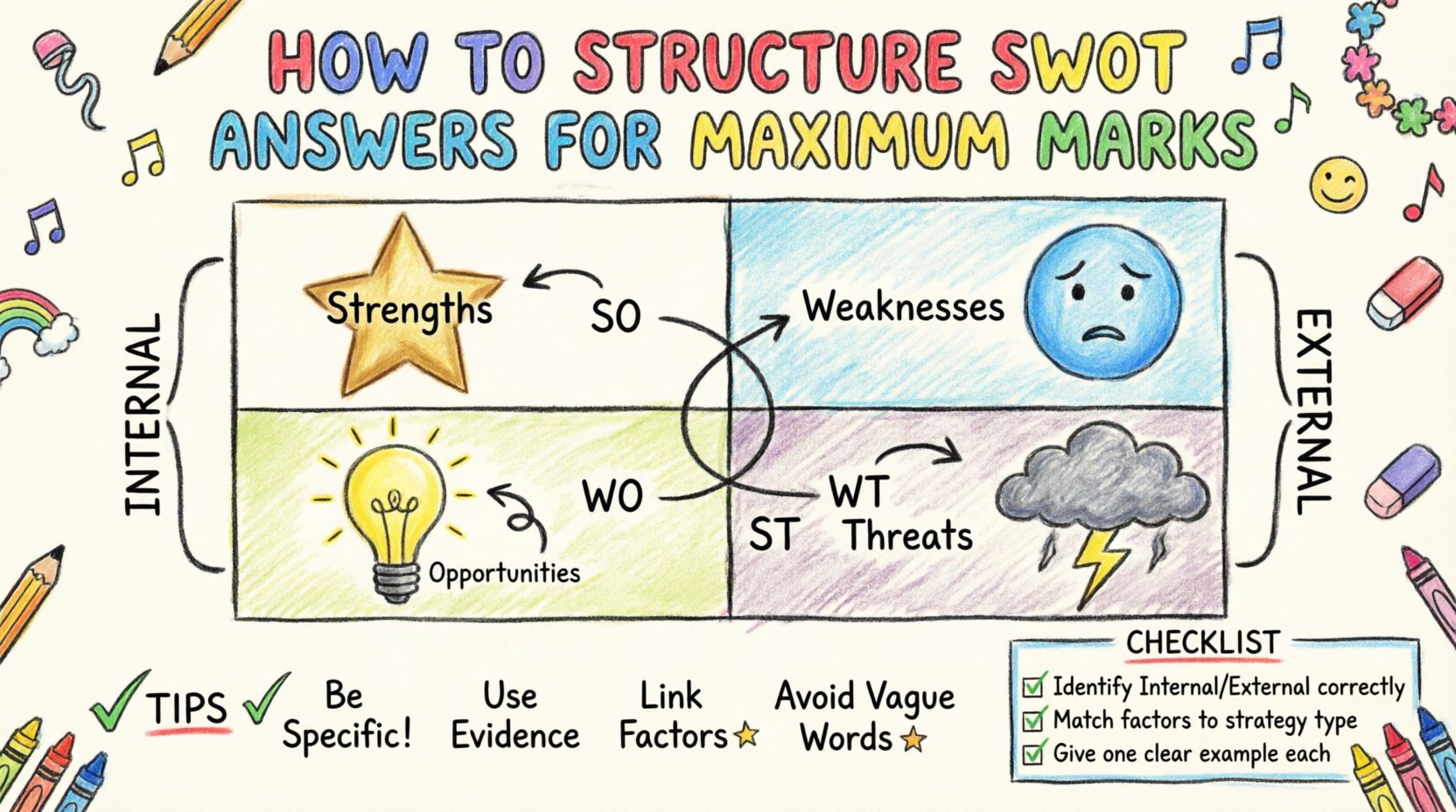
Before drafting your response, ensure you have a firm grasp of the four quadrants. Each section serves a specific purpose in the broader analysis.
- Strengths (S): Internal attributes that give an advantage. Think resources, skills, or market position.
- Weaknesses (W): Internal limitations that hinder performance. These are areas needing improvement.
- Opportunities (O): External factors the organization can exploit for growth. Market trends or gaps.
- Threats (T): External factors that could cause trouble. Competitors, regulations, or economic shifts.
To score well, you must distinguish clearly between what is inside the company (Internal) and what is outside (External). Confusing these categories is a primary reason for lost marks.
Structuring Your Answer for Clarity ✍️
A well-organized answer guides the marker through your logic. Use the following structure to ensure you cover all bases.
1. Introduction and Context
Start by defining the scenario. Briefly describe the organization or situation provided in the question. This sets the stage.
- State the company name or subject of analysis.
- Define the industry context briefly.
- Mention the strategic goal (e.g., expansion, turnaround, sustainability).
2. The Quadrant Analysis
Dedicate a specific paragraph or section to each letter of the acronym. Do not mix them up. Use subheadings for clarity.
- Strengths: Focus on what the organization does better than competitors. Use specific examples.
- Weaknesses: Be honest about gaps. Avoid vague terms like “poor management” without context.
- Opportunities: Look outward. How does the market change benefit the organization?
- Threats: Identify risks. What external forces could damage the strategy?
3. Linking the Factors (The TOWS Matrix Approach)
High-level marks are often awarded for connecting the dots. Simply listing points is descriptive; linking them is analytical. Show how Strengths can be used to seize Opportunities, or how Weaknesses make the company vulnerable to Threats.
- SO Strategies: Use strengths to capture opportunities.
- WO Strategies: Overcome weaknesses by taking advantage of opportunities.
- ST Strategies: Use strengths to avoid threats.
- WT Strategies: Minimize weaknesses and avoid threats.
Common Pitfalls to Avoid ⚠️
Reviewing past exam scripts reveals recurring mistakes. Avoid these to protect your grade.
| Mistake | Why it hurts marks | The Fix |
|---|---|---|
| Mixing Internal and External | Confuses the core logic of SWOT. | Label factors clearly as Internal or External. |
| Being Too Vague | “Good reputation” is generic. | “95% customer satisfaction rating in 2023”. |
| Ignoring the Scenario | Answers feel copy-pasted. | Tailor every point to the specific company given. |
| Listing without Explanation | Lacks critical analysis. | Explain why it is a strength or threat. |
| No Strategic Output | Misses the application phase. | Include brief recommendations based on findings. |
Drafting High-Quality Points 📝
Quality matters more than quantity. Five strong, evidence-backed points beat ten generic ones. Here is how to elevate the quality of your text.
Specificity and Evidence
Avoid empty adjectives. Use data, names, and specific business functions.
- Bad: “They have a good product.”
- Good: “Their flagship software holds a 40% market share in the SME sector.”
- Bad: “They are vulnerable to regulation.”
- Good: “New data privacy laws will increase compliance costs by 15%.”
Relevance to the Question
Always check the question stem. If the question asks about “Market Entry,” focus on SWOT factors relevant to entering a new region. Do not waste time on irrelevant internal details.
- Focus on the strategic implications.
- Discard points that do not influence the decision.
- Ensure the tone matches the business context.
Visual Presentation Matters 📊
Even in text-based exams, structure aids readability. Use the following formatting techniques.
- Bold Key Terms: Highlight specific factors for quick scanning.
- Bullet Points: Use lists for the four quadrants to break up walls of text.
- Separate Sections: Use clear headings for each part of the analysis.
- Diagrams: If allowed, a simple 2×2 grid can visually represent the analysis effectively.
Sample Answer Breakdown 🧐
Consider a scenario where a company named “GreenLeaf” wants to expand into the Asian market.
Strengths (Internal)
- Brand Loyalty: High retention rates in the European home market.
- Supply Chain: Established relationships with sustainable material suppliers.
- Technology: Proprietary recycling process reduces waste costs.
Weaknesses (Internal)
- Capital: Limited cash reserves for aggressive marketing campaigns.
- Experience: No prior operational history in Asian logistics.
- Staffing: Lack of multilingual customer support team.
Opportunities (External)
- Market Demand: Rising consumer awareness of eco-friendly products in the region.
- Partnerships: Potential collaboration with local distributors.
- Regulation: New government incentives for green technology adoption.
Threats (External)
- Competition: Local rivals with lower production costs.
- Trade Barriers: Tariffs on imported raw materials.
- Economic Volatility: Currency fluctuation risks affecting pricing.
Linking Factors for Strategic Insight 🔗
The final step to securing maximum marks is showing how these factors interact. This demonstrates strategic thinking.
Example Strategy 1 (SO): Leverage the proprietary recycling technology (Strength) to capitalize on government incentives for green tech (Opportunity).
Example Strategy 2 (WT): Mitigate the lack of local experience (Weakness) by partnering with a regional distributor (Opportunity) to reduce risk.
Example Strategy 3 (ST): Use strong brand loyalty (Strength) to maintain pricing power against cheaper local competitors (Threat).
By explicitly stating these connections, you move from description to analysis.
Review Checklist ✅
Before submitting your answer, run through this quick audit.
- Did I define the context in the introduction?
- Are all points correctly categorized (Internal vs External)?
- Did I use specific evidence rather than vague adjectives?
- Did I link at least two factors to form a strategy?
- Is the formatting clean with clear headings and bullet points?
- Did I avoid forbidden terms or irrelevant fluff?
Conclusion on Structure 🏁
Success in SWOT questions relies on discipline and clarity. A structured approach ensures you do not miss key criteria. By separating internal and external factors, providing evidence, and linking elements strategically, you create an answer that demonstrates true business understanding. Remember, the goal is not just to list factors, but to explain how they shape the future of the organization.