

Academic life is a complex landscape filled with deadlines, exams, career choices, and personal growth. Navigating this environment requires more than just hard work; it demands strategy. The SWOT Matrix offers a proven framework for evaluating your position and planning your future. It breaks down complex situations into four distinct categories: Strengths, Weaknesses, Opportunities, and Threats. While often associated with business strategy, this tool is equally powerful for students aiming to optimize their study habits, manage projects, or prepare for post-graduation life.
This guide provides a deep dive into the mechanics of SWOT analysis. We will explore how to identify internal and external factors, how to apply this framework to specific academic scenarios, and how to avoid common analytical errors. The goal is to build a clear, actionable plan based on reality rather than assumption.
What is the SWOT Matrix? 🔍
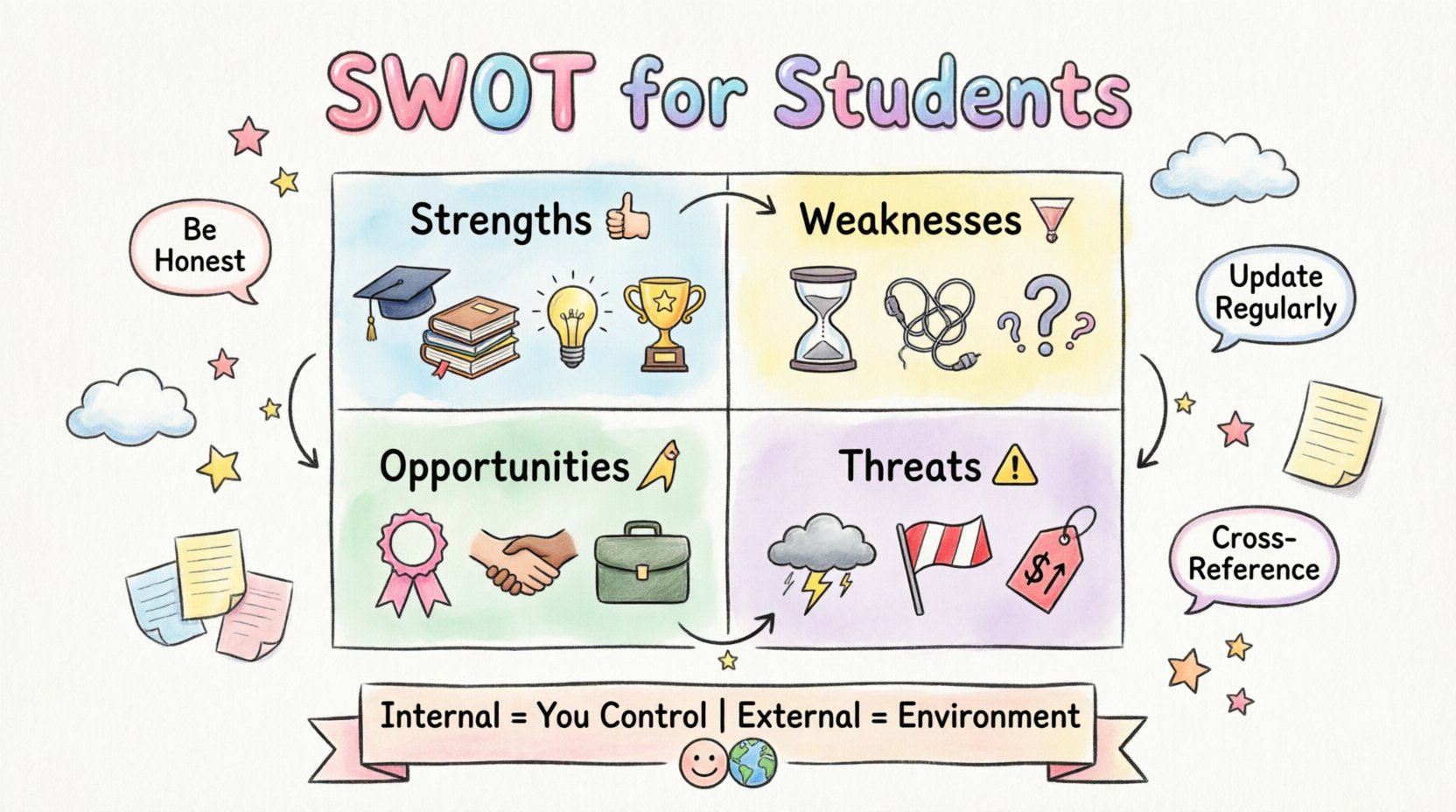
At its core, the SWOT Matrix is a strategic planning tool. It helps individuals or organizations identify internal and external factors that affect their goals. The acronym stands for:
- Strengths: Internal attributes that help you achieve your goals.
- Weaknesses: Internal attributes that hinder your progress.
- Opportunities: External chances to improve your position.
- Threats: External elements that could cause trouble.
For a student, this analysis is not static. It changes as you move from freshman year to graduation. A skill you possess now might become obsolete in three years, or a new course offering might open a door you didn’t see before. Regularly updating this matrix ensures your strategy remains relevant.
Breaking Down the Four Pillars 🧱
To use this matrix effectively, you must understand the nature of each quadrant. Confusion between internal and external factors is the most common mistake. Here is a detailed breakdown of what belongs in each section.
1. Strengths (Internal) 💪
Strengths are resources you already control. They are positive attributes inherent to you. These are not things you *hope* to have, but things you *do* have. In an academic context, these might include:
- Hard Skills: Proficiency in specific software, strong writing abilities, or advanced mathematical knowledge.
- Soft Skills: Time management, leadership during group projects, or effective communication.
- Resources: Access to a quiet study space, a supportive mentor, or financial stability that allows focus on studies.
- Reputation: A history of high grades or positive feedback from professors.
When listing strengths, be honest. Do not exaggerate. If you claim to be a “natural leader” but have never led a team, that is a weakness in disguise. Authenticity ensures the strategy you build rests on solid ground.
2. Weaknesses (Internal) 📉
Weaknesses are internal limitations. They are areas where you lack capability or resources. Acknowledging these is difficult, but necessary for growth. Common academic weaknesses include:
- Gaps in Knowledge: Fundamental concepts you missed in previous years.
- Bad Habits: Procrastination, poor note-taking, or inconsistent study schedules.
- Resource Limitations: Lack of funding for research materials or limited access to technology.
- Personal Factors: Health issues, family responsibilities, or anxiety that impacts performance.
Identifying weaknesses allows you to mitigate them. You cannot fix what you do not admit. If you struggle with time management, the strategy is not to blame the workload, but to implement a scheduling system.
3. Opportunities (External) 🚀
Opportunities are external possibilities. They are situations outside your control that you can leverage. These often stem from changes in the environment. For students, opportunities include:
- Course Offerings: New elective classes that align with emerging industry trends.
- Networking: Upcoming career fairs, alumni events, or guest lectures.
- Financial Aid: Scholarships or grants specifically for your major.
- Technological Shifts: New tools or platforms that make research easier.
The key to opportunities is timing. An internship offer is an opportunity only if you have the skills to accept it. Identifying an opportunity without the internal capacity to seize it is a missed chance.
4. Threats (External) ⚠️
Threats are external obstacles that could harm your progress. You cannot control these, but you can prepare for them. Common threats in an academic setting include:
- Market Saturation: High competition for jobs in your chosen field.
- Curriculum Changes: Universities changing degree requirements that delay graduation.
- Economic Factors: Inflation affecting the cost of textbooks or living expenses.
- Competitors: Peers who are more dedicated or have better resources.
Recognizing threats allows you to build contingency plans. If a major industry shift is happening, you might need to learn a complementary skill to remain employable.
Internal vs. External Factors 🔄
Clarity on whether a factor is internal or external is crucial. The table below summarizes the distinction to ensure accurate categorization.
| Category | Control | Focus Area | Example |
|---|---|---|---|
| Strengths | Internal (You control it) | Leverage what you have | Strong GPA, good network |
| WeaknessesInternal (You control it) | Improve or mitigate | Public speaking anxiety, poor math skills | |
| Opportunities | External (Environment controls it) | Seize the moment | New scholarship, internship opening |
| Threats | External (Environment controls it) | Defend or adapt | Recession, automated entry-level jobs |
Step-by-Step Execution 📝
Creating a SWOT Matrix is a process. It requires research, reflection, and organization. Follow these steps to conduct a robust analysis.
Step 1: Define Your Objective
Before drawing the grid, state what you are analyzing. Is it your entire university journey? A specific semester? A job application? A specific project? Narrowing the scope prevents vague answers. For example, “Improving my final semester grades” is more actionable than “Academic Success”.
Step 2: Gather Data
Do not rely on memory. Collect evidence. Look at your transcript, review feedback from professors, check job descriptions for roles you want, and talk to peers. Data validates your perceptions.
Step 3: Brainstorm the Four Quadrants
Dedicate time to list factors for each section. Use a blank sheet of paper or a digital document. Do not judge ideas yet. Quantity comes before quality in the brainstorming phase.
Step 4: Prioritize and Filter
You will likely have too many items. Select the top 3-5 most critical factors for each quadrant. Irrelevant details dilute the strategy. Ask yourself: “If I fix this, will it significantly change my outcome?”
Step 5: Develop Strategies
Now, cross-reference the quadrants. How can you use your strengths to grab opportunities? How can you use strengths to defend against threats? How do you fix weaknesses to avoid threats? This cross-analysis creates actionable strategies.
Academic Scenarios 🏛️
Applying the SWOT Matrix to different academic contexts yields specific benefits. Here is how to adapt the framework.
1. Study Planning
Use the matrix to prepare for a difficult exam. Identify your strengths (e.g., good memory) to leverage. Identify weaknesses (e.g., lack of practice questions) to address. Look for opportunities (e.g., study groups) and threats (e.g., fatigue). Adjust your study schedule based on this data.
2. Group Projects
In team settings, a SWOT analysis helps assign roles. If a team member has a strength in research but a weakness in writing, assign them the data gathering. If the team faces a threat of low time, leverage the strengths of the most efficient members.
3. Career Selection
When choosing between majors, analyze the market. Is the major aligned with your strengths? Are there opportunities in that industry? Are there threats like automation or saturation? This prevents choosing a path solely based on interest without regard for viability.
Common Pitfalls to Avoid ⚠️
Even with a structured tool, errors occur. Avoid these common traps to maintain the integrity of your analysis.
- Mixing Internal and External: Ensure you do not list “High Tuition Fees” as a weakness. That is external (Threat). Your “Poor Budgeting” is the internal Weakness.
- Being Too Vague: “Good grades” is not a specific strength. “Consistently scoring above 90% in Calculus” is a specific strength.
- Ignoring Threats: Students often focus only on strengths and opportunities, ignoring potential risks. This leads to shock when obstacles arise.
- One-Time Use: A SWOT Matrix is a living document. Revisit it every semester. Your strengths change as you learn new skills.
- Subjectivity: Avoid letting emotions dictate the analysis. A friend or mentor can provide an objective view of your weaknesses.
Sample Analysis: The Senior Capstone Project 📄
To illustrate, consider a student working on a final year capstone project. Here is how the matrix might look in practice.
| Strengths | Weaknesses |
|---|---|
| Strong relationship with supervisor Access to university lab equipment Previous experience with data analysis High motivation and discipline |
Limited coding skills Part-time job reduces study time Procrastination on initial draft Limited budget for materials |
| Opportunities | Threats |
|---|---|
| University grant for research Peer collaboration on data New software tutorials available Publication opportunity in student journal |
Equipment failure during critical phase Unexpected job overtime Competitor students publishing similar work Technical glitches with software |
From this grid, the student can derive a plan. They can use their strong supervisor relationship (Strength) to get an extension on the deadline (Mitigating Weakness). They can use the available research grant (Opportunity) to buy materials (Countering Threat). This transforms a static list into a dynamic plan.
Long-Term Strategic Integration 🗺️
Once you have completed the analysis, the real work begins: integration. You must align your daily actions with the strategic insights.
- Set SMART Goals: Translate your SWOT insights into Specific, Measurable, Achievable, Relevant, and Time-bound goals.
- Resource Allocation: Direct your time and energy toward your Strengths and Opportunities. Minimize time spent on Weaknesses that cannot be fixed immediately.
- Regular Review: Schedule a monthly review to update the matrix. Markets change, and so do you.
- Feedback Loops: Ask professors or mentors to review your plan. They may see threats you missed.
The Psychology of Self-Assessment 🧠
Conducting a SWOT analysis requires psychological honesty. It is easy to inflate strengths to feel good or minimize weaknesses to avoid discomfort. This is known as self-serving bias. To counter this, treat the analysis like a scientific experiment. Gather data, test hypotheses, and accept results. If you fail a task, analyze why without shame. Failure is data. It points to a weakness that needs addressing.
Confidence comes from competence. By systematically identifying and improving your Weaknesses, you build genuine competence. This is more sustainable than relying on natural talent alone.
Conclusion 🏁
The SWOT Matrix is a foundational tool for academic and professional success. It moves you from reactive living to proactive planning. By understanding your internal capabilities and external environment, you make informed decisions. This guide has covered the definition, the components, the execution steps, and practical applications. Use this framework regularly to navigate the complexities of your education and career. Clarity leads to action, and action leads to results.
Start your analysis today. Write down your Strengths, Weaknesses, Opportunities, and Threats. Review them weekly. Adjust your path as needed. This simple habit can distinguish a good student from a strategic thinker.