Now Reading: Transforming Architecture Visuals into Living Code: A Guide to Visual Paradigm’s AI Platform
-
01
Transforming Architecture Visuals into Living Code: A Guide to Visual Paradigm’s AI Platform


Transforming Architecture Visuals into Living Code: A Guide to Visual Paradigm’s AI Platform
The Evolution of Architectural Documentation
In traditional diagramming workflows—and even when utilizing generic Large Language Models (LLMs)—architectural visuals frequently devolve into static artifacts. These outputs, often delivered as PNGs or SVGs, become frozen in time immediately after creation. They are difficult to edit, impossible to version-control meaningfully, and prone to becoming outdated as system requirements evolve.
Development teams often waste hours regenerating diagrams from scratch or manually tweaking shapes in drawing tools. This inefficiency leads to documentation drift, confusion regarding versioning, and a significant loss of institutional knowledge. Visual Paradigm’s AI-powered platform solves this challenge by shifting the paradigm from pixel-based artifacts to text-based, executable “living code.”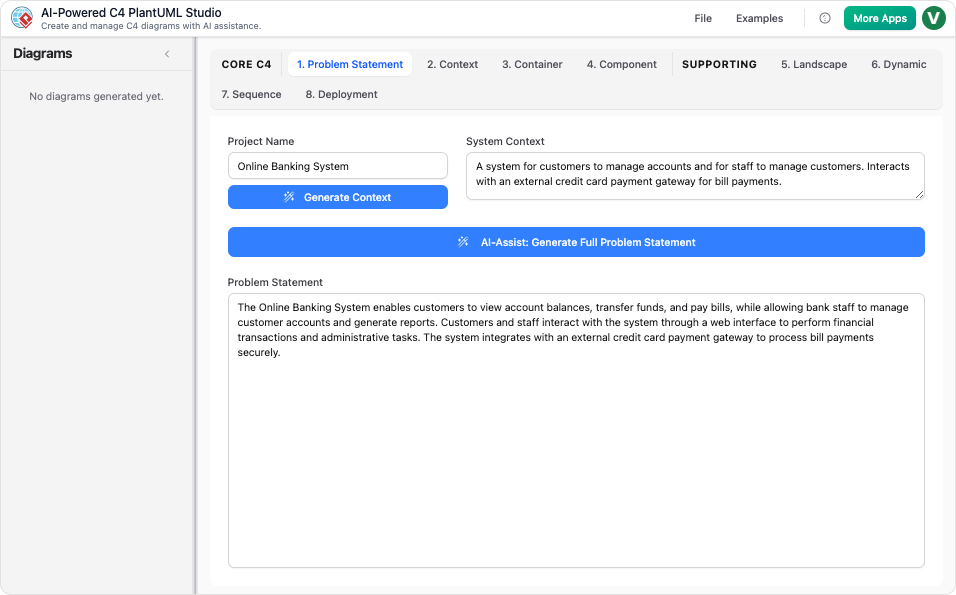
By leveraging the AI-Powered C4 PlantUML Studio, the AI Diagram Generator, and an integrated AI Chatbot, Visual Paradigm ensures that diagrams become version-controllable source files. These files live alongside your codebase, integrate seamlessly into CI/CD pipelines, and evolve through natural-language conversation.
The Core Problem with Static AI Outputs
When engineering teams rely on generic AI tools for documentation, they typically encounter several limitations that hinder long-term maintainability:
- One-off Artifacts: Tools produce raster or vector images that lack an underlying logical model.
- No Version Control: There is no mechanism to diff changes or revert to previous states programmatically.
- Lack of Integration: Static images cannot be regenerated automatically upon code commits.
- Painful Updates: Modifying a diagram requires re-prompting the AI entirely or manually editing graphics.
These limitations create “dead” documentation—visuals that look impressive at launch but become obsolete within weeks. Visual Paradigm flips the script by treating diagrams as code. Every visual is backed by editable PlantUML text, a lightweight and human-readable Domain Specific Language (DSL) that utilizes the official C4-PlantUML standard library.
Key Capabilities Enabling “Living Code”
1. PlantUML as the Single Source of Truth
The platform uses AI to generate complete, syntactically valid PlantUML code for various architectural views, including Context, Containers, Components, Deployment, and Landscape views. The environment features a side-by-side editor that displays the code on the left and the rendered diagram on the right. This allows users to edit text and see instant visual updates, or vice versa.
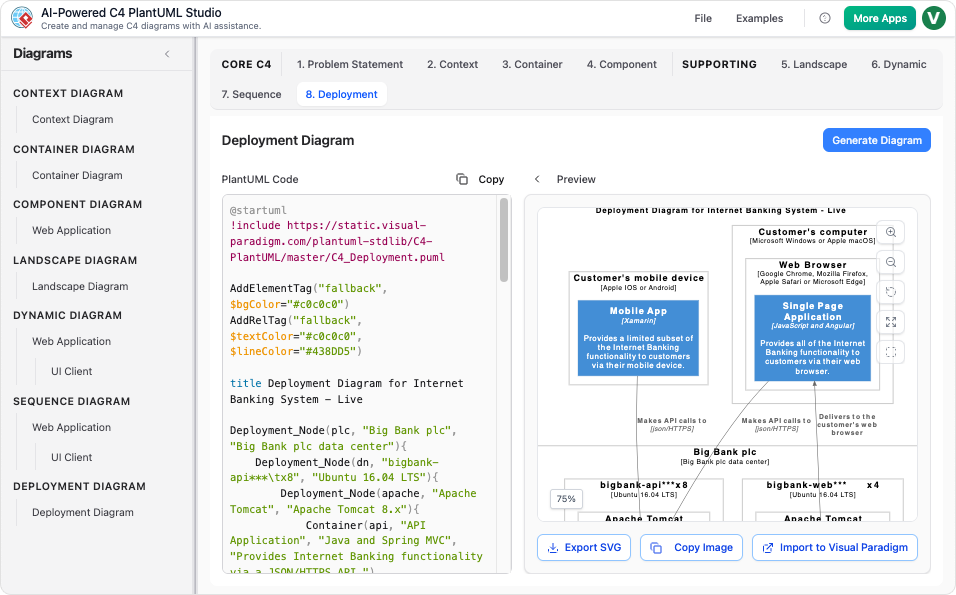
Because the underlying format is text, it is inherently Git-friendly. Teams can commit .puml files just like application code. Diffs show precise element and relationship changes, allowing for branching, merging, and release tagging. Furthermore, PlantUML is open and tool-agnostic, meaning diagrams can be rendered anywhere, from VS Code to Markdown wikis.
2. Conversational Refinement
The AI Chatbot acts as an active co-pilot that maintains context across multiple turns of conversation. Rather than redrawing from scratch, users can issue specific commands to refine the model:
- “Add a payment gateway service using Stripe”
- “Rename the ‘Order Service’ to ‘Order Processing Microservice'”
- “Introduce Redis caching in the backend container”
- “Add a load balancer and show replica pods in the deployment view”
The AI intelligently updates the model by adjusting relationships, propagating renames, suggesting C4-compliant connections, and regenerating affected views without the need for copy-pasting.
3. Incremental and Hierarchical Evolution
Visual Paradigm supports a drill-down approach to architecture. Users can start high-level with a Context view and a problem statement via AI expansion, then move deeper into Containers, Components, and Deployment views. Changes cascade intelligently; adding a component in one view validates ripple effects across the hierarchy. The auto-sync feature ensures that editing PlantUML refreshes all rendered diagrams, while conversational tweaks update the underlying code.
4. CI/CD and DevOps Integration
Treating diagrams as code artifacts allows for robust DevOps integration. Teams can store PlantUML files in their repositories and configure automated rendering on push events (e.g., using GitHub Actions and a PlantUML server) to update Confluence or internal wikis. This enables the generation of living documentation, where rendered SVGs or PNGs are embedded in READMEs, API docs, or Architecture Decision Records (ADRs). Git blame functionality further aids in tracking architectural decisions by showing who added specific elements and when.
Comparison: Generic LLMs vs. Visual Paradigm AI
The following table outlines the distinct advantages of using a dedicated AI modeling platform over generic chatbots.
| Feature | Generic LLMs / Chatbots | Visual Paradigm AI Platform |
|---|---|---|
| Output Format | Static image + optional loose text | Editable PlantUML code + live-rendered diagram |
| Version Control | None (images not diffable) | Native Git support – commit, branch, diff, revert |
| Incremental Updates | Regenerate whole prompt each time | Conversational commands update model in-place |
| Contextual Memory | Limited session memory | Full conversation context + hierarchical model awareness |
| Dev Workflow Integration | Manual copy-paste | CI/CD rendering, repo storage, auto-doc generation |
| C4 Compliance | Variable – drift common | Enforced standards + auto-propagation across levels |
Real-World Impact and Getting Started
Teams adopting Visual Paradigm’s AI tools report significant improvements in efficiency and accuracy. Initial architecture documentation is produced 80-90% faster, and diagrams remain current throughout sprints without the need for dedicated “documentation sprints.” Collaboration improves as developers can review .puml diffs in pull requests, and knowledge loss is minimized because the architecture lives within the code.
How to Begin
To start transitioning from static snapshots to living documentation:
- Cloud: Launch the AI-Powered C4 PlantUML Studio at Visual Paradigm Online (no installation required).
- Desktop: Use the Professional Edition, navigate to Tools > App > AI-Powered C4 PlantUML Studio, or use the AI Diagram Generator.
- Workflow: Describe your system to build a baseline, refine it conversationally, commit the PlantUML to your repository, and integrate it into your pipeline.
Visual Paradigm moves beyond simple drawing; it transforms architecture into executable, collaborative, and versioned code that grows alongside your system.