
Enterprise Architecture (EA) often gets misunderstood as a theoretical exercise or a bureaucratic hurdle. In practice, it is the connective tissue between business strategy and technological execution. Leaders who succeed in this discipline do not focus solely on diagrams. They focus on outcomes. This guide explores the practical insights gained from seasoned professionals navigating complex digital landscapes. It is not about following a specific framework perfectly. It is about adapting principles to fit the unique reality of your organization.
When you look at the most effective architectural functions, you see a common thread. They are not selling technology. They are selling clarity. They bridge the gap between high-level business goals and the code that runs the enterprise. Below are the core lessons derived from observing how top-tier organizations structure their approach to architecture.
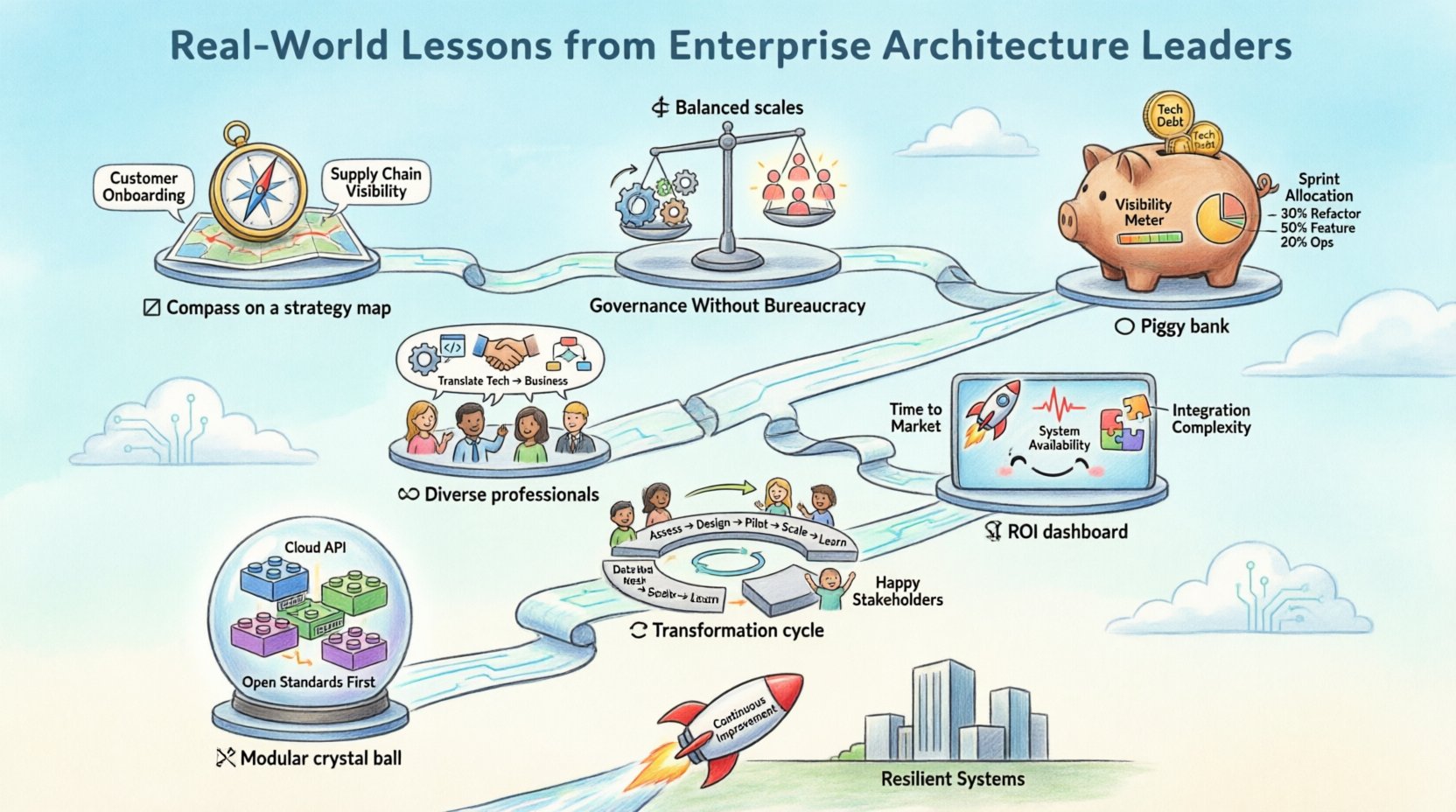
1. Strategy Must Drive the Architecture, Not the Reverse 🧭
One of the most common failures in architectural planning is building a model before understanding the business problem. Leaders emphasize that architecture is a servant to strategy, not the master. If the business strategy shifts, the architecture must adapt. Rigid adherence to a pre-defined model often leads to stagnation.
Effective leaders prioritize the following:
- Business Capability Mapping: Start by defining what the business needs to do, not what software it uses. Focus on capabilities like “Customer Onboarding” or “Supply Chain Visibility”.
- Dynamic Roadmaps: Treat the architecture roadmap as a living document. Revisit it quarterly to ensure alignment with current market conditions.
- Value Streams: Map the flow of value from customer request to delivery. Identify where technology adds friction or speed.
When strategy and architecture are decoupled, you end up with systems that are technically impressive but business-irrelevant. The goal is to ensure every component of the technology stack has a clear line of sight to a business outcome.
2. Governance Without Bureaucracy ⚖️
Governance is often viewed as a gatekeeping mechanism that slows down development. However, without guardrails, technical debt accumulates rapidly, eventually halting progress. The lesson from successful leaders is that governance should enable speed, not hinder it.
Here is how to balance control with agility:
- Automated Compliance: Use tools to check for security and architectural standards automatically. Reduce human intervention in routine checks.
- Community of Practice: Create groups where architects and developers collaborate. This builds trust and shared understanding rather than enforcing rules from above.
- Decision Rights: Clearly define who makes what decision. Some choices belong to the enterprise team, while others belong to local product squads.
Consider the following comparison of governance models:
| Model Type | Decision Speed | Consistency | Best Use Case |
|---|---|---|---|
| Centralized | Slow | High | Regulated Industries, Core Systems |
| Distributed | Fast | Low | Innovation Labs, Experimental Products |
| Hybrid | Medium | Medium | Most Large-Scale Enterprises |
A hybrid approach often works best. It allows for standardization in core areas like security and data while permitting innovation in customer-facing applications.
3. Managing Technical Debt Strategically 🏦
Technical debt is not inherently bad. It is a loan taken to achieve speed. The problem arises when the debt is never repaid. Leaders treat debt like financial debt. You must track it, manage interest payments, and pay it down when possible.
Key strategies include:
- Visibility: Make debt visible to business stakeholders. Explain the cost in terms of time and money, not just technical jargon.
- Allocation: Reserve a percentage of sprint capacity specifically for debt reduction. Do not rely on “when we have time”.
- Refactoring Standards: Establish guidelines for when a system must be rewritten versus patched. Define thresholds for legacy replacement.
Ignoring debt leads to a fragile system where changes become risky. Conversely, trying to eliminate all debt immediately can stall innovation. The balance lies in treating it as a continuous operational cost.
4. The Human Element of Architecture 🤝
Technology is built by people, and it is consumed by people. The most advanced architecture will fail if the culture does not support it. Leaders invest heavily in soft skills and communication.
Success in this area requires:
- Stakeholder Management: Engage with business leaders early. Understand their pain points before proposing solutions.
- Translation: Architects must be translators. They convert technical constraints into business risks and vice versa.
- Talent Development: Encourage continuous learning. The technology landscape changes too fast for static skill sets.
Building a community of practice helps architects share knowledge and avoid silos. When architects collaborate with developers, they build systems that are easier to maintain and extend.
5. Defining Value and ROI in EA 📊
Measuring the success of Enterprise Architecture is notoriously difficult. Unlike a sales team, architects do not generate direct revenue. However, their impact is measurable through efficiency and risk reduction.
Common metrics used by experienced leaders include:
- Time to Market: How quickly can new features be deployed? EA should aim to reduce this time by removing redundant processes.
- System Availability: The stability of critical services. Architecture contributes directly to uptime.
- Integration Complexity: The number of point-to-point connections versus standardized interfaces.
- Cost of Change: The effort required to modify a system. Good architecture lowers this cost over time.
Focus on value realization rather than output. Producing a diagram is an output. Reducing the time to launch a product is a value realization.
6. Navigating Change and Transformation 🔄
Transformation initiatives often fail because they focus too much on technology and not enough on process. Architecture leaders understand that change is cultural. They prepare the organization for the shift before the technology is deployed.
Effective transformation involves:
- Incremental Steps: Avoid “big bang” releases. Break transformation into manageable phases.
- Communication: Keep stakeholders informed about progress and delays. Transparency builds trust.
- Feedback Loops: Create mechanisms to gather feedback from users during the transition.
Resistance to change is natural. Address it by highlighting the benefits to the end user. Show how the new architecture makes their daily work easier, not harder.
7. Future Proofing Without Speculation 🔮
It is tempting to design for technologies that do not exist yet. This leads to over-engineering. Instead, design for flexibility and modularity.
Principles for future readiness include:
- Loose Coupling: Ensure components can be replaced without affecting the whole system.
- Standard Interfaces: Use open standards for data and communication where possible.
- Data Sovereignty: Plan for data management and privacy regulations that may evolve.
Building a modular system allows you to swap out specific technologies as the market evolves without rebuilding the entire foundation.
Conclusion on Continuous Improvement 🚀
The journey of Enterprise Architecture is never finished. It requires constant vigilance and adaptation. The leaders who succeed are those who remain flexible, prioritize communication, and focus on business value. By applying these lessons, organizations can build resilient systems that support long-term growth. The focus remains on enabling the business to move forward, not on building walls that stop it.
Remember that architecture is a discipline of trade-offs. Every decision involves a compromise between cost, speed, and quality. Acknowledging this reality allows for better decision-making. Stay grounded in the needs of the business, and the technology will follow.