
In the dynamic landscape of Agile and Scrum, the Product Backlog serves as the single source of truth for all work to be done. However, a backlog filled with hundreds of items can become a source of confusion rather than clarity. The true challenge lies not in gathering requirements, but in arranging them in a sequence that delivers the highest return on investment. Prioritizing your product backlog is a critical responsibility that determines the success of the Sprint and the long-term viability of the product.
This guide explores the methodologies, principles, and practical steps required to order your backlog effectively. We will move beyond simple lists and focus on strategies that align development efforts with strategic business goals. Whether you are a Product Owner, a Scrum Master, or a Development Team member, understanding how to rank items ensures that every line of code contributes to real-world value.
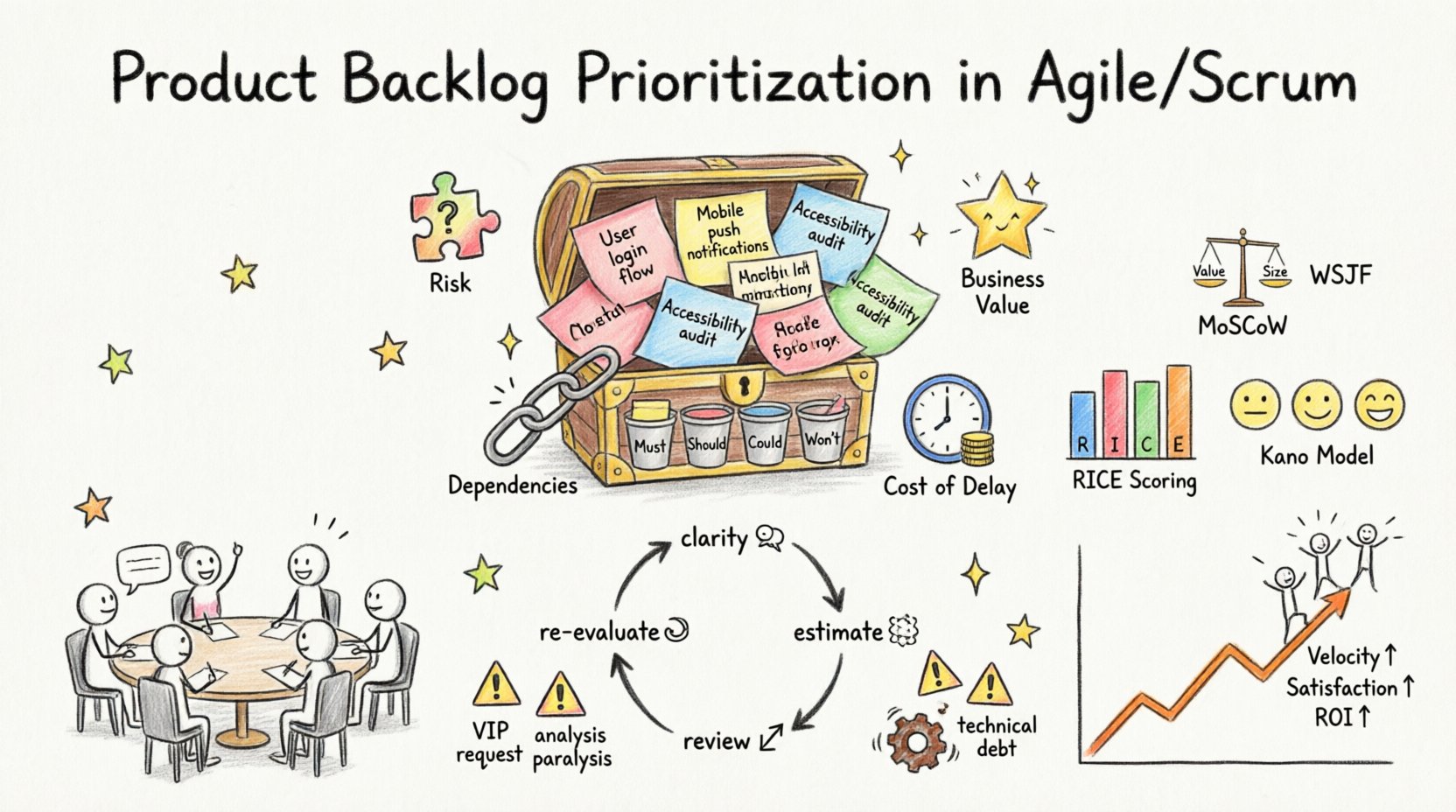
Why Prioritization Matters in Scrum 🏆
The Scrum framework relies on empirical process control. We make decisions based on observation and experimentation rather than prediction. Because the future is uncertain, we cannot commit to a plan that lasts for years. Instead, we commit to the next few weeks. This requires a rigorous selection process.
If the team works on low-value items first, the product may fail to meet market needs before high-value features are even started. Prioritization ensures that:
- Resources are allocated efficiently: Time and effort are spent on the most important tasks.
- Risk is managed: High-risk items are addressed early to validate assumptions.
- Feedback loops are shortened: Users see value sooner, allowing for faster iteration.
- Stakeholder trust is built: Consistent delivery of high-priority features demonstrates competence.
Without a clear order, the Development Team may face constant context switching or work on features that are no longer relevant by the time they are completed. A well-ordered backlog acts as a roadmap that adapts as the environment changes.
Core Principles of Backlog Ordering 🧭
When deciding which item comes first, there are several factors that must be weighed. It is rarely just about “what the customer wants.” A balanced approach considers multiple dimensions.
1. Business Value
This is the primary driver. Value can be monetary, such as revenue generation or cost reduction. It can also be strategic, like entering a new market or complying with new regulations. The Product Owner must quantify or qualify the value of each item. Items that drive revenue or reduce churn should typically sit higher than minor cosmetic changes.
2. Risk and Uncertainty
Some features are technically complex or rely on unproven technology. These items carry higher risk. By prioritizing high-risk items early, the team can validate the technical feasibility without delaying the overall timeline. If a technology does not work, the team knows this early rather than late.
3. Cost of Delay
This concept measures the economic penalty of not delivering a feature immediately. If a feature becomes obsolete or less valuable over time due to market shifts, the cost of delay is high. Prioritizing these items ensures the organization does not lose competitive advantage.
4. Dependencies
Some work cannot begin until other work is completed. External dependencies, such as third-party APIs or legal approvals, can block progress. Identifying these early prevents bottlenecks. However, dependencies should not dictate the entire order if a valuable feature can be delivered independently.
Prioritization Frameworks and Techniques 🛠️
There is no single “correct” way to order a backlog. Different situations call for different tools. Below are the most effective frameworks used by experienced Product Owners to bring clarity to chaos.
The MoSCoW Method
MoSCoW categorizes items into four distinct buckets. This method is excellent for ensuring that critical requirements are never missed during a specific release or timebox.
- Must Have: Non-negotiable requirements. The system cannot function without these.
- Should Have: Important but not vital. These can be deferred with minimal impact.
- Could Have: Desirable features that add value but are not expected.
- Won’t Have: Agreed-upon items that will not be delivered in the current timeframe.
When using this method, it is crucial to ensure that the “Must Have” list is not too large. If everything is a “Must Have,” then nothing is prioritized. Regular reviews help move items between categories as the release date approaches.
Weighted Shortest Job First (WSJF)
WSJF is a model often used in Large-Scale Scrum environments. It prioritizes based on the ratio of value to time. The formula is:
WSJF = (Business Value + Time Criticality + Risk Reduction) / Job Size
- Business Value: How much money or satisfaction does this create?
- Time Criticality: How urgent is the delivery? Does the value expire soon?
- Risk Reduction: Does this reduce technical or operational risk?
- Job Size: How long will it take to complete?
By dividing value by size, the team identifies small, high-value jobs that deliver quick wins. This keeps momentum high and cash flow positive.
RICE Scoring
RICE is a simple scoring system that stands for Reach, Impact, Confidence, and Effort.
- Reach: How many users will this feature affect in a given period?
- Impact: How much will it improve the experience? (Massive, High, Medium, Low, Minimal).
- Confidence: How sure are we about our estimates? (100%, 80%, 50%).
- Effort: How much time will it take to build? (Person-weeks).
The score is calculated as (Reach × Impact × Confidence) / Effort. Items with the highest scores are worked on first. This method forces the team to quantify their assumptions and reduces the influence of the highest-paid person’s opinion.
The Kano Model
The Kano Model classifies features based on customer satisfaction. It divides features into three categories:
- Basic Needs: Features that are expected. If missing, users are dissatisfied. If present, they do not necessarily increase satisfaction.
- Performance Needs: Features where more is better. Users are more satisfied as these improve.
- Excitement Needs: Unexpected features that delight users. These differentiate the product.
A balanced backlog includes all three. Basic needs must be met first to ensure the product works. Performance needs drive the core experience. Excitement needs create loyalty and marketing buzz.
Comparison of Prioritization Techniques ⚖️
Choosing the right tool depends on your organizational maturity and the complexity of the work. The table below summarizes the strengths and weaknesses of each approach.
| Technique | Best For | Complexity | Data Required |
|---|---|---|---|
| MoSCoW | Releases with fixed deadlines | Low | Subjective stakeholder input |
| WSJF | Large portfolios, Lean environments | Medium | Financial data, time estimates |
| RICE | Product management, feature discovery | Medium | User data, effort estimates |
| Kano | Customer experience focus | Medium | User research, surveys |
| Value vs. Effort Matrix | Quick triage, limited data | Low | Team estimates |
The Process of Backlog Refinement 🔄
Prioritization is not a one-time event. It is a continuous activity known as Backlog Refinement or Grooming. This session ensures that the items at the top of the backlog are ready for the next Sprint.
1. Clarify Requirements
Before an item can be prioritized, it must be understood. Vague descriptions lead to poor estimates. The Product Owner must write clear acceptance criteria. The Development Team must ask questions to remove ambiguity. If a story is too large, it should be broken down into smaller, manageable pieces.
2. Estimate Effort
Teams use planning poker or relative sizing to estimate effort. These estimates help determine the Cost of Delay and the Effort component of scoring models like RICE. If the team cannot estimate an item, it indicates a lack of understanding or high risk. This is a signal to investigate further before prioritizing.
3. Review Dependencies
During refinement, the team identifies blockers. If Feature A depends on Feature B, and Feature B is not yet started, Feature A cannot be prioritized for immediate development. This dependency mapping helps the Product Owner sequence the work logically.
4. Re-evaluate Regularly
Market conditions change. A feature that was critical last month may be less important today. The Product Owner should review the top of the backlog before every Sprint Planning. Items at the bottom of the backlog can be archived or removed entirely if they no longer serve the product vision.
Managing Stakeholder Expectations 🤝
One of the most difficult aspects of prioritization is dealing with requests from stakeholders. Every department may have a list of “must-haves.” Saying no requires diplomacy and data.
Data-Driven Decisions
When a stakeholder requests a feature, ask for data. How many users will this help? How does it align with the quarterly goals? If the request is based on a single opinion, weigh it against quantitative evidence. Presenting the RICE score or WSJF calculation helps depersonalize the decision.
The “No” is Necessary
You cannot build everything. If you say yes to everything, you say no to quality and speed. Explain that prioritization is about opportunity cost. By choosing one item, you are implicitly choosing not to do another. This trade-off is the essence of management.
Involving the Team
The Development Team should participate in the prioritization conversation. They understand the technical debt and the effort required. Their input ensures that the schedule is realistic. If the team feels their expertise is valued, they are more likely to commit to the plan.
Common Pitfalls to Avoid ⚠️
Even experienced Product Owners make mistakes. Recognizing these traps helps maintain a healthy backlog.
- VIP Requests: Just because a senior leader asks for something does not make it the highest priority. Treat all requests based on their value, not the source.
- Analysis Paralysis: Spending weeks debating the order of items prevents work from starting. Use the “good enough” principle. Make a decision, test it, and adjust later.
- Ignoring Technical Debt: Refactoring and infrastructure work are often deprioritized in favor of new features. This leads to a slowing velocity over time. Reserve a portion of capacity for technical health.
- Static Backlogs: A backlog that never changes is a lie. If the market shifts, the backlog must shift with it. Keep the top items flexible.
- Overloading Sprints: Trying to cram too many items into a Sprint because they are prioritized high leads to burnout and lower quality. Respect the team’s velocity.
Measuring the Effectiveness of Prioritization 📊
How do you know if your prioritization strategy is working? You need to look at the outcomes, not just the output.
Velocity and Predictability
If the team is consistently delivering the planned items, the prioritization is likely sound. If there is constant slipping of commitments, the estimates or the priority order may be flawed.
Customer Satisfaction
Track Net Promoter Scores (NPS) or customer feedback. Are users happy with the features being released? If satisfaction drops despite high velocity, the team may be building the wrong things.
Time to Market
Measure how long it takes from idea to delivery. Effective prioritization reduces the time between identifying a need and solving it. This agility is a competitive advantage.
Return on Investment (ROI)
For revenue-generating features, track the actual return. Did the feature pay for the development time? This financial feedback loop helps refine future value estimates.
Conclusion and Next Steps 📝
Prioritizing your product backlog is an ongoing discipline that balances ambition with reality. It requires the Product Owner to act as the strategic leader of the team, making tough calls based on data and vision. By applying frameworks like MoSCoW, WSJF, and RICE, you bring structure to the decision-making process.
Remember that the goal is not to create a perfect list, but to create a living document that guides the team toward maximum value. Start by auditing your current backlog. Remove items that are no longer relevant. Apply a scoring model to the top twenty items. Engage your team in the conversation. Review the order before every Sprint.
As you implement these strategies, you will find that the chaos of the backlog transforms into a clear path forward. The team will know what to build, stakeholders will understand the trade-offs, and the product will deliver value consistently. The work is never finished, but the path becomes clearer with every iteration.
Focus on the value. Respect the team. Iterate often. This is the way to sustainable success in Scrum.