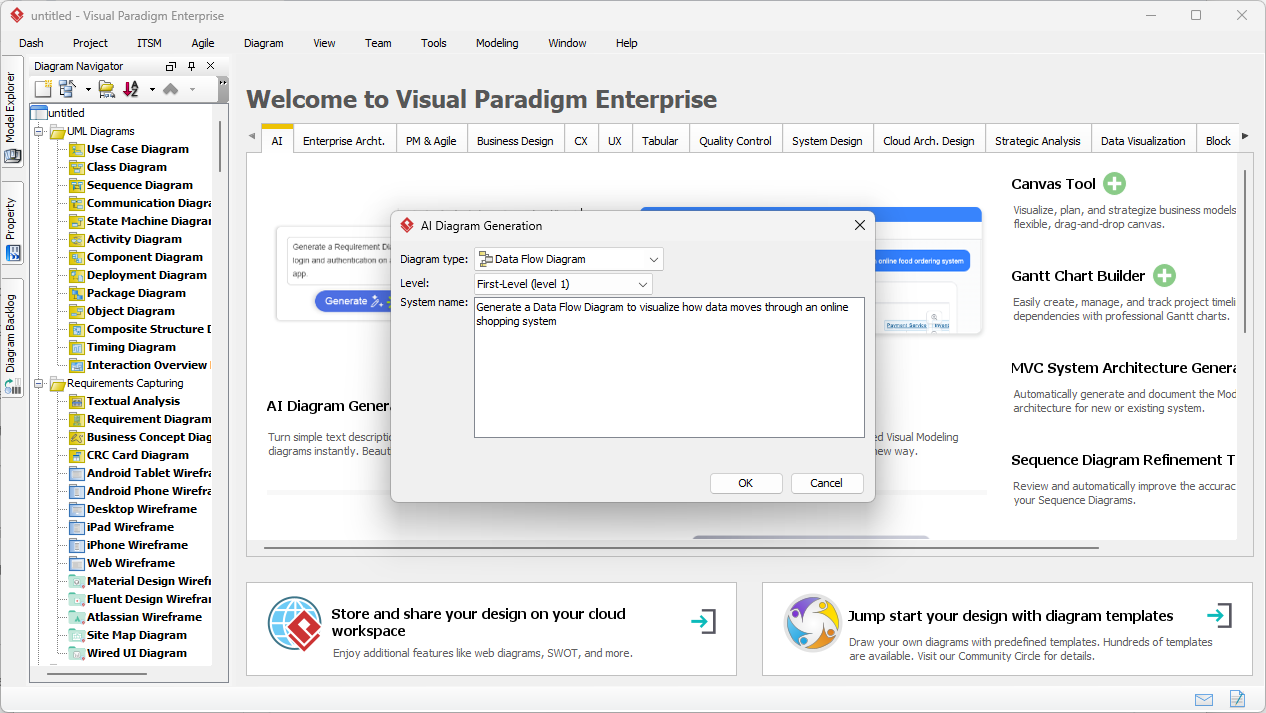
Learn how to use Visual Paradigm's AI DFD generator to automate online shopping diagrams. Convert text to professional Gane-Sarson or Yourdon diagrams instantly.

Learn how to use Visual Paradigm's AI DFD generator to automate online shopping diagrams. Convert text to professional Gane-Sarson or Yourdon diagrams instantly.
Turning a business process idea into a clear flowchart used to mean hours of dragging shapes, fixing arrows, and fighting alignment. Visual Paradigm’s AI Flowchart Generator changes that forever. Just

Learn how to create festive Lunar New Year animations using AniFuzion's drag-and-drop tool with 3D characters and AI features.
Introduction: The Evolution of Visual Modeling in Software Development In the intricate world of software engineering, the sequence diagram stands as a critical tool for visualizing the temporal flow of

Introduction: The Challenge of Hierarchical Consistency in Software Architecture In modern software development, maintaining hierarchical consistency across architectural diagrams is critical. A System Context diagram should seamlessly align with Container

Introduction: The Challenge of Architectural Diagramming In software development, clear and accurate architectural diagrams are essential for communication, planning, and documentation. However, creating these diagrams manually is time-consuming and error-prone.
In traditional diagramming workflows—or when relying on generic LLMs—architecture visuals often end up as static PNGs or SVGs. These outputs are frozen in time: hard to edit, impossible to version-control
The Evolution of Architectural Documentation In traditional diagramming workflows—and even when utilizing generic Large Language Models (LLMs)—architectural visuals frequently devolve into static artifacts. These outputs, often delivered as PNGs or
The C4 model (Context, Containers, Components, Code) provides a hierarchical, abstraction-based approach to visualizing software architecture. Higher-level views (e.g., System Context) set boundaries and relationships that lower-level views (e.g., Containers
Architecting software systems via text-based code, such as PlantUML, presents a unique set of hurdles that closely resemble the challenges of writing high-level software code. While the rise of generic