
In the modern business landscape, stability is the exception rather than the rule. Markets shift, technologies evolve, and customer expectations transform rapidly. Organizations that survive and thrive are those capable of adapting their internal structures to meet these external pressures. However, change is often chaotic without a guiding framework. This is where Enterprise Architecture (EA) becomes essential. EA provides the blueprint for understanding how business capabilities, information, applications, and technology infrastructure interact. By leveraging EA principles, leaders can navigate organizational change with clarity, reducing risk and ensuring alignment between strategy and execution.
This guide explores how to integrate architectural thinking into change management initiatives. We will examine the mechanisms that connect high-level strategy to operational reality, the importance of stakeholder alignment, and the metrics used to validate success. The goal is to build a resilient organization capable of sustained transformation.
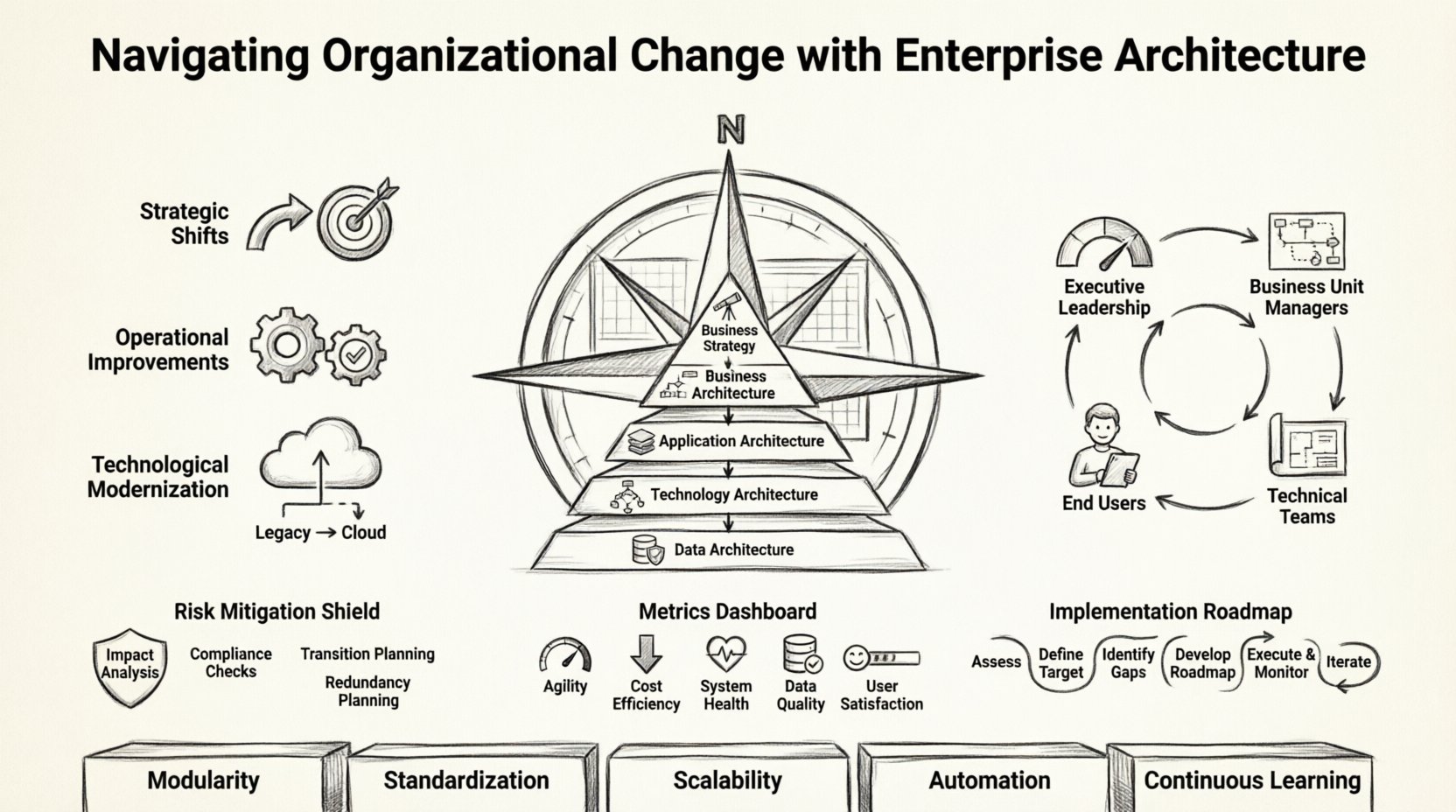
🔍 Understanding the Role of Architecture in Transformation
Enterprise Architecture is often misunderstood as merely a technical exercise involving diagrams and servers. In reality, it is a strategic discipline that maps the entire enterprise. When an organization decides to undergo significant change, such as a merger, a digital pivot, or a restructuring, the impact ripples through every layer of the business. Without a clear view of these connections, change efforts can stall, budgets can balloon, and value can be lost.
- Visibility: EA provides a holistic view of the current state, highlighting dependencies that might otherwise remain hidden until they cause failure.
- Consistency: It ensures that new initiatives do not contradict existing standards or protocols, maintaining coherence across departments.
- Communication: Architectural models serve as a common language for business leaders and technical teams, bridging the gap between intent and implementation.
During periods of flux, the architecture acts as a stabilizing force. It allows leaders to simulate the impact of decisions before they are enacted. For example, if a decision is made to move operations to the cloud, EA helps identify which legacy systems rely on on-premise infrastructure that cannot be migrated easily. This foresight prevents costly rework and project delays.
🔄 The Dynamics of Organizational Change
Change comes in many forms, and each requires a different architectural approach. Understanding the specific nature of the change is the first step in applying the right EA practices. Organizations typically face three primary types of transformation:
1. Strategic Shifts
These involve fundamental changes to the business model or market positioning. Examples include moving from a product-centric model to a service-based subscription model. EA supports this by analyzing capability maps to determine which business functions need to be strengthened or retired.
2. Operational Improvements
This type of change focuses on efficiency and cost reduction. It might involve streamlining supply chains or automating manual processes. Here, EA helps identify redundant applications and processes that add no value, allowing for rationalization without disrupting core operations.
3. Technological Modernization
Often driven by the need for agility or security, this involves updating legacy systems. EA ensures that the new technology stack integrates seamlessly with the broader ecosystem. It prevents the creation of isolated silos that hinder data flow and collaboration.
Regardless of the type, the human element remains critical. Change often fails not because of technology, but because of culture and resistance. Architecture frameworks must incorporate people and processes, not just systems.
📊 Aligning Strategy with Technical Reality
One of the most common pitfalls in organizational change is the disconnect between what leadership wants to achieve and what the technology can deliver. Strategy documents often speak in high-level terms, while IT teams deal with specific configurations. Enterprise Architecture bridges this gap by creating intermediate layers of abstraction.
The following table illustrates how EA aligns different levels of the organization during a transformation initiative:
| Level | Focus Area | EA Contribution |
|---|---|---|
| Business Strategy | Goals, Vision, Market Position | Defines the target capabilities required to achieve the vision. |
| Business Architecture | Processes, Organization Structure, Governance | Maps processes to capabilities, identifying gaps and redundancies. |
| Application Architecture | Software Systems, Integrations | Ensures applications support the defined processes and data flows. |
| Technology Architecture | Infrastructure, Networks, Security | Provides the platform for applications to run securely and reliably. |
| Data Architecture | Information Assets, Quality, Governance | Ensures data is accessible, accurate, and protected across all layers. |
By maintaining this alignment, organizations avoid the scenario where strategy is set but execution is impossible due to technical debt or infrastructure limitations. EA ensures that every dollar spent on change is traceable back to a strategic objective.
🤝 Engaging Stakeholders Effectively
Successful change initiatives require buy-in from a wide range of stakeholders. Architects cannot work in isolation; they must collaborate with business executives, department heads, and frontline employees. The role of the architect in this context is to facilitate understanding and manage expectations.
- Executive Leadership: They need high-level dashboards showing progress against strategic goals. EA provides the metrics to demonstrate value realization.
- Business Unit Managers: They require clarity on how changes affect their daily operations. Architects use process maps to show workflow impacts.
- Technical Teams: They need detailed specifications and standards. EA provides the blueprints and guardrails for implementation.
- End Users: They care about usability and stability. EA ensures that user experience is considered in the design of new systems.
Communication strategies must be tailored to each group. Technical jargon should be avoided when speaking to business leaders, while strategic ambiguity should be avoided when speaking to developers. Regular forums, such as architecture review boards, allow for continuous feedback and adjustment. This transparency builds trust and reduces resistance to change.
🛡️ Mitigating Risk and Managing Technical Debt
Organizational change introduces risk. New systems may fail, integration points may break, and security vulnerabilities may emerge. Enterprise Architecture serves as a risk management function by enforcing standards and reviewing proposed changes. It creates a governance model that ensures all modifications are evaluated for their impact on the overall ecosystem.
Technical debt is a significant factor in this equation. Legacy systems often hold critical data and logic but are difficult to maintain. When an organization tries to change, it is often tempted to patch old systems rather than replace them. EA helps quantify this debt. It allows leaders to see the cost of keeping the status quo versus the investment required for modernization.
Key risk mitigation strategies include:
- Impact Analysis: Before any change is approved, the architectural impact is assessed. This identifies potential bottlenecks or single points of failure.
- Compliance Checks: Ensuring that new architectures meet regulatory requirements, such as data privacy laws or industry standards.
- Transition Planning: Defining clear phases for moving from the current state to the target state. This minimizes disruption to business operations.
- Redundancy Planning: Designing systems that can fail gracefully. If one component goes down, the architecture should have backups to maintain continuity.
By proactively managing these risks, organizations can navigate change with greater confidence. They are less likely to encounter surprise failures that derail projects or damage reputation.
📈 Measuring the Impact of Architectural Decisions
How do you know if the architectural approach to change is working? Without metrics, it is impossible to evaluate success. Enterprise Architecture provides a framework for defining and tracking Key Performance Indicators (KPIs) related to both business and technology outcomes.
Effective metrics should cover several dimensions:
- Agility: How quickly can the organization respond to market changes? Measured by the time to deploy new features or services.
- Cost Efficiency: Are we spending less on maintenance and more on innovation? Measured by the ratio of operational to development spend.
- System Health: Are systems reliable and secure? Measured by uptime percentages and security incident rates.
- Data Quality: Is information accurate and accessible? Measured by data completeness and accessibility scores.
- User Satisfaction: Are employees and customers happy with the tools? Measured through surveys and feedback loops.
These metrics should be reviewed regularly. If an initiative is not meeting its targets, the architecture must be re-evaluated. This iterative process ensures that the organization remains on track. It also provides accountability, as progress is visible to all stakeholders.
🚀 Future-Proofing Your Organizational Structure
Change is not a one-time event; it is a continuous journey. The technologies and market conditions of today will not be the same in five years. Therefore, the architecture must be designed for adaptability. Rigid structures that are difficult to modify will become liabilities over time.
To future-proof the organization, consider the following principles:
- Modularity: Build systems as independent modules that can be updated or replaced without affecting the whole. This reduces coupling and increases flexibility.
- Standardization: Use common standards for data and interfaces. This makes it easier to swap out vendors or technologies in the future.
- Scalability: Design infrastructure that can grow with demand. Avoid bottlenecks that require a complete rebuild as volume increases.
- Automation: Leverage automation for routine tasks. This frees up human resources for strategic work and reduces the chance of human error.
- Continuous Learning: Establish a culture where feedback from operations informs future design. Architecture should evolve based on real-world usage.
By embedding these principles, the organization builds resilience. When a new trend emerges, the architecture can absorb it without requiring a complete overhaul. This agility is a competitive advantage in a fast-paced environment.
🛠️ Practical Steps for Implementation
Implementing EA within a change initiative requires discipline and commitment. It is not enough to create a document and file it away. The architecture must be living and breathing. Here is a practical roadmap for integration:
- Assess the Current State: Document the existing landscape. Understand what works and what does not. Identify gaps in knowledge or capability.
- Define the Target State: Create a vision of the future architecture. Align this with the strategic goals of the organization.
- Identify Gaps: Compare the current state with the target state. List the changes required to bridge the gap.
- Develop a Roadmap: Sequence the changes logically. Prioritize high-value, low-risk initiatives first.
- Execute and Monitor: Implement the changes according to the plan. Monitor progress against the defined metrics.
- Iterate: Review the architecture periodically. Adjust the roadmap as new information becomes available.
This process ensures that architecture is not just a theoretical exercise but a practical tool for driving value. It keeps the organization focused and prevents scope creep.
💡 Building a Culture of Architectural Awareness
Finally, the success of Enterprise Architecture depends on the culture of the organization. Everyone involved in the change process should understand the importance of architecture. This does not mean everyone needs to be an architect, but they should understand the principles of alignment and structure.
Training programs can help raise awareness. Workshops can teach teams how to think in terms of capabilities and processes rather than just tasks. Leadership must model this behavior, making architectural decisions visible and valued. When employees see that architecture is respected, they are more likely to follow standards and contribute to the overall quality of the system.
Resistance to change is natural. People prefer the familiar. However, when the benefits of the new architecture are clear, and the path forward is well-defined, resistance diminishes. Transparency and education are the keys to overcoming this hurdle.
🌐 The Path Forward
Navigating organizational change is complex, but it is not impossible. Enterprise Architecture provides the structure needed to manage complexity. It turns chaos into order and uncertainty into a plan. By focusing on alignment, risk management, and continuous improvement, organizations can transform effectively.
The journey does not end with a single project. It is an ongoing commitment to maintaining a healthy, adaptable enterprise. Leaders who embrace this approach will find themselves better equipped to handle whatever challenges the future brings. The architecture is the foundation upon which the future is built.